
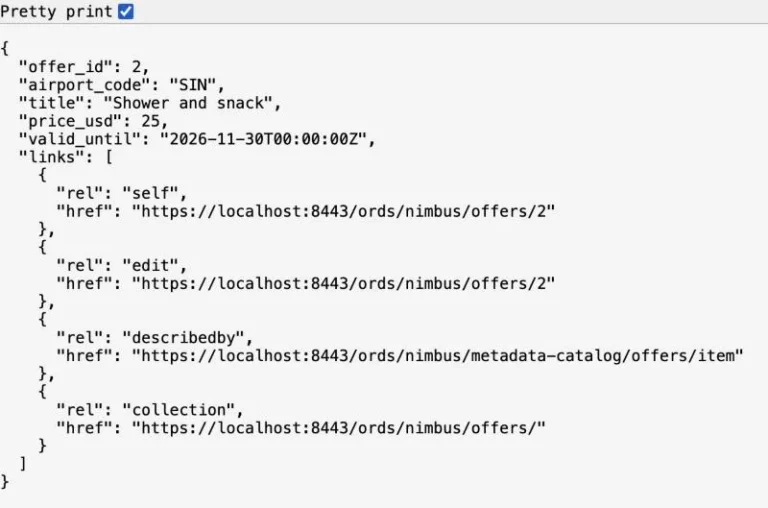
How to REST-Enable a Table with ORDS AutoREST
Publish a table as a full REST API with two ORDS calls, then read, insert, update, and delete rows over HTTP with real responses.
Publish a table as a full REST API with two ORDS calls, then read, insert, update, and delete rows over HTTP with real responses.
Register a schema with ORDS under a URL alias, check its status, browse its catalogs, and decide whether the catalog is public.
Read the query string, headers, and other request data in PL/SQL web procedures, and test them without a web server.
Make every SQLcl and SQL*Plus session start with your settings: output format, NLS formats, time zone, and server output.
Turn a query into a readable report with column headings and formats, grouped rows, and subtotals, without changing the SQL.
Reuse scripts with different values through DEFINE, ampersand references, and variables filled from query results.
Give frequent queries short names in SQLcl, pass arguments to their bind variables, and keep them across sessions.
Turn any query into CSV, JSON, INSERT statements, or delimited text in SQLcl with one SET SQLFORMAT command.
Rank every column of a table by how much it explains a target column, in one call and without building a model.
Score held-out rows, then measure a classification model with a confusion matrix, its accuracy, and the area under the ROC curve.
Let a single query build a temporary model from its own rows and score them, with the analytic form of PREDICTION.
Train a one-class support vector machine on normal data and rank rows by how likely they are to be anomalies.
Compress several attributes into a few features with a feature extraction model, and see which feature describes each row best.
Predict a number with a generalized linear model and get a 95 percent range around each prediction, not just one value.
Tell a classification model that some mistakes cost more than others, and let predictions choose the cheapest outcome.
See how likely every class is for each row, not only the top prediction, and use the probabilities in your decisions.
Build a classification model in the database, score rows in SQL, and explain each prediction with its most important attributes.
Write HTML pages from PL/SQL procedures with HTP and HTF, and test them in a SQL session by printing the page buffer.