
Vibe coding is currently driving a massive transformation in software development. You are living in an era where writing code no longer requires memorizing endless lines of complex syntax. Developers around the world are embracing this new methodology to build applications at unprecedented speeds.
This methodology relies entirely on natural language and artificial intelligence. By simply describing what you want a program to do, you can watch the code generate before your eyes. This is the reality of modern software creation, and it is accessible to anyone willing to learn.
You no longer have to spend hours hunting down a missing semicolon or a syntax error. Instead, you spend your time designing the system and directing the AI to implement your vision. This shift is revolutionizing how software is built across the globe.
What Is Vibe Coding?
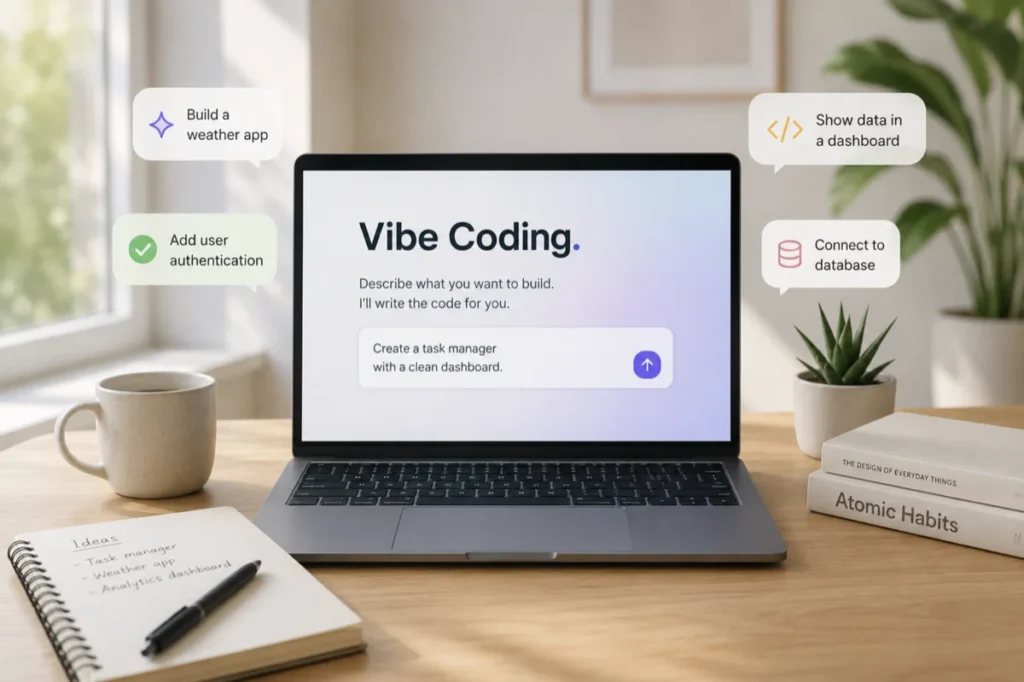
Vibe coding is the process of building software primarily through interactions with AI coding assistants. You express your intent using plain English, and the artificial intelligence translates that intent into functional code. It shifts your focus away from the mechanics of typing syntax and towards overall system design.
You act more as a director or architect than a traditional programmer. The AI handles the repetitive typing while you handle the creative problem-solving. It feels much more like a collaborative conversation than a rigid engineering task.
Why Is It Called Vibe Coding?
The term was popularized by prominent AI researchers to describe the intuitive nature of this new workflow. Instead of rigidly structuring logic, you are providing the general vibes or feeling of what the application should accomplish. You set the broad direction and let the machine handle the granular details.
It captures the creative and almost conversational relationship you develop with your AI tools. You are no longer writing strict commands for a dense machine. You are guiding a highly capable assistant using context and natural language.
The Rise of AI-Driven Development
The software industry has seen a rapid influx of highly capable large language models. These models have been trained on millions of public code repositories and technical documents. This extensive training allows them to understand complex programming patterns and logic structures.
As these tools became integrated directly into code editors, the way developers work changed almost overnight. Features like intelligent autocomplete and inline code generation became standard. You can now access world-class programming knowledge directly within your development environment.
Why Vibe Coding Is Becoming Popular
This approach is gaining massive traction because it dramatically lowers the barrier to entry for software creation. You do not need a computer science degree to start building functional applications today. It opens up the world of technology to non-technical founders and hobbyists.
It also supercharges the productivity of experienced developers by automating repetitive boilerplate code. People love it because it removes the most tedious parts of software engineering. It lets them focus their energy entirely on creative problem solving and feature design.
How Vibe Coding Actually Works
You start by opening an AI-integrated development environment. You then type a prompt describing the specific feature or function you need the software to perform. The AI reads your prompt, analyzes the context of your existing project files, and generates a code snippet.
You review the generated snippet, test it in your application, and ask the AI to make adjustments if necessary. This iterative conversation continues until the feature works exactly as you envisioned. It is a cycle of prompting, reviewing, and refining.
Traditional Coding vs Vibe Coding
You will notice stark differences when comparing these two methodologies side by side. They require completely different daily activities and cognitive mindsets. Let us look at a breakdown of how they compare in a typical workflow.
| Aspect | Traditional Coding Workflow | Vibe Coding Workflow |
|---|---|---|
| Primary Daily Task | Writing syntax manually line by line | Writing prompts and reviewing code |
| Development Speed | Slower execution and manual setup | Extremely fast code generation |
| Required Skill Focus | Language mastery and memorization | Clear communication and system design |
| Debugging Process | Finding missing syntax elements manually | Refining prompt instructions iteratively |
Tools Powering the Vibe Coding Movement
To participate in this movement, you need the right software stack on your computer. Several tools have emerged as absolute industry standards for natural language programming. You must choose the tools that best fit your specific workflow and project needs.
- Dedicated AI-first code editors built specifically for intelligent code generation.
- Standard editor extensions that provide inline chat and smart autocomplete features.
- Standalone language models accessed via web interfaces for quick brainstorming sessions.
- Command-line interface tools that automate repetitive repository management tasks.
Pros and Cons of Vibe Coding
| Pros | Cons |
|---|---|
| Massive increase in raw output speed for rapid prototyping. | AI models are not completely infallible and can make errors. |
| Allows you to experiment freely without worrying about wasted effort. | Risk of AI hallucinations generating code that fails upon execution. |
| Helps you learn entirely new programming languages incredibly quickly. | Potential to unknowingly introduce severe security vulnerabilities. |
| Provides tailored AI-generated examples for your exact project requirements. | Requires continuous critical review and rigorous testing before deployment. |
Is Vibe Coding Replacing Software Engineers?
You do not need to worry about AI stealing your job entirely anytime soon. This technology is a powerful tool, not an autonomous worker capable of independent thought. It still requires a human to define the architecture and understand the complex business requirements.
Your role is simply evolving from a pure code typist into a technical project manager. You must ensure the final product delivers real value to the end user. The demand for people who can solve business problems with technology will only increase.
The future belongs to developers who learn to orchestrate AI tools effectively, not those who resist the changing technology.
Best Practices for Effective Vibe Coding
To get the best possible results, you must treat your AI assistant exactly like a junior developer. Give it extremely clear, detailed, and unambiguous instructions for every single task. Provide ample context about the overall project goals and outline any edge cases you anticipate.
If the AI makes a mistake, correct it gently by explaining exactly what went wrong and how to fix it. Do not just delete the code and start over completely. Building a continuous context window with the AI will yield much better long-term results.
Common Mistakes Beginners Make
Many newcomers expect the AI to build an entire complex application from a single, vague prompt. This will almost always result in massive failure and intense frustration. You must break large projects down into very small, manageable pieces for the AI to handle properly.
Another common mistake is blindly pasting generated code into a production environment without reading or testing it. This is incredibly dangerous and can lead to broken applications. You must also strictly avoid putting sensitive data like API keys or passwords into your chat prompts.
Real-World Use Cases of Vibe Coding
You can use this approach for a wide variety of tasks in your daily professional workflow. It is incredibly useful for writing repetitive boilerplate code or generating complex database schemas quickly. You can save hours of tedious typing by offloading these tasks to the AI.
You can also ask the AI to write unit tests for existing functions you have already built. This ensures your code is robust without requiring you to write every single test case manually.
def calculate_total_price(items):
    total = 0
    for item in items:
        total = total + item.get('price', 0)
    return total
If you have a function like the one above, you can simply ask the AI to generate ten specific test cases for it. It will provide the exact testing code you need in mere seconds.
Who Should Use Vibe Coding?
This methodology is highly beneficial for almost anyone currently involved in software creation. Beginners can use it to overcome the massive initial hurdle of learning complex programming syntax. Experienced engineers can use it to offload tedious tasks and focus on high-level system architecture.
Product managers and non-technical founders can even use it to build functional prototypes themselves. They no longer need to hire a full development team immediately to test a simple application idea. It truly democratizes the ability to build technology.
The Future of Vibe Coding
As large language models continue to improve, their ability to generate complex applications will increase dramatically. You will likely see AI assistants that can autonomously manage entire codebases based on your high-level instructions. The barrier to building software will continue to drop to zero.
The primary skill required for software engineering will shift completely. It will change from knowing how to write code to knowing how to communicate effectively. Your ability to articulate complex problems clearly in natural language will become your greatest asset.
Final Thoughts
Vibe coding represents a massive leap forward in how you interact with computers and build software. By leveraging natural language programming, you can build powerful software faster and with less friction than ever before. It completely redefines the modern development lifecycle.
While you must always remain vigilant about security risks and AI hallucinations, the immense productivity gains are impossible to ignore. As you integrate these practices into your daily routine, you will discover a much more creative approach. You will find a highly enjoyable way to bring your software ideas to life.
