
Interactive Reports in Oracle APEX provide a robust set of capabilities for your applications. You can use them for filtering, sorting, control breaks, highlighting, and creating charts. But configuring these powerful features often requires navigating through multiple menus and dialogs.
Many of these capabilities go underutilized due to discoverability challenges. You might find the time and effort required to apply the appropriate settings overwhelming. That is all about to change with the introduction of generative AI in your applications.
What if you could simply ask your data a question and get the immediate answer? APEX AI Interactive Reports makes this possible for your projects. You can query your data in plain language and automatically apply the right configurations.
In every configuration, the AI applies surfaces as a visible chip. You can see exactly what has been set and review it at a glance. You can then adjust anything that does not perfectly match your intent.
Understanding AI for Interactive Reports in Oracle APEX
In an upcoming release, Oracle APEX introduces natural language support for your data grids. You ask a question in plain language, and the system automatically configures your report. It applies the necessary filters, sorting, pivots, and aggregates to match your exact intent.
You no longer have to navigate complex menus or dialogs. You just get the results you need through simple natural language queries. This bridging of the gap between everyday users and full data power is a massive leap forward.
"The ability to simply converse with your data transforms the entire reporting experience from tedious to effortless." As someone working with data visualization, you will appreciate how much time this saves. You can engage with your data freely and trust the outcome.
How Oracle APEX Generative AI Works Behind the Scenes
Oracle APEX uses a Large Language Model to interpret your prompt. It converts your request into trusted declarative report settings. These settings apply directly to the report without any extra steps on your part.
The resulting configuration is applied as standard chips. This ensures the experience remains entirely consistent with existing report behavior you already know. To generate these settings, the system provides the Large Language Model with specific report context.
This context includes your report definition, column metadata, available reference values, and the current report state. The model uses this information to determine the exact appropriate settings to apply.
Importantly, your actual business data never leaves your environment. The system only shares report metadata and configuration context with the Large Language Model. The sensitive data in your report stays right where it belongs.
Two Ways to Use Natural Language Queries
Using the Search with AI Feature
The familiar search bar now includes an intelligent new option. When enabled, it accepts natural language queries and intelligently applies the appropriate report configurations. It also preserves the standard behavior where entering one or two words triggers an immediate row search.
This design provides continuity with your existing end user flows. You get to enable natural language input directly in the same control you already use. When the feature is active, a gradient color in the search bar lets you know your query is being processed by AI.
This gradient color provides clear visual feedback so you always know what is happening. You never have to guess whether the system is doing a standard search or an intelligent query.
Using the Interactive Report Chat Assistant
The right-side chat panel provides a conversational experience focused exclusively on report configuration. This assistant performs an AI-driven search only. The dialog explains which settings were applied and supports incremental refinement through follow-up prompts.
Only the report grid displays your actual data. The assistant never displays business data, analytics, or summaries directly in the chat. It simply applies the configuration by setting the appropriate chips on your screen.
"Having a dedicated assistant to configure reports allows you to focus on the analysis rather than the setup." For example, you might ask to show open opportunities grouped by stage. You could also ask to create a pivot showing total pipeline value by region.
Step-by-Step Setup for Oracle APEX Setup
Setting up these features is a straightforward process for your development workflow. You have to follow a few specific steps to get everything running smoothly.
Workspace and Application Prerequisites
Before enabling natural language support, you must configure a service at the workspace level. You then assign it to your application under your shared components. You will find this specific setting under the AI Attributes section.
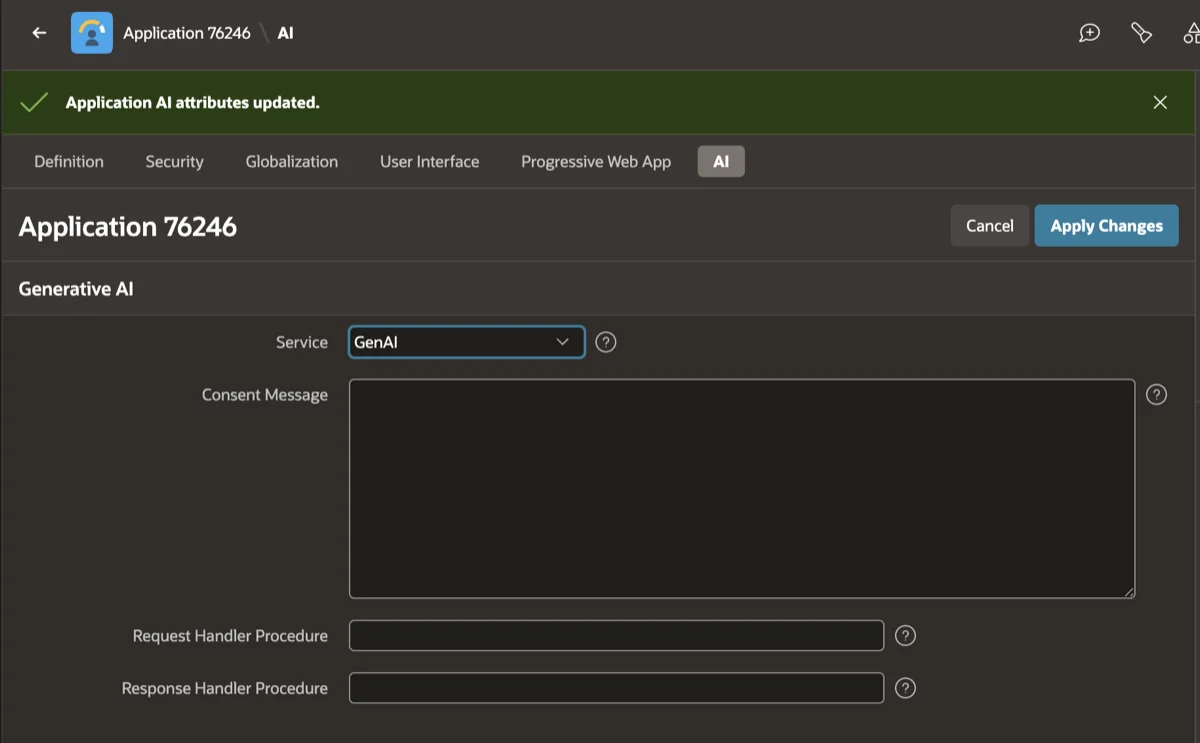
Natural language support strictly requires this preliminary step to function properly. Without this service configured, your application cannot process natural language queries.
Configuring Report Level Settings
To support natural language, a generative AI section is available in your attributes tab. This section allows you to enable the feature and control how the report behaves. You can toggle the feature on or off entirely from this screen.
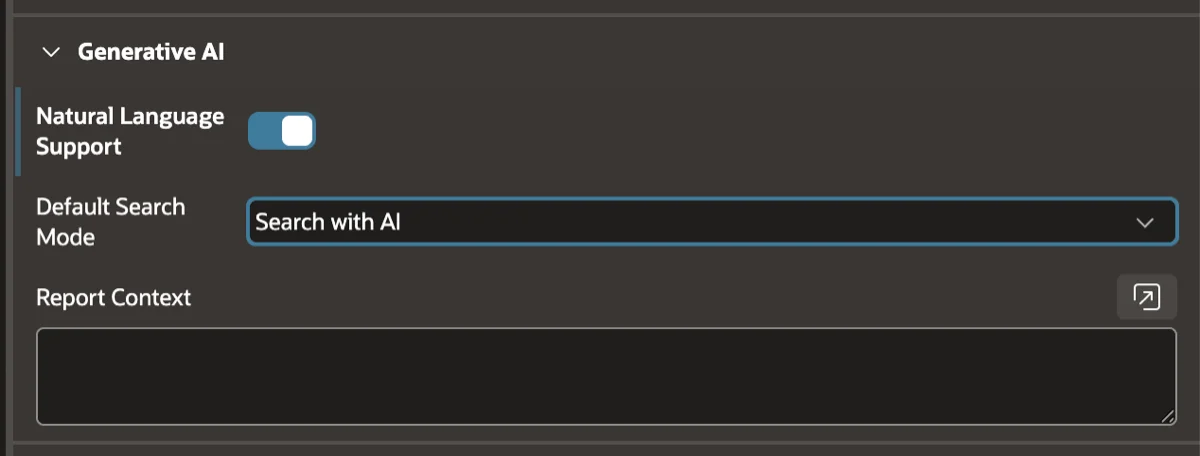
You can also determine the default mode of the search bar. You might select row search to keep the original behavior by default. You also have a text area where you can provide extra context about the report.
This report context guides the interpretation of your queries. You can provide definitions for pipeline metrics, meanings of stages, or relevant business terminology. The system sends this information to the Large Language Model as part of the system prompt.
Refining Column Level Settings
Column attributes feature a new generative AI section in the property editor. You can refine the behavior at a very granular level for each specific column. You use this to improve how user requests map to specific report settings.
- You can provide additional notes describing the purpose of a column.
- You can indicate the type of reference data that can be used by the system.
- You can support reference data types like shared components, SQL queries, or static values.
Here is a breakdown of when to use specific column-level attributes to guide the system.
| Attribute Configuration | When to Use It | What Information to Provide |
|---|---|---|
| Column Context Only | When queries use business language rather than database terminology. | Provide a short business definition, common synonyms, and interpretation rules. |
| Reference Data Type Only | When queries name specific values from a known list of statuses. | Provide a reference list so the system can select valid exact values. |
| Context and Reference Together | When queries combine business language with specific list values. | Provide both the meaning and the valid list to ensure accurate filtering. |
Guardrails and Data Visualization Governance
Natural language requests are limited strictly to those capabilities explicitly enabled by you. This ensures the feature adheres to the same governance model as your standard functionality. The system respects the rules you have already put in place.
If filtering is disabled at the report level, natural language prompts cannot apply filters. If highlighting is disabled for a column, it cannot be triggered by the assistant. You maintain complete control over what the user can and cannot do.
Natural language support is disabled for both new and existing reports when the feature is first introduced. This gives you the opportunity to review behavior and validate outcomes. You can test everything thoroughly before enabling it for your end users.
Conclusion
APEX AI Interactive Reports lets you ask questions of your data in plain language while the system takes care of the rest. Filters, pivots, sorting, and column selections apply automatically based on your request. Every single setting surfaces as a chip you can easily review and adjust.
With the search integration and the chat assistant, you get both a familiar entry point and a conversational configuration experience. You can engage with your data freely and completely trust the outcome. This bridges the gap between everyday users and the full power of data visualization in your applications.
