
When you chat with a Large Language Model (LLM) like ChatGPT or Claude, the interaction feels seamless and conversational. You type a sentence, and the machine "reads" it word-for-word, just like a human would.
However, this is a convincing illusion; machines do not fundamentally understand words, grammar, or syntax in the way biological brains do. Instead, they process vast streams of numbers, performing complex mathematical operations to predict the next logical step in a sequence.
The bridge between your human language and the machine's numerical world is a tiny unit of data called a token. These tokens are the fundamental atoms of Generative AI, dictating everything from the model's memory span to the cost of every query.
To truly master AI engineering or optimization, you must stop thinking in words and start thinking in tokens. In this comprehensive guide, we will dismantle the mechanics of tokenization, explore why "1,000 tokens" rarely equals "1,000 words," and analyze the economic implications of this technology.
What is a Token in AI?
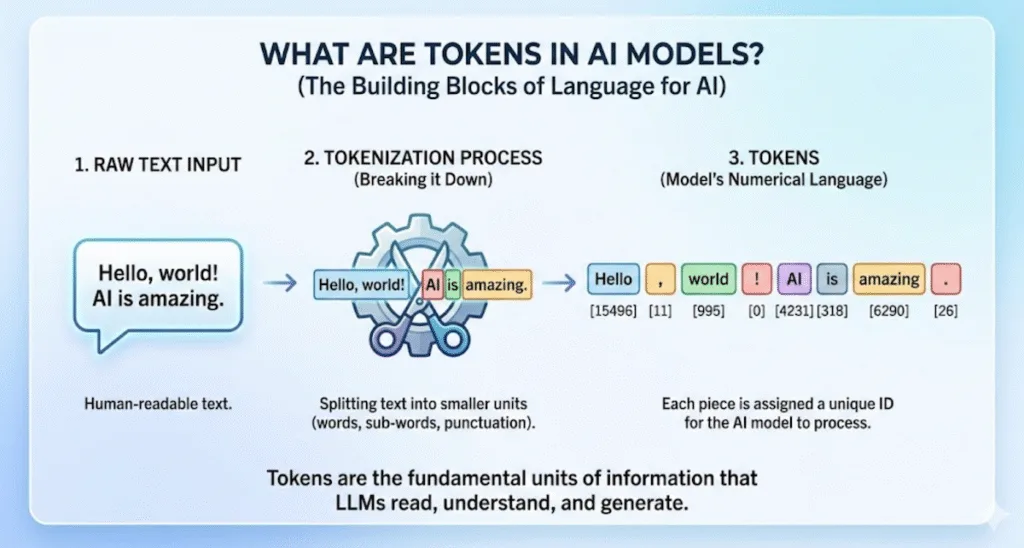
A token is the smallest unit of text that an AI model can process and generate. While we intuitively break language down into words or sentences, AI models require a more flexible system.
A token can be a single character, a fragment of a word, or an entire common word. For example, the word "apple" is common enough to be a single token.
However, a complex word like "antidisestablishmentarianism" would be broken down into multiple meaningful chunks. This flexibility allows the model to handle millions of unique words without needing a dictionary entry for every single one.
The "4 Characters" Rule of Thumb
For English text, a widely accepted heuristic is that 1 token is approximately 4 characters or 0.75 words. This means that a standard 1,000-token limit typically allows for about 750 words of coherent text.
It is important to note that this rule fluctuates wildly depending on the complexity of the text. Simple dialogue consumes fewer tokens than dense code or scientific literature.
Word vs. Token: The Key Differences
You might wonder why engineers didn't simply map every word in the dictionary to a number. The answer lies in the sheer messiness and vastness of human language.
If a model required a unique ID for every word, name, misspelling, and conjugation in every language, its vocabulary would be billions of entries long. This would make the model impossibly slow and memory-intensive to train.
The Efficiency of Subword Tokenization
By using subword tokens, models can construct "unknown" words from "known" parts. If the model has never seen the word "Blogosphere," it doesn't fail or output an "unknown token" error.
Instead, it recognizes "Blog" and "osphere" as separate, familiar concepts. It processes them sequentially, effectively understanding the new word by analyzing its components.
How Tokenization Works in LLMs
Tokenization is the translation layer that sits between the user interface and the neural network. It follows a rigorous, multi-step process to prepare data for processing.
1. Normalization and Pre-processing
Before text is split, it is often normalized to ensure consistency. This might involve standardizing capitalization or handling special characters to reduce noise in the data.
2. Segmentation (The Split)
The tokenizer scans the input text and breaks it down based on a specific algorithm. Modern models typically use Subword Tokenization, which strikes a balance between character-based and word-based approaches.
For instance, the string "learning" might be kept as one token, while "unlearning" might be split into "un" and "learning."
3. ID Assignment (The Map)
Once split, each text chunk is assigned a unique numerical ID from the model's static vocabulary. The model does not see the letters "c-a-t"; it sees the ID 834.
4. Embedding (The Meaning)
Finally, this ID is converted into a vector—a long list of numbers representing the semantic meaning of that token in multidimensional space. This is where the machine begins to "understand" the context of the input. Learn more about AI embeddings in this article.
Tokenization Algorithms: Byte-Pair Encoding (BPE)
How does the model decide where to split a word? It uses statistical algorithms like Byte-Pair Encoding (BPE) or WordPiece.
How BPE Optimizes Vocabulary
BPE starts by treating every character as a token. It then iteratively merges the most frequently occurring adjacent pairs of characters into new, single tokens.
For example, if "t" and "h" appear together often (as in "the," "that," "this"), BPE merges them into a "th" token. It repeats this process millions of times until it has a vocabulary of the most efficient, high-frequency chunks (usually around 50,000 to 100,000 tokens).
Token Limits and Context Windows in ChatGPT
Every LLM has a hard limit known as the Context Window. This is the maximum number of tokens the model can hold in its "working memory" at any given moment.
- GPT-4: 128k tokens (roughly 300 pages of text).
- Gemini 1.5 Pro: 2 million tokens (massive video files or codebases).
The Sliding Window Problem
Once a conversation exceeds this limit, the "oldest" tokens are forcibly removed to make room for new ones. This explains why a chatbot might suddenly forget a rule you established at the very beginning of a long session.
Increasing this window is incredibly computationally expensive. due to the Attention Mechanism in Transformers, the computational cost scales quadratically with the number of tokens, meaning doubling the window makes the model four times harder to run.
The "Multilingual Tax"
Tokenizers are often trained primarily on English text, which introduces a hidden inequality known as the "Multilingual Tax."
Because the BPE algorithm optimizes for English patterns, common English words are usually single tokens. However, words in languages like Hindi, Arabic, or Japanese may be split into many small fragments because their patterns are less represented in the tokenizer's vocabulary.
This means expressing the same idea in a non-English language often consumes significantly more tokens. Consequently, API costs and latency are higher for non-English applications, a critical consideration for global software deployment.
AI Cost Per Token and Economics
In the API economy, tokens are money. You are billed for every token processed, not for every request made.
Input vs. Output Costs
Usually, Input Tokens (what you read/send) are cheaper than Output Tokens (what the model writes). This is because processing input can be parallelized, while generating output must be done sequentially, one token at a time.
Optimization Strategies
Smart developers use "Context Engineering" to save money. This involves scrubbing prompts of unnecessary fluff, summarizing long conversation histories, and using concise data formats like JSON or Markdown.
Every redundant adjective or polite greeting in a system prompt adds up to real financial waste at scale.
Visualizing the Invisible
To truly grasp tokenization, it helps to see it. Tools like the OpenAI Tokenizer allow you to type text and see exactly how it gets sliced.
You will notice that spaces are often part of the following word (e.g., " hello"). You will also see that numbers are often split strangely; "12345" might be one token, but "123456" might be split into "123" and "456".
These quirks can cause models to struggle with math. Since the model sees "123" and "456" rather than the number 123,456, it sometimes fails to perform accurate arithmetic on large figures.
The Future of Tokenization
While tokens are the standard today, research is moving toward Token-Free or Byte-Level models. These architectures aim to process raw bytes or pixels directly, bypassing the rigid tokenizer vocabulary entirely.
This could eliminate the "Multilingual Tax" and allow models to handle typos, code, and DNA sequences much more natively. Until then, however, mastering token economics remains a required skill for any AI practitioner.
Conclusion: The Atomic Unit of AI
Tokens are the currency of the AI revolution. They measure the cost of intelligence, the limit of memory, and the speed of processing.
They are the reason models hallucinate on math problems and why non-English languages cost more to process. By shifting your mental model from "words" to "tokens," you gain a deeper understanding of how to architect efficient AI solutions.
Frequently Asked Questions (FAQ)
- Do spaces count as tokens? Yes. In most modern tokenizers, a leading space is fused with the word it precedes, but standalone spaces also consume token counts.
- Why is my model bad at math? Tokenization often splits numbers arbitrarily (e.g., year "2024" might be "20" and "24"), making it hard for the model to understand the numerical value.
- Can I change the tokenizer? generally no. The tokenizer is baked into the model during pre-training; changing it would require retraining the entire neural network from scratch.
