
Oracle covers a lot of ground. A developer who works with it may write SQL and PL/SQL in the database in the morning, build an Oracle APEX page after lunch, look after an Oracle Forms application that has run the business for twenty years, and get asked to "add some AI" before the day is over. Finding one good book for each of those jobs is harder than it should be, because most Oracle books are either out of date or stop at the basics.
This post lists five Oracle books that together cover almost all of that work, from SQL and PL/SQL to APEX, the APEX API, Oracle Forms and AI applications. Each one is written for the current release: Oracle AI Database 26ai, Oracle APEX 26.1 and Oracle Forms 14.1.2.
The best five Oracle books at a glance
| Book | Best for | What you build | Pages |
|---|---|---|---|
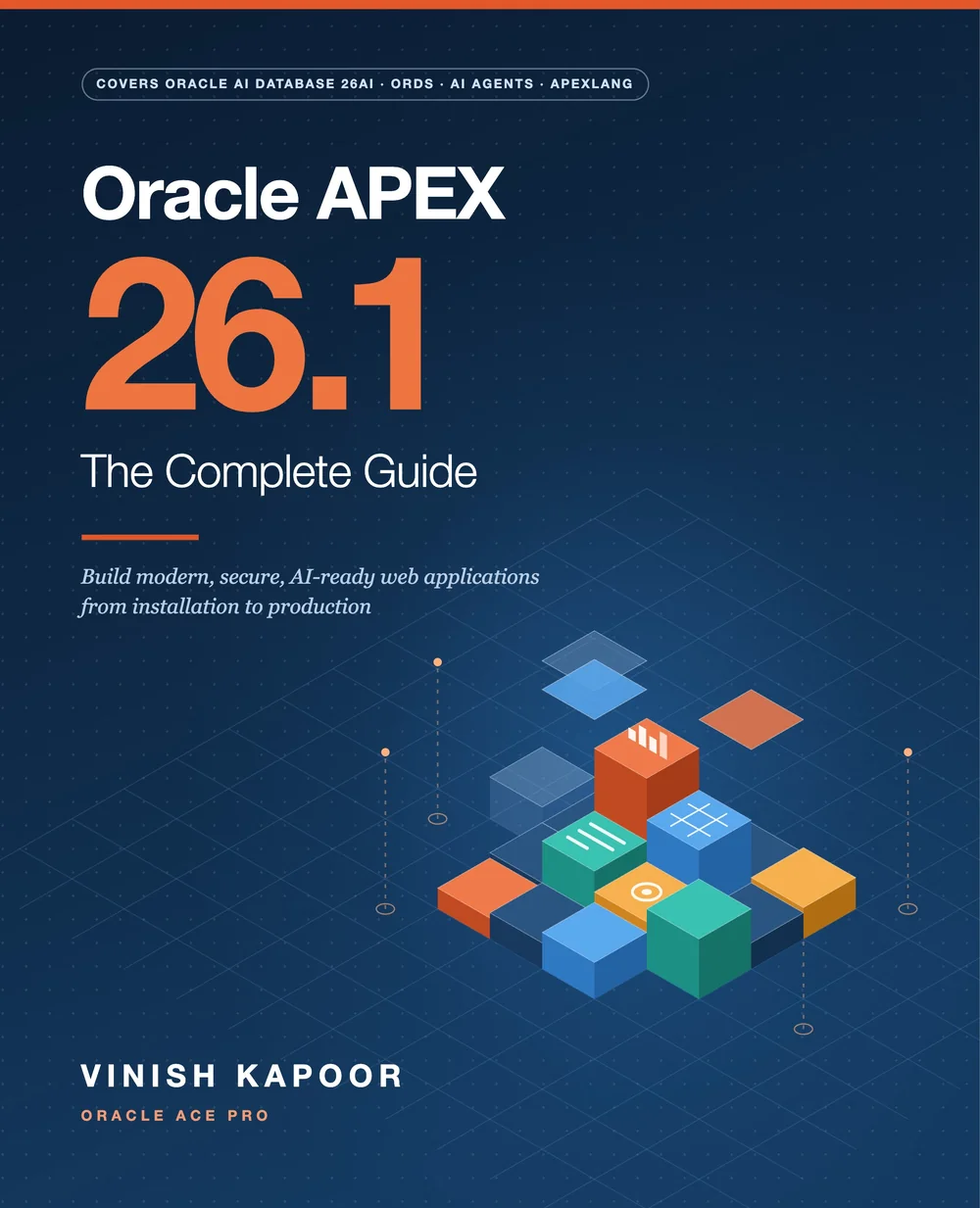
| Oracle APEX 26.1: The Complete Guide | Learning Oracle APEX from start to finish | Orbit Sales, an order-management app | 828 |
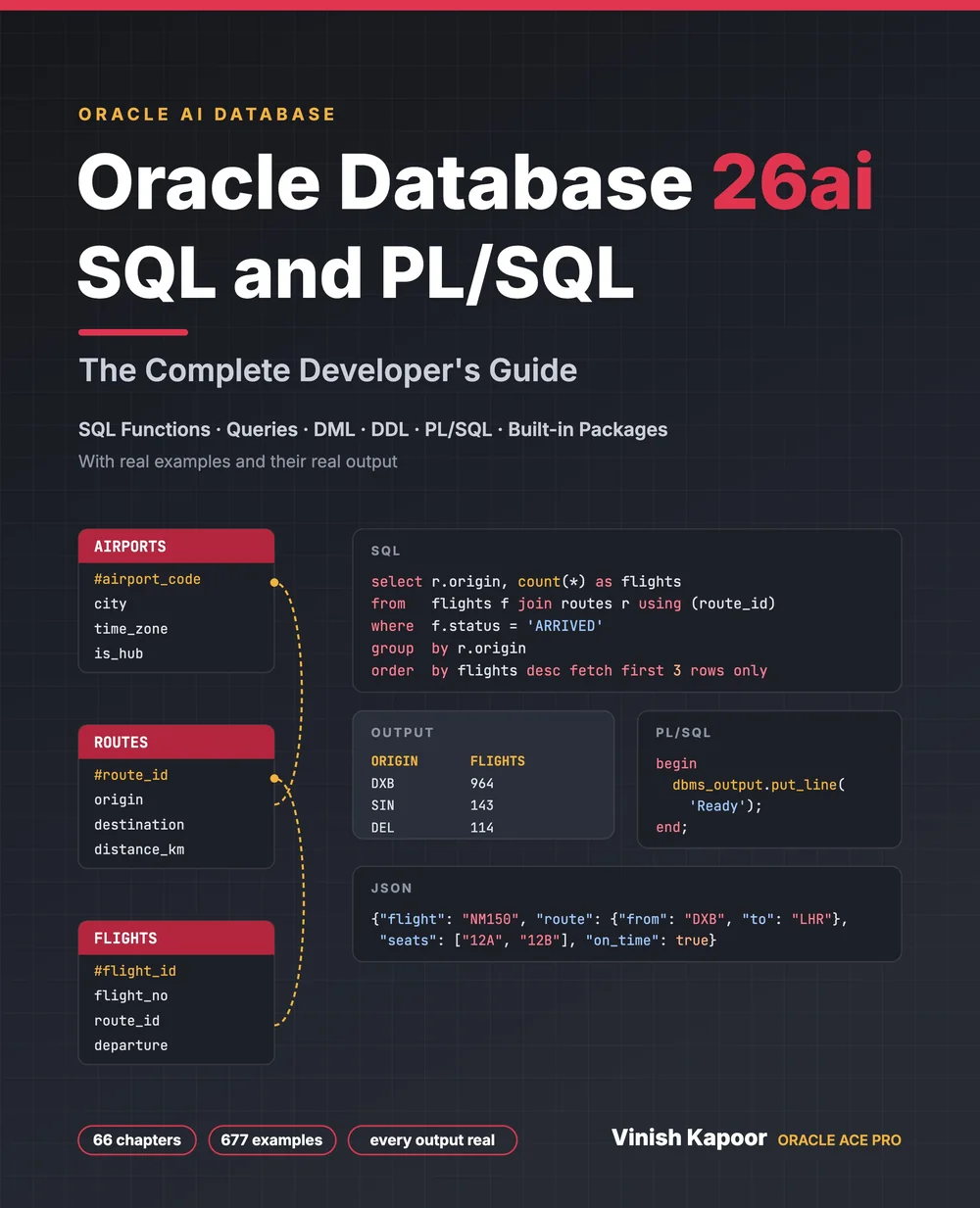
| Oracle Database 26ai SQL and PL/SQL | One reference for SQL and PL/SQL | 677 examples on an airline schema | 700 |
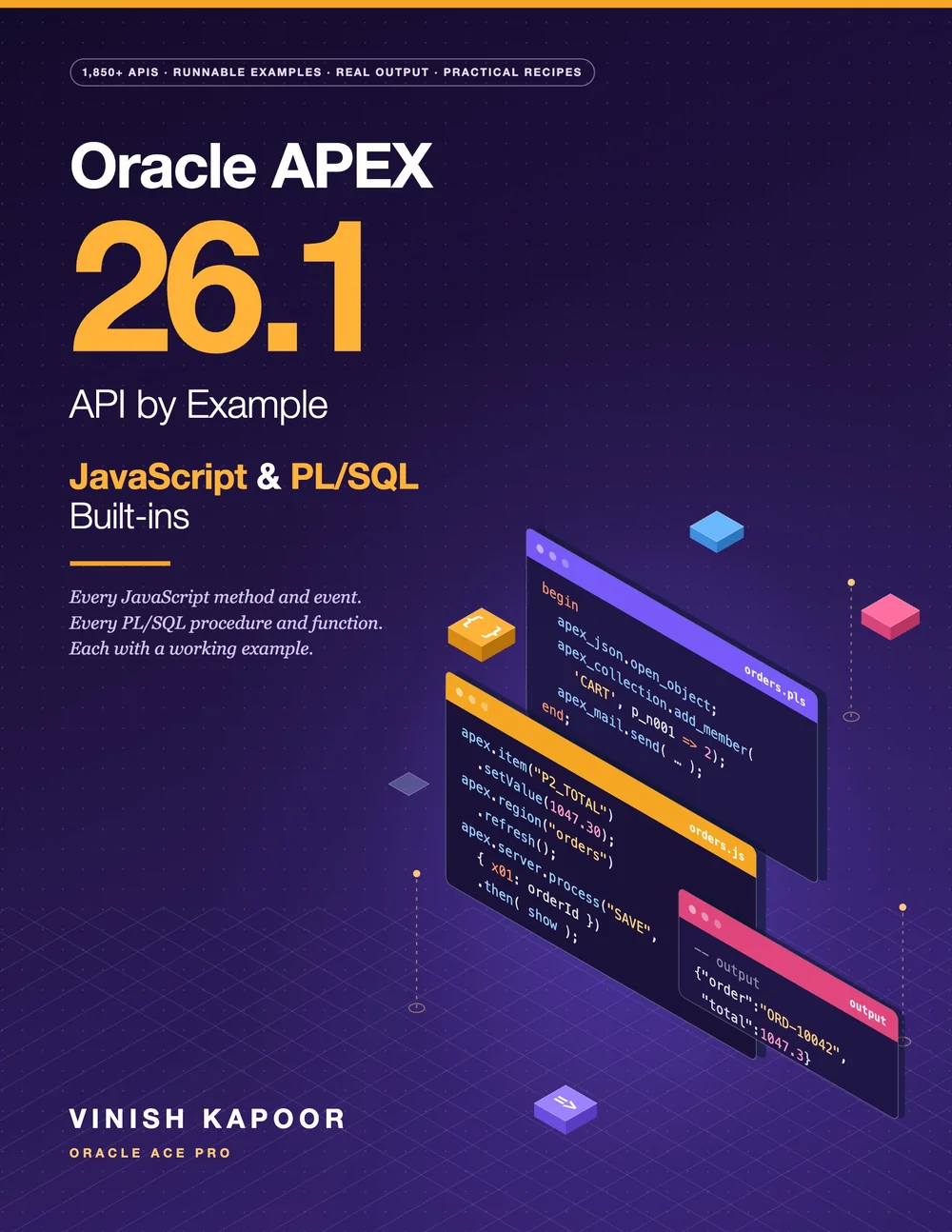
| Oracle APEX 26.1 API by Example | Writing JavaScript and PL/SQL in APEX apps | The API Lab app and 32 recipes | 528 |
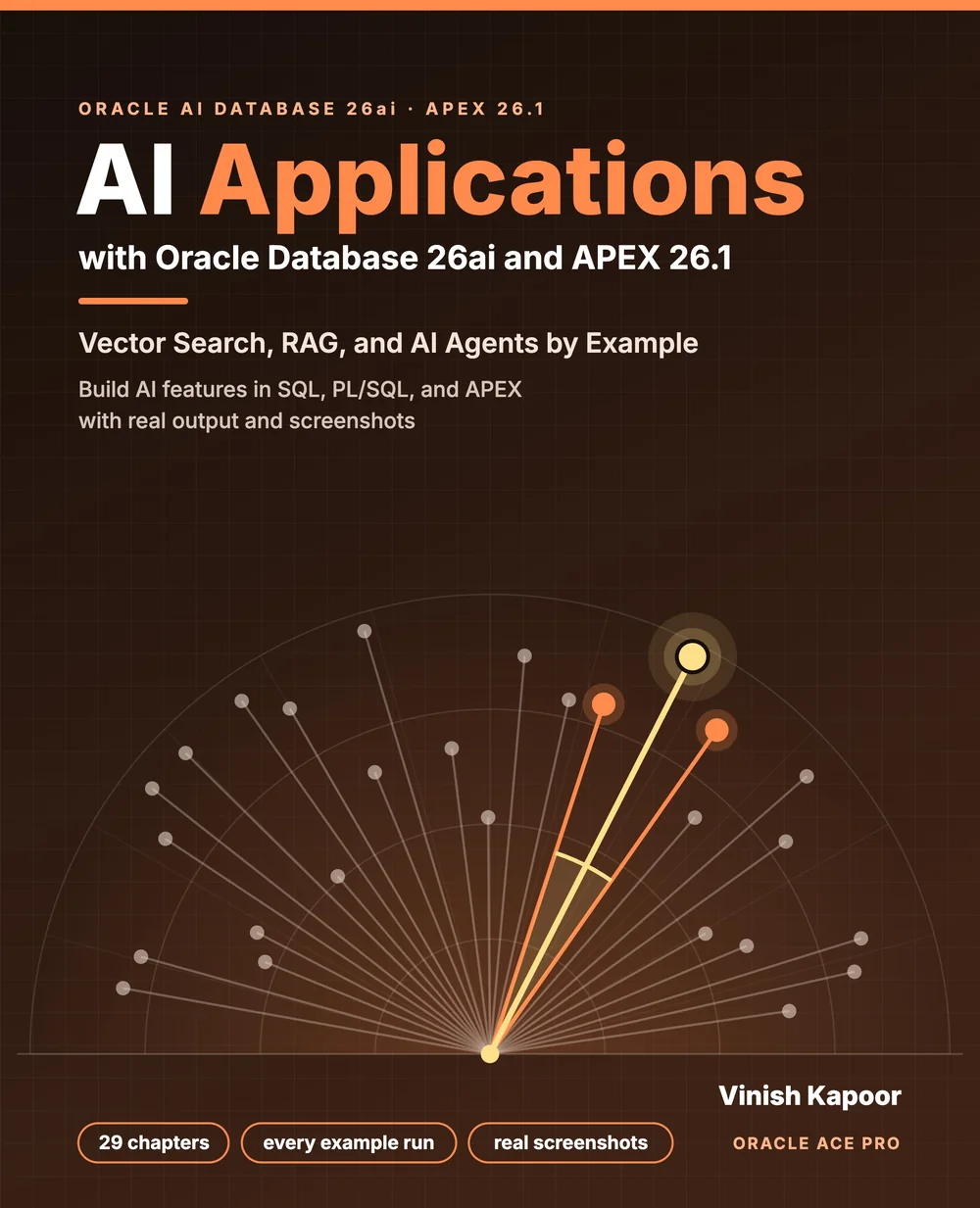
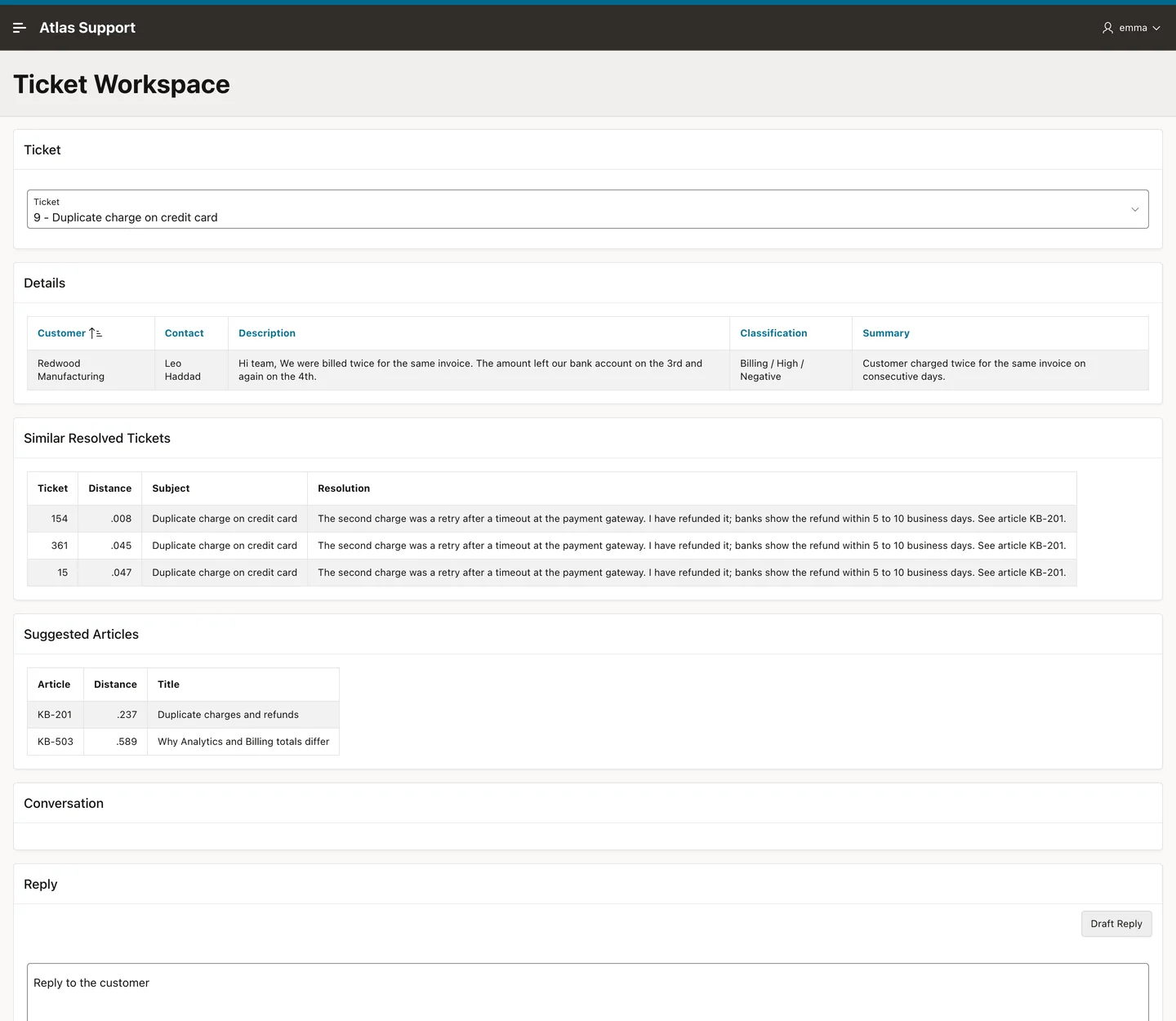
| AI Applications with Oracle Database 26ai and APEX 26.1 | Adding AI to Oracle applications | Atlas Support, an AI help desk | 409 |
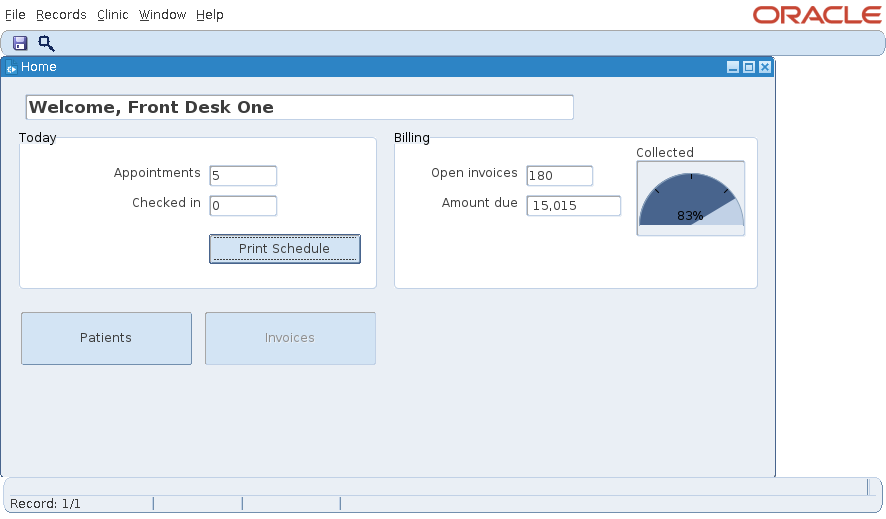
| Oracle Forms 14c: The Complete Developer's Guide | Building and maintaining Oracle Forms | 64 forms for a clinic | 484 |
All five share the same approach. Every example was run on the release the book covers, and the book shows the output it returned rather than the output it should return. The code of every book is on GitHub, so you can run it yourself.
1. Oracle APEX 26.1: The Complete Guide
- 828 pages
- 48 chapters
- 474 screenshots
- Paperback, Kindle and Apple Books
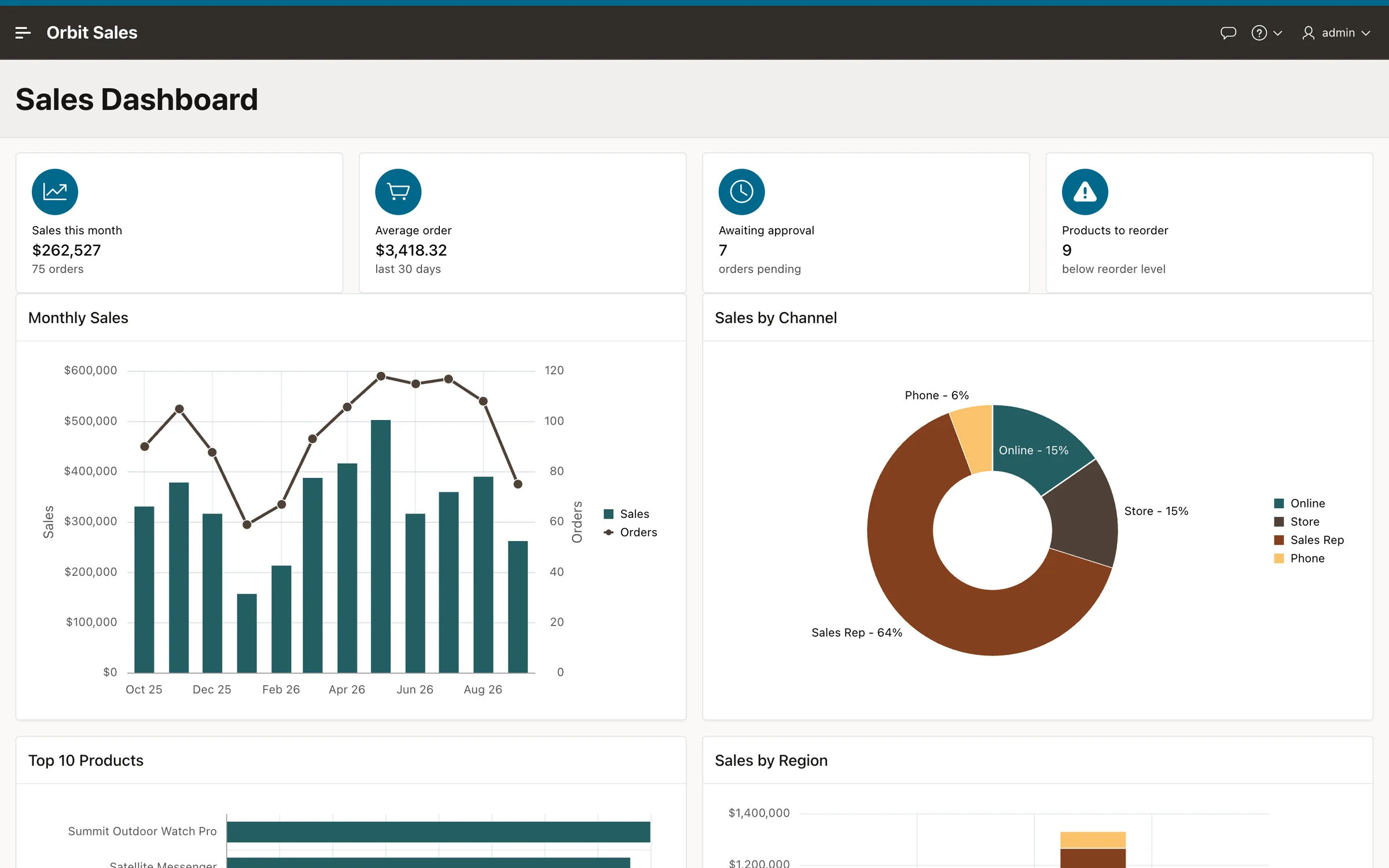
Oracle APEX turns SQL and PL/SQL skills into complete, secure web applications. The hard part is rarely one feature. It is knowing how the features fit together, and in what order to learn them. This book takes you through all of APEX on a single application you build yourself.
You start with an empty laptop and install Oracle AI Database 26ai, APEX 26.1 and ORDS. Then you build Orbit Sales, an order-management application for an outdoor-gear retailer, page by page. Along the way you cover reports and interactive grids, forms, charts and maps, faceted search, security, workflows and generative AI, and you finish with REST services, debugging, deployment and the administration of workspaces and the instance.
Read it if you are new to APEX, or you have used it for a while and want to fill the gaps. Each chapter starts with what you will build, and the code is explained line by line.
2. Oracle Database 26ai SQL and PL/SQL: The Complete Developer's Guide
- 700 pages
- 66 chapters
- 677 examples
- Paperback, Kindle and Apple Books
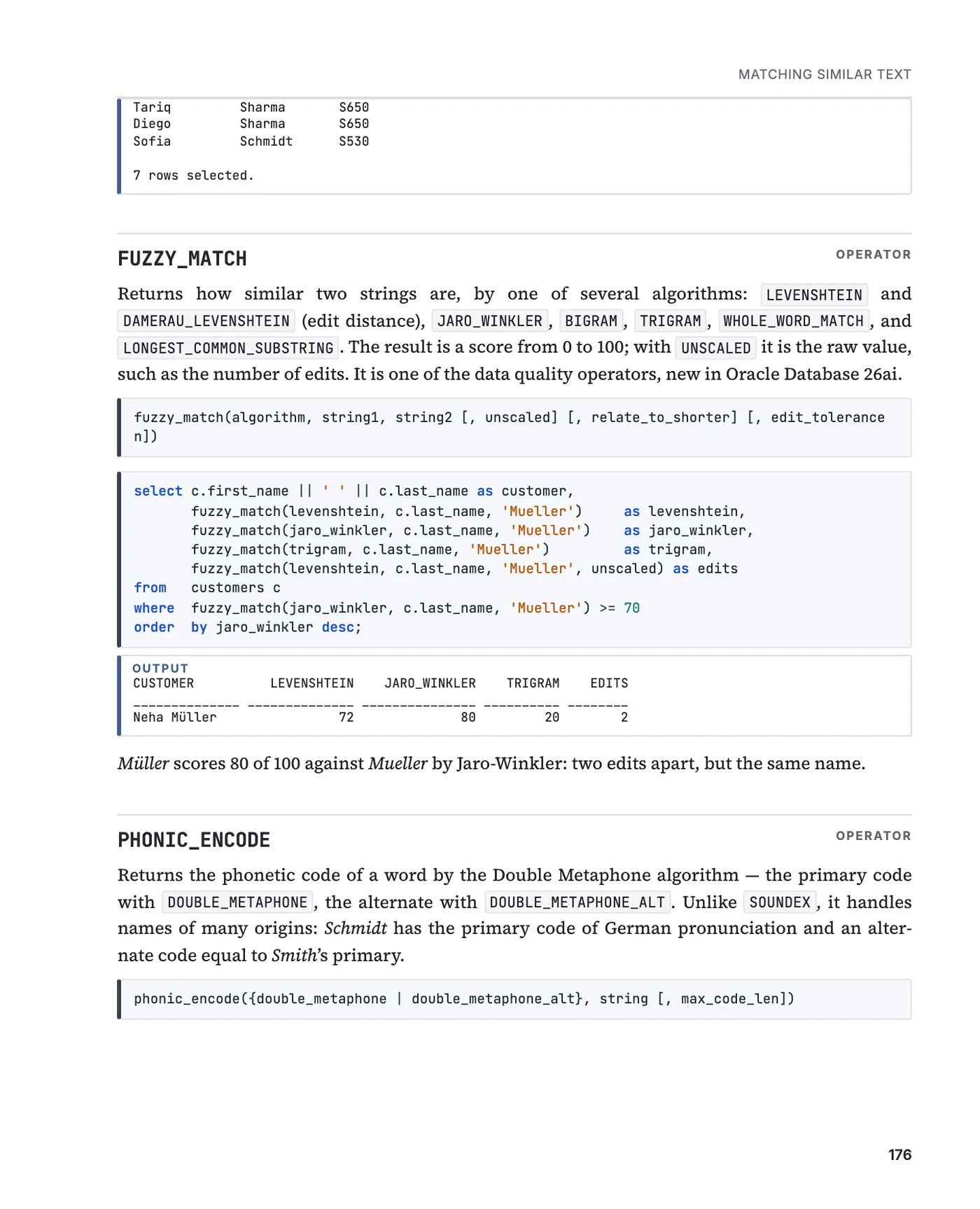
This is a reference to keep open next to your editor. Every SQL function, statement and developer package of Oracle AI Database 26ai gets its own entry with the syntax, an example that ran, and the output it produced.
All 677 examples use one airline schema, Nimbus Air, with its airports, routes, flights, crew and bookings, so you can run them and get the same results. The book covers querying and analytic functions, MATCH_RECOGNIZE, JSON and JSON-relational duality views, property graphs and AI Vector Search, changing and defining data, PL/SQL, and about a hundred built-in DBMS_ and UTL_ packages.
Read it if you write SQL or PL/SQL for a living and want one book that answers most of your questions. If your team is moving from Oracle Database 19c, Appendix B lists the developer features added since 19c, with the chapter that covers each one.
3. Oracle APEX 26.1 API by Example
- 528 pages
- 32 chapters
- 1,850+ APIs
- 518 examples
- 32 recipes
The official APEX reference tells you what each API does. It rarely shows you a working example. This book covers the methods and events of the APEX JavaScript API and the procedures and functions of its PL/SQL packages, more than 1,850 APIs, and gives each one an example that ran in APEX 26.1 with the output it produced.
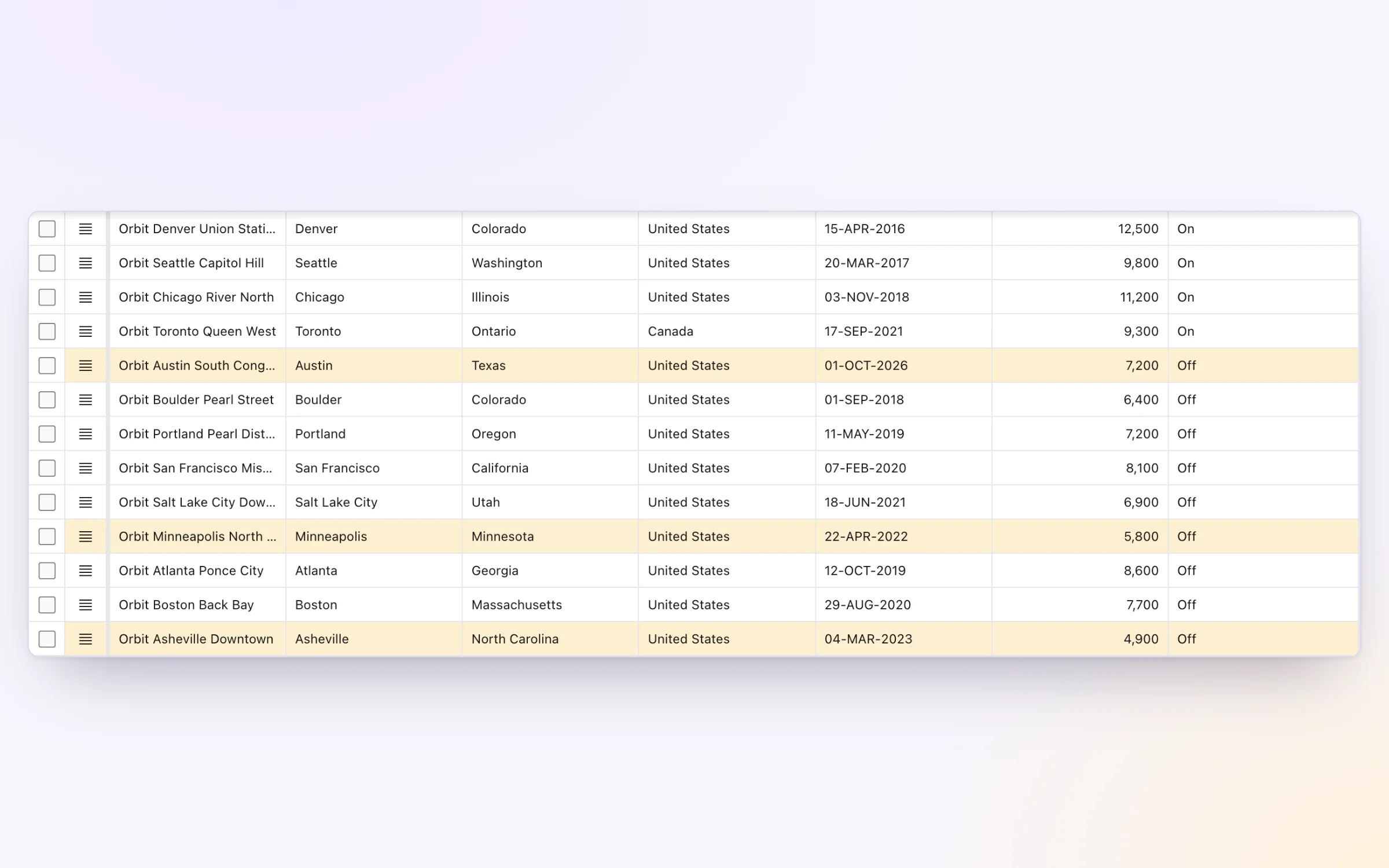
On the JavaScript side you get apex.item, apex.region, apex.server, apex.model, apex.actions and the interactive grid. On the PL/SQL side you get packages such as APEX_JSON, APEX_EXEC, APEX_COLLECTION, APEX_WEB_SERVICE, APEX_AI and APEX_WORKFLOW. Thirty-two recipes put the APIs together for everyday tasks, such as colored rows, toolbar buttons and row menus in an interactive grid, or flying a map to a feature.
Read it if you already build APEX applications and spend time writing JavaScript or PL/SQL inside them. You can look up an API by task in the chapters, or by name in Appendix C, which indexes every API in the book.
4. AI Applications with Oracle Database 26ai and APEX 26.1
- 409 pages
- 29 chapters
- 237 examples
- 3 APEX projects
Oracle AI Database 26ai stores vectors next to your tables, and APEX 26.1 brings AI into the pages you already build. That means you can add AI to an Oracle application without moving your data to another platform. This book shows how, using only SQL, PL/SQL and APEX.
It starts with the ideas, explaining what a vector is with two dimensions before the 384 of a real embedding. From there it moves to the VECTOR type and embeddings, semantic and hybrid search, retrieval-augmented generation with citations, natural language queries and AI agents with tools. Three projects bring it together: a knowledge assistant, an AI help desk called Atlas Support, and a page that answers questions about your data.
Read it if you are an Oracle developer who has been asked to add AI to an application and wants to do it with the tools you already know. Appendix E lists every error the lab met, with its cause and its fix, which saves a lot of time when something fails.
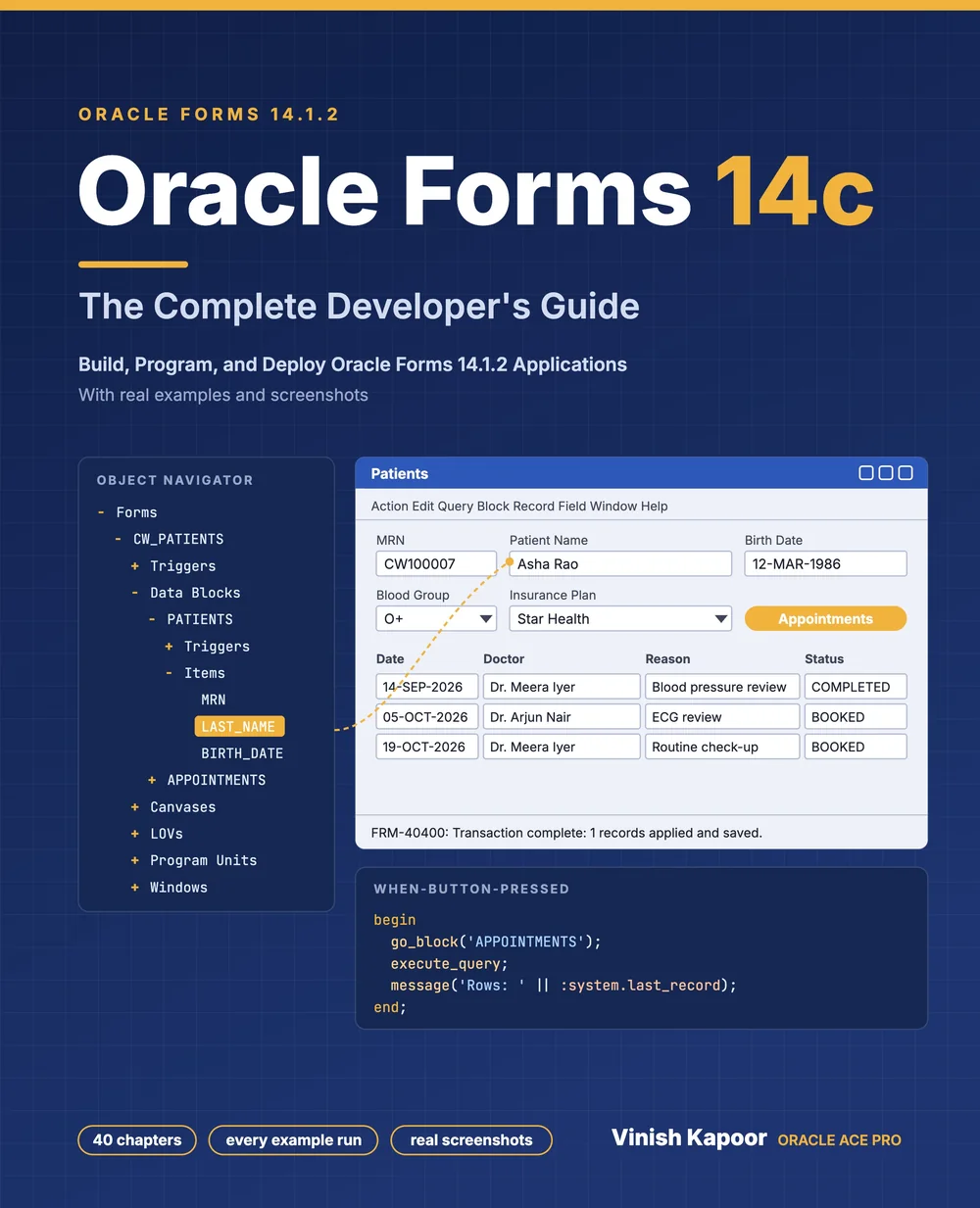
5. Oracle Forms 14c: The Complete Developer's Guide
- 484 pages
- 40 chapters
- 64 forms
- 187 figures
Oracle Forms still runs many of the business applications that companies depend on, and Forms 14.1.2 keeps them current. Good, current material on it is hard to find, though. Most Forms books were written for releases that went out of support long ago.
This book takes you from your first data block to a finished clinic application, CareWell Clinic. It covers Forms Builder, triggers and built-ins, lists of values, menus and roles, WebUtil, calling REST services and reading JSON, and Oracle Reports. You build 64 forms, and every screen in the book comes from a form that ran in Forms 14.1.2.
Read it if you build or maintain Oracle Forms applications. Appendices A to D list the properties, all 260 built-ins, the triggers and the FRM errors of Forms, so the book stays useful long after you finish it. Appendix F lists what Forms 14.1.2 adds to Forms 12c, with the chapter that covers each addition.
Which book should you read first?
That depends on the work in front of you. These are the paths I suggest to developers who ask me.
You are new to Oracle development
Start with SQL and PL/SQL, because everything else is built on it. Then move to The Complete Guide to APEX.
You want to build web apps on Oracle
Read The Complete Guide to APEX first, then keep APEX API by Example open while you write code.
You have been asked to add AI
Go straight to AI Applications. If APEX is new to you, read the first part of the APEX book alongside it.
You look after Oracle Forms
Read Oracle Forms 14c. When you start planning what comes next, the APEX book shows you where web development on Oracle is today.
What these books have in common
- Current releases. Everything is written for Oracle AI Database 26ai, Oracle APEX 26.1 and Oracle Forms 14.1.2.
- Real output. Every example was run, and the books print what it returned.
- One sample application per book. Instead of disconnected snippets, each book builds or uses one realistic application, so the examples make sense together.
- Code you can run. The scripts and applications of every book are on GitHub.
- Reference you will come back to. Each book ends with appendices, such as an index of every API, the developer features since 19c, or every Forms built-in, that stay useful after the first read.
Frequently asked questions
Are these books suitable for beginners?
The APEX Complete Guide and the SQL and PL/SQL book both start from the beginning, including installation. The APEX API book and the AI book assume you can already write SQL and have built at least a simple APEX page.
I use Oracle Database 19c or 23ai. Are the books still useful?
Yes. Most of SQL and PL/SQL works the same way across these releases. The SQL and PL/SQL book has an appendix that lists the developer features added since 19c, so you can see exactly which parts need a newer release.
Should I buy the paperback or the Kindle edition?
The paperbacks are printed in black and white. The Kindle editions show every screenshot in color, which helps most in the APEX, APEX API, AI and Forms books. The paperback is easier to keep open on the desk, and the Kindle edition is easier to search.
Can I run the examples myself?
Yes. The code of each book is on GitHub, and every book explains how to set up the lab it uses, so you can follow along and get the same results.
Where can I see sample pages?
Each book has a page on this site with real pages from the book, the full table of contents and screenshots of what you build. Use the "Look inside the book" link under each book above.
See my articles more often when you search Google.
