
If your codebase feels like it was written by engineers who never talked to the business team, you already know the problem domain-driven design (DDD) was built to solve. The gap between what the software does and what the business actually needs is one of the oldest pain points in software development.
DDD is a way of designing software so that the code reflects the real-world business domain it represents. It was introduced by Eric Evans in his 2003 book "Domain-Driven Design: Tackling Complexity in the Heart of Software," and it has shaped how developers think about building complex systems ever since.
What Is Domain-Driven Design?
At its core, DDD is about putting the business domain at the center of your software design decisions. Instead of starting with a database schema or a UI wireframe, you start by deeply understanding the business problem you are solving.
As Evans himself put it: "The heart of software is its ability to solve domain-related problems for its users." When your software accurately models the domain, it becomes easier to change, easier to explain, and easier to maintain.
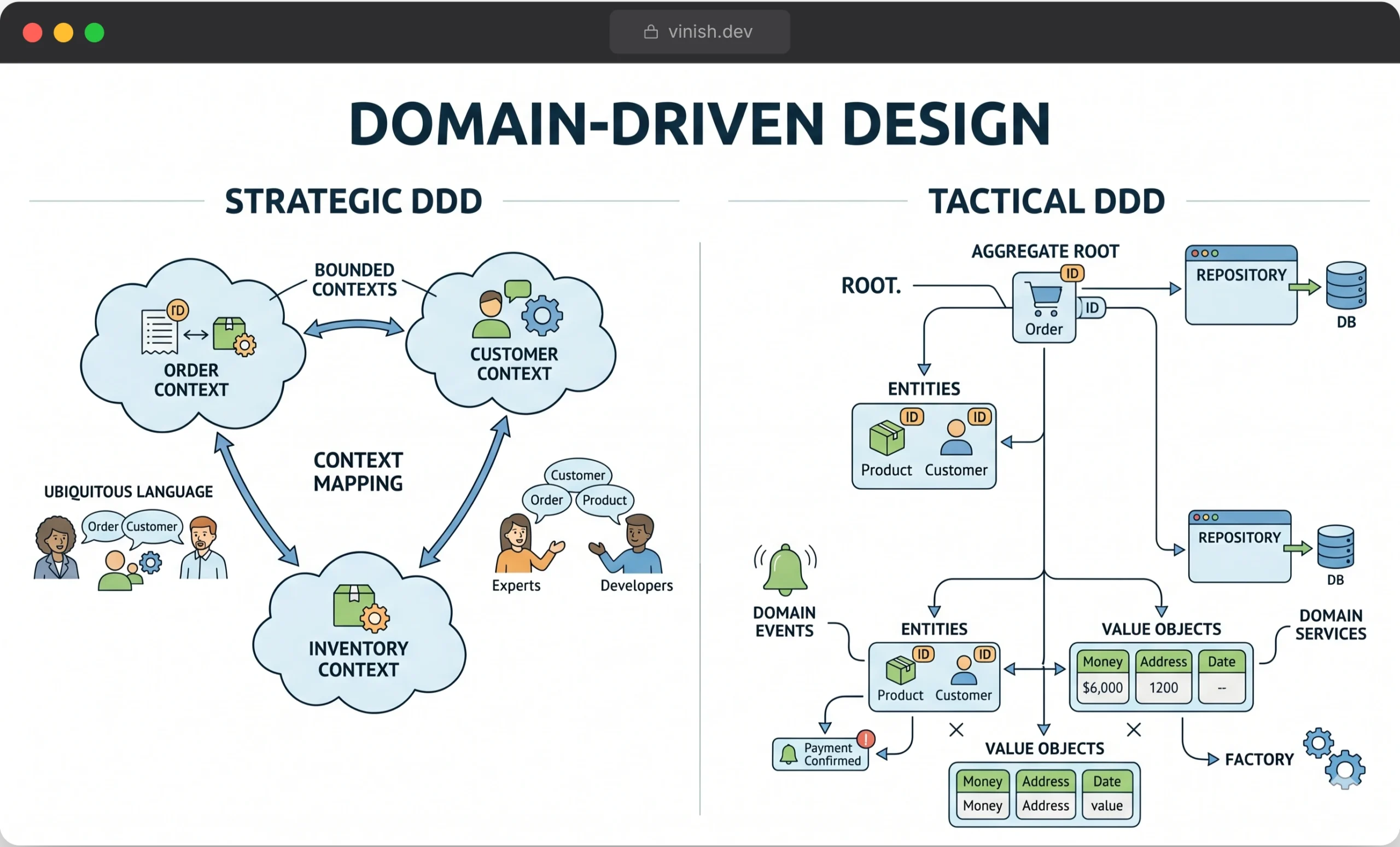
DDD gives you both a strategic framework for organizing large systems and tactical patterns for writing clean, expressive code at the class and method level.
Core Domain-Driven Design Concepts You Need to Know
Ubiquitous Language
One of the foundational ideas in DDD is building a shared vocabulary between developers and domain experts. This is called the ubiquitous language. Every term used in conversations with business stakeholders should appear verbatim in your code, and vice versa.
If a business analyst calls something a "shipment," your code should have a Shipment class, not a OrderDeliveryRecord. This consistency eliminates translation errors and makes conversations about the code far more productive.
Bounded Contexts
In large systems, the same word can mean different things in different parts of the business. A "customer" in the sales department and a "customer" in the support department may have completely different attributes and behaviors.
DDD addresses this with bounded contexts. A bounded context is a clear boundary within which a particular domain model applies. Each bounded context has its own ubiquitous language, and different contexts can have different models for the same concept without conflicting.
This is especially useful in microservices architecture, where each service can own its own bounded context.
Entities and Value Objects
DDD draws a clear distinction between two types of domain objects. Understanding both is key to writing expressive domain models.
| Concept | Defined By | Example |
|---|---|---|
| Entity | A unique identity (ID) | A user account, an order |
| Value Object | Its attribute values | A money amount, a postal address |
Entities need to be tracked over time even when their attributes change. Value objects are interchangeable as long as their values match. Getting this distinction right leads to cleaner, more intentional code.
Aggregates and Aggregate Roots
An aggregate is a cluster of related entities and value objects that are treated as a single unit for data changes. Every aggregate has one entry point called the aggregate root, which is the only object that outside code is allowed to reference directly.
For example, an Order aggregate might contain LineItem objects. Outside code should only interact with Order, never directly modify a LineItem. This protects the business rules that live inside the aggregate.
Repositories and Domain Services
Repositories provide a clean abstraction for storing and retrieving aggregates. They make your domain code independent of the underlying database technology. A OrderRepository interface in your domain layer can have a PostgreSQL implementation in your infrastructure layer.
Domain services handle business logic that does not naturally belong to a single entity or value object. If a business rule involves multiple aggregates, a domain service is often the right place for it.
Domain Events
Domain events represent something meaningful that happened in your domain. When an order is confirmed, an OrderConfirmed event can notify other parts of your system without creating tight coupling between bounded contexts.
This makes your system more loosely coupled, auditable, and easier to extend. Domain events are a cornerstone of event-driven architecture and work well alongside DDD.
Strategic Design vs. Tactical Design in DDD
DDD operates at two levels: strategic and tactical.
- Strategic design focuses on the big picture, identifying bounded contexts, their relationships, and how they map to teams and organizational structure.
- Tactical design focuses on the building blocks inside a single bounded context: entities, value objects, aggregates, repositories, and domain services.
Many teams jump straight to the tactical patterns without doing the strategic work first. That is a mistake. Without clear bounded context boundaries, even well-written tactical code can become a mess over time.
When Should You Use Domain-Driven Design?
DDD is not always the right tool. It shines in specific situations.
- The business domain is complex with intricate rules and workflows
- Multiple stakeholders need to collaborate on the design
- The system is expected to evolve significantly over time
- You are working with microservices and need to define clear service boundaries
For simple CRUD applications, DDD can be overkill. The overhead of defining aggregates and bounded contexts adds value only when the domain complexity justifies it. A good rule of thumb: if a junior developer can understand all the business rules in an afternoon, you probably do not need DDD.
A Simple Domain-Driven Design Example
Here is a minimal example showing how an aggregate root might enforce a business rule in code.
class Order {
  constructor(id, customerId) {
    this.id = id;
    this.customerId = customerId;
    this.lineItems = [];
    this.status = "draft";
  }

  addItem(productId, quantity, price) {
    if (this.status !== "draft") {
      throw new Error("Cannot add items to a confirmed order.");
    }
    this.lineItems.push({ productId, quantity, price });
  }

  confirm() {
    if (this.lineItems.length === 0) {
      throw new Error("Cannot confirm an empty order.");
    }
    this.status = "confirmed";
  }
}
Notice that the Order class owns the business rules. The rule "you cannot confirm an empty order" lives right in the domain model, not scattered across service methods or controllers. This is the essence of a rich domain model.
Common Mistakes Teams Make with DDD
- Using DDD patterns without investing in domain knowledge first
- Treating DDD as a technical exercise rather than a collaboration between engineers and business experts
- Creating an anemic domain model where entities are just data bags with no behavior
- Skipping event storming or similar workshops that help surface the domain language
- Applying aggregates too broadly, making them large and hard to manage
"The most important thing in software is the domain model. It should reflect the business reality, not the technical implementation," said Vaughn Vernon, author of "Implementing Domain-Driven Design."
DDD and Modern Software Architecture
Domain-driven design pairs naturally with several modern architectural styles. Bounded contexts map cleanly to microservices. Domain events feed event sourcing and CQRS (Command Query Responsibility Segregation). The aggregate pattern supports eventual consistency across distributed systems.
Many cloud-native teams use DDD as the starting point for service decomposition decisions. When you know your bounded contexts, you know where to draw the lines between your services.
Conclusion
Domain-driven design is ultimately about closing the gap between your software and the business it serves. By investing in a shared language, clear boundaries, and a domain model that reflects real business rules, you create systems that are easier to grow and easier to reason about. The upfront investment in understanding the domain pays off as your software evolves alongside your business.
