
You have probably come across the term Phantom Loop while searching for help with a stubborn programming bug. It sounds like a legitimate computer science concept, something you might study in a college course or find referenced in official documentation.
But here is the surprising truth. The term Phantom Loop in coding is not a real programming term at all.
It is a fabricated phrase, one that AI models invented when trying to explain common software bugs they struggle to describe accurately.
Phantom Loop Is an AI Hallucination
When large language models generate responses about coding problems, they sometimes create terminology that does not actually exist. This behavior is called an AI hallucination, and the phantom loop is a textbook example of it.
You will not find this term in any Python documentation, JavaScript specification, or computer science textbook. It has no formal definition because it was never defined by any programming language or software engineering authority.
What typically happens is this: a developer asks an AI assistant about a loop-related bug, and the AI responds with a confident explanation of something called a phantom loop. The explanation sounds convincing, but the term itself is entirely made up.
The most dangerous AI errors are not the ones that sound wrong. They are the ones that sound perfectly right.
Here is a screenshot of the incident when I first saw Gemini use this term:
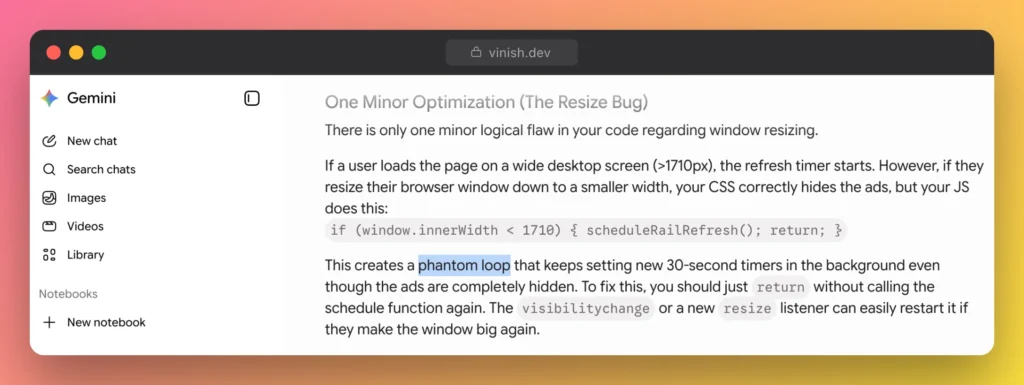
What AI Models Actually Mean When They Say Phantom Loop
Even though the phrase is fabricated, the problems the AI is trying to describe are very real. When an AI mentions a phantom loop, it is almost always referring to one of these well-known programming issues.
Infinite Loops
An infinite loop occurs when a piece of code keeps repeating because the condition to stop it is never satisfied. Your program freezes, your browser tab becomes unresponsive, or your system runs out of memory.
Here is a simple example in JavaScript.
let i = 0;
while (i >= 0) {
  console.log("Still running...");
  i++;
}
The variable i will always be greater than or equal to zero, so this loop never ends. This is a standard infinite loop, not a phantom loop.
Race Conditions and Timing Bugs
The other common issue mislabeled as a phantom loop involves asynchronous code. In modern web development, multiple operations run at the same time. When one operation depends on the result of another that has not finished yet, things break.
Your application might appear stuck in a loop when it is actually just waiting for data that never arrives. The AI sees this behavior and reaches for a dramatic-sounding label instead of using the correct term: race condition.
Deadlocks
Sometimes two processes each hold a resource the other one needs. Neither can move forward, and your program appears frozen in a repeating cycle. This is called a deadlock, and it is another bug that AI models occasionally describe as a phantom loop.
Real Coding Terms vs AI-Generated Jargon
Understanding the difference between actual programming terminology and AI-invented phrases will save you hours of confusion. Here is a quick comparison.
| Actual Programming Term | AI Hallucination Term | What Actually Happens |
|---|---|---|
| Infinite Loop | Phantom Loop | Code repeats endlessly because the exit condition is never met. |
| Race Condition | Ghost Thread | Multiple processes compete for resources in an unpredictable order. |
| Deadlock | Shadow Lock | Two processes block each other permanently, waiting on shared resources. |
| Memory Leak | Data Bleed | A program keeps consuming memory without releasing what it no longer needs. |
If you ever encounter a programming term that returns zero results on MDN, Stack Overflow, or official language docs, there is a good chance it is AI-generated jargon.
Why AI Models Invent Terms Like Phantom Loop
Large language models work by predicting what word should come next in a sentence. They do not truly understand programming concepts the way a human developer does.
When a model encounters a bug it cannot precisely categorize, it combines familiar words into something that sounds technical. The word "phantom" suggests something invisible or elusive. The word "loop" is directly tied to repetition in code. Put them together, and you get a phrase that feels legitimate but means nothing.
Training data plays a role too. AI models learn from millions of blog posts, forum threads, and casual discussions where developers use imprecise language. A frustrated programmer might have once described a tricky bug as a "phantom loop" in a Reddit comment, and the AI absorbed it as valid terminology.
How to Verify Coding Terms You Get from AI
You do not need to stop using AI coding assistants. You just need a reliable verification process. Here are some practical steps.
- Search for the term in the official documentation for the programming language you are using.
- Check whether the term appears in established computer science resources like textbooks or academic papers.
- Ask the AI to provide a source or documentation link for the term. If it cannot, that is a red flag.
- Rephrase your question to describe the behavior instead of using the term. For example, ask about "a loop that never stops" instead of "phantom loop."
- Cross-reference the explanation with trusted developer communities like Stack Overflow.
A Practical Example of Misdiagnosis
Imagine your web application shows a loading spinner that never goes away. You ask an AI assistant what is wrong, and it tells you that your code is caught in a phantom loop.
In reality, the problem is much simpler. Your fetch request failed and you forgot to add error handling.
fetch('/api/users')
  .then(response => response.json())
  .then(data => renderUsers(data));
If the API returns an error, the renderUsers function never runs. The spinner keeps spinning. There is no loop involved at all, phantom or otherwise. Adding a catch block solves the entire problem.
fetch('/api/users')
  .then(response => response.json())
  .then(data => renderUsers(data))
  .catch(error => showErrorMessage(error));
The Real Cost of Using Made-Up Terms
Using fabricated terminology like phantom loop creates real problems in professional settings. If you file a bug report mentioning a phantom loop, your teammates will have no idea what you mean.
Clear and precise language is one of the most underrated skills in software development. Saying "the while loop on line 42 never terminates because the counter resets each iteration" is infinitely more useful than saying "there is a phantom loop in the code."
Good debugging starts with good vocabulary. Name the problem correctly, and you are halfway to solving it.
Conclusion
The phantom loop in coding is not a real programming concept. It is an AI hallucination where language models invent technical-sounding terms to describe standard bugs like infinite loops, race conditions, and deadlocks. The next time an AI tool throws an unfamiliar term at you, take a moment to verify it against official documentation before accepting it as fact. Sticking with established programming vocabulary will make you a better communicator, a faster debugger, and a more effective developer overall.
