
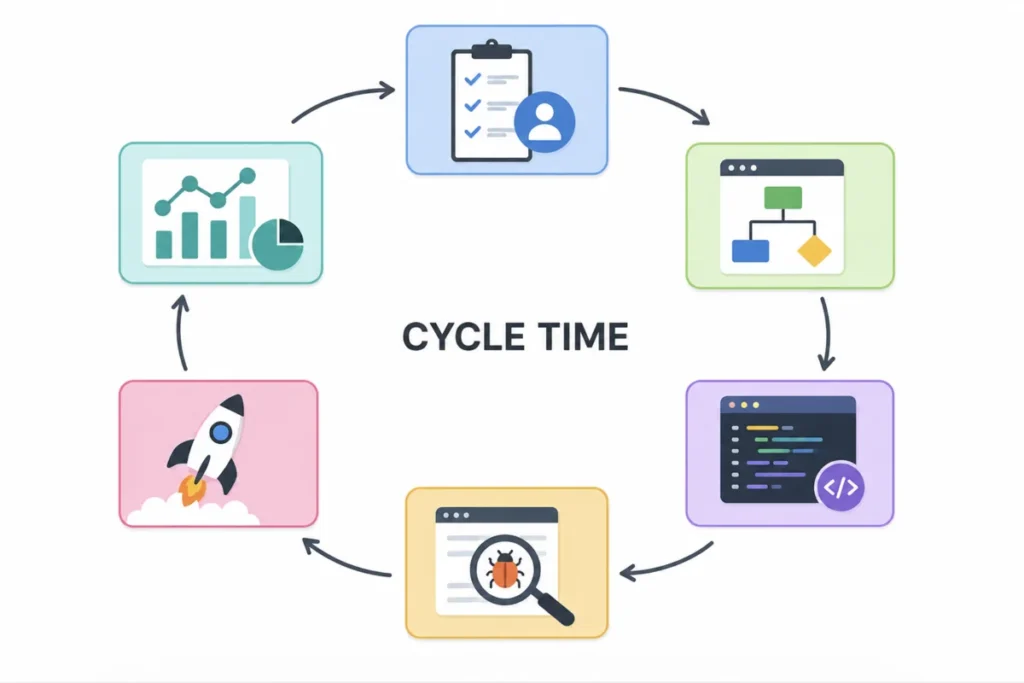
Understanding your cycle time in software development is the secret to building better products faster. It measures the time elapsed from when work begins on a task to when it reaches the end user. This metric provides a clear window into your engineering team's efficiency and overall workflow health.
Every engineering team struggles with bottlenecks that slow down feature delivery. Tracking your software development cycle time helps you identify exactly where those delays occur. It allows you to pinpoint whether a slowdown happens during coding, testing, or deployment.
Focusing on this metric is not about forcing developers to type faster. It is about removing friction from the development pipeline to enable smooth, continuous delivery. A healthy cycle time indicates a streamlined process with minimal context switching and crystal-clear requirements.
Why Software Development Cycle Time Matters
Speed to market is a massive competitive advantage in today's fast-paced tech industry. When you reduce your cycle time, you can ship new features and bug fixes to your users much faster. This rapid feedback loop ensures you are building the right tools and responding to market changes quickly.
High cycle times often indicate deeper organizational issues within your software engineering roadmap. Long wait times between stages lead to stale code and frustrating merge conflicts. Ultimately, optimizing your workflow naturally improves team morale and reduces engineering burnout.
Predictability is another major benefit of tracking your cycle time metrics. When you know exactly how long a typical task takes, you can make accurate commitments to key stakeholders. This reliability builds lasting trust between engineering and the rest of the business across every phase of SDLC.
Cycle Time vs. Lead Time
Many people confuse cycle time with lead time, but they measure two distinct parts of your workflow. Lead time starts the moment a customer request is created and ends when it is finally delivered. Cycle time, however, only begins when an engineer actively starts working on that specific request.
As a famous management expert once noted, "What gets measured gets managed." If a ticket sits in a backlog for three weeks before work begins, your lead time increases while your cycle time remains at zero. High lead times combined with low cycle times usually indicate a prioritization or capacity issue rather than an engineering slowdown.
Here is a simple breakdown of the differences between these two critical metrics to help you understand them better.
| Metric | Starting Point | Ending Point | What It Measures |
|---|---|---|---|
| Lead Time | Request is submitted by the user | Feature is successfully delivered | Total wait time for the customer |
| Cycle Time | Work actually begins by developer | Feature is successfully delivered | Execution speed of the engineering team |
Key Cycle Time Metrics You Should Track
Breaking down your agile cycle time into distinct phases provides actionable insights into your team's performance. You should closely track your coding time, which covers the period from the first commit to when a pull request is opened. If this specific phase takes too long, it might mean the unit of work is simply too large.
Review time is notoriously the biggest bottleneck for many modern engineering teams. It measures how long a pull request waits before being formally approved and merged into the main branch. Implementing strict code review practices is absolutely essential for keeping this phase as short as possible.
Deployment time tracks the duration from merging code to releasing it safely into your production environments. If this phase feels sluggish, you likely need to invest in a robust continuous integration pipeline. Automating your deployment ensures that merged code reaches users efficiently without any manual intervention.
How to Measure Agile Cycle Time
Measuring your software development cycle time requires the right tools and a disciplined approach to task management. Most teams use Kanban boards or sprint trackers to visualize their workflow from start to finish. When an engineer moves a ticket from the backlog into an active status, the clock officially starts ticking.
Popular project management tools can automatically calculate these metrics for you effortlessly. They track precise timestamps every time a ticket moves between columns on your digital board. This helpful automation removes the need for manual time tracking, which is notoriously inaccurate and widely disliked by developers.
You can also pull cycle time data directly from your modern version control systems. Code repositories offer deep insights into how long pull requests stay open before finally being merged. Combining project management data with version control metrics gives you a highly accurate picture of your web application development pipeline.
The Role of Communication in Cycle Time
Effective communication is the invisible engine that drives a fast software development cycle time. When product managers, designers, and engineers are tightly aligned, the entire process moves with incredible speed. Misunderstandings about feature requirements frequently cause developers to build the wrong things and restart their work entirely.
Asynchronous communication tools can both help and hurt your agile cycle time depending on how they are used. Endless notification pings pull developers out of their flow state and severely disrupt critical deep work sessions. A dedicated developer advocate can help establish strong communication best practices across large engineering teams.
Documentation plays a surprisingly large role in keeping your cycle time metrics consistently low. When onboarding new team members or working on unfamiliar services, excellent documentation prevents hours of aimless searching. The ultimate goal is to give engineers the precise context they need to work autonomously and efficiently.
Common Causes of High Agile Cycle Time
Unclear requirements are a primary culprit for bloated delivery times and frustrated engineering teams. When developers have to stop and ask clarifying questions, forward progress completely grinds to a halt. Good software architecture planning upfront saves countless hours during the actual code implementation phase.
Technical debt significantly slows down your feature delivery capabilities over the long run. Working with messy codebases requires more time to understand existing logic and prevents quick, confident changes. Regularly addressing hidden code smells keeps your codebase clean, manageable, and highly efficient.
Flaky testing environments often cause massive delays during the crucial deployment phase. Engineers waste precious time trying to figure out if a test failed due to bad code or a bad environment. Implementing reliable test automation ensures quick and accurate validation of your critical code changes.
Strategies to Improve Software Development Cycle Time
Adopt Effective Development Methodologies
Writing tests before your application logic can dramatically reduce your overall cycle time. The test-driven development methodology forces you to clarify requirements before writing a single line of production code. Catching tricky bugs early in the process is always much faster than fixing them later in production.
This proactive practice might seem slower initially, but it massively speeds up the later stages of your workflow. Your developers spend significantly less time debugging and far more time delivering actual business value. This automated safety net is especially helpful for junior developers learning the complex codebase.
Implement Shift-Left Testing
Shift-left testing is a remarkably powerful strategy for drastically reducing your software development cycle time. This approach involves moving testing activities as early in the development lifecycle as fundamentally possible. Following the core principles of the test pyramid ensures you have a robust foundation of fast unit tests.
This early validation catches critical logic errors long before they reach the formal QA review phase. It prevents the frustrating ping-pong effect where tickets bounce continuously between developers and testers. These faster feedback loops empower developers to quickly fix issues while the code is still completely fresh in their minds.
Leverage Artificial Intelligence Tools
Modern engineering teams use artificial intelligence to eliminate repetitive tasks and drastically reduce cycle time. You can leverage prompt engineering techniques to quickly generate boilerplate code or write initial unit test cases. Exploring AI driven SDLC practices can help you successfully identify hidden workflow bottlenecks automatically.
Initial code reviews can be significantly accelerated using automated static analysis and powerful AI tools. Using AI pair programmers helps you flag bad code before a human reviewer even looks at the pull request. This ensures your senior staff, like your principal software engineer, only spend valuable time on complex architectural decisions.
Focus on Continuous Code Improvement
Improving your cycle time is an ongoing process, not a simple one-time project. You must continuously monitor your metrics and proactively look for new areas to optimize and strategically refine. Enhancing your team's problem solving skills helps them navigate technical challenges much faster and more efficiently.
Sometimes legacy systems are the hidden root cause of your frustratingly slow delivery speeds. When this happens, you must consider strategic code modernization efforts to remove these systemic roadblocks permanently. Small, incremental refactoring changes will eventually compound into massive productivity gains over time.
Here are some quick wins you can implement today to start improving your metrics.
- Limit work in progress to drastically reduce expensive context switching.
- Break large, complex features into small and independent pull requests.
- Automate your deployment pipeline completely to remove manual steps.
- Monitor your specific cycle time metrics during weekly team reviews.
- Hold retrospective meetings focused purely on improving workflow efficiency.
Conclusion
Mastering your cycle time in software development is absolutely essential for building a high-performing engineering organization. It gives you the actionable, objective data you need to accurately identify bottlenecks and streamline your entire delivery pipeline. By focusing relentlessly on the speed of execution, you can ship better software to your users faster and far more reliably.
Remember that reducing agile cycle time requires a holistic, team-wide approach to your daily workflow. You must address everything from initial requirement gathering to automated testing and final deployment strategies. Consistent monitoring and a strong commitment to continuous improvement will eventually yield a smooth, highly efficient development process.
