
Oracle TIME_BUCKET Function
Group events into periods of any length, from fifteen-minute slots to six-hour blocks, by placing each timestamp in a fixed-size bucket.
Explore comprehensive Oracle SQL resources designed for database developers and administrators. Our guides cover everything from basic query construction to advanced techniques for complex joins, analytical functions, and hierarchical data manipulation. Learn practical approaches to performance optimization through execution plan analysis, smart indexing strategies, and efficient table partitioning. Discover best practices for data modeling, constraint management, and large dataset handling that solve real business challenges. Whether you're writing reports, building data warehouses, or maintaining enterprise databases, enhance your Oracle SQL proficiency with our actionable insights.
Group events into periods of any length, from fifteen-minute slots to six-hour blocks, by placing each timestamp in a fixed-size bucket.
Get the hours, minutes, seconds, or milliseconds between two timestamps as a number, correctly across time zones and clock changes.
Count the days, weeks, months, or years between two dates in one function, and understand why DATEDIFF counts boundaries, not whole units.
Add any unit from years to nanoseconds to a date or timestamp with DATEADD, and see how it differs from ADD_MONTHS at month ends.
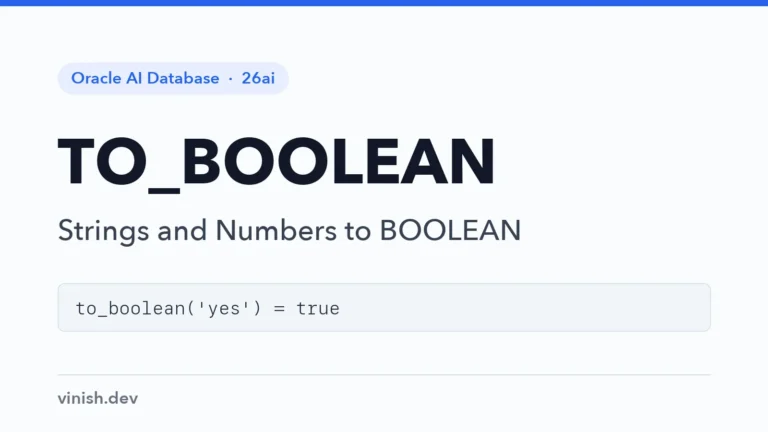
Turn yes and no flags, true and false strings, and numbers into the BOOLEAN data type, with a default for values it does not recognize.
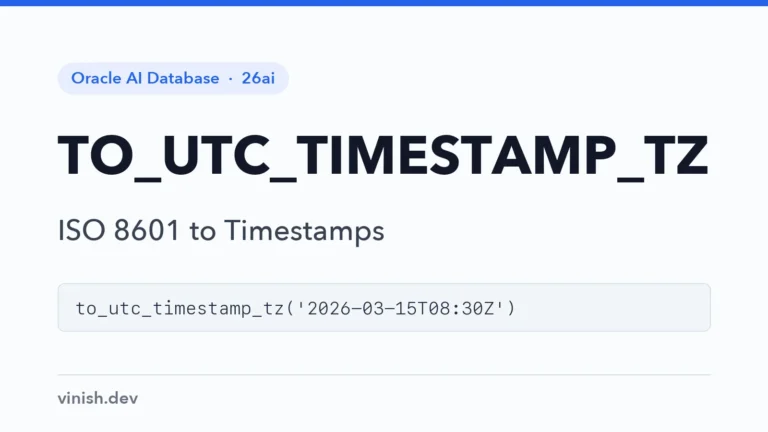
Read ISO 8601 dates and timestamps from JSON and REST services without a format model, and get the UTC time with SYS_EXTRACT_UTC.
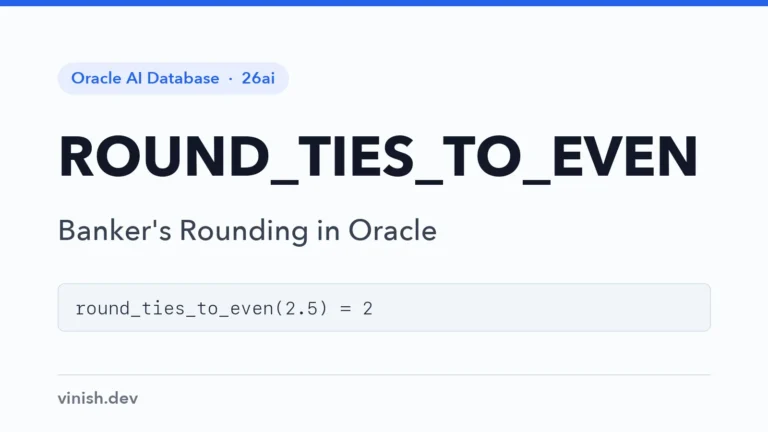
Round exact halves to the nearest even number with banker's rounding, and keep totals of many rounded values from drifting upward.
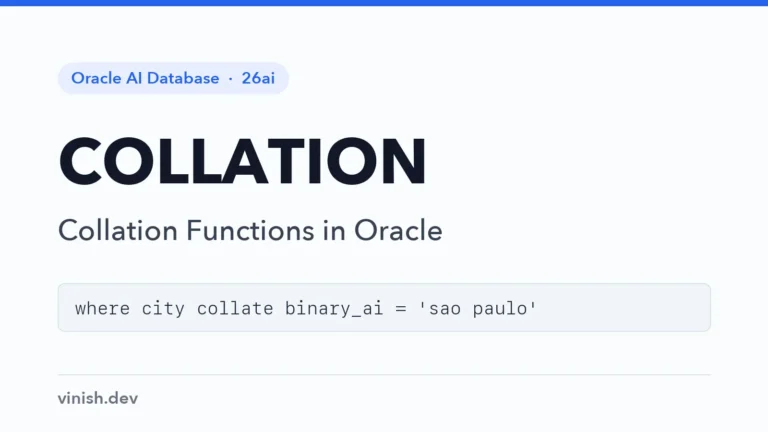
See which collation applies to an expression, convert collation names and numbers, and compare text without regard to case or accents.
Convert between character set names and numbers, find the database's character sets, and size NCHAR columns with NLS_CHARSET_DECL_LEN.
Sort and compare strings by linguistic rules instead of byte values, ignoring case with BINARY_CI and accents with BINARY_AI.
Find names that sound alike despite different spellings by comparing Double Metaphone codes, with primary and alternate pronunciations.
Find misspelled and similar names in SQL by scoring string similarity with Levenshtein, Jaro-Winkler, bigram, and other algorithms.
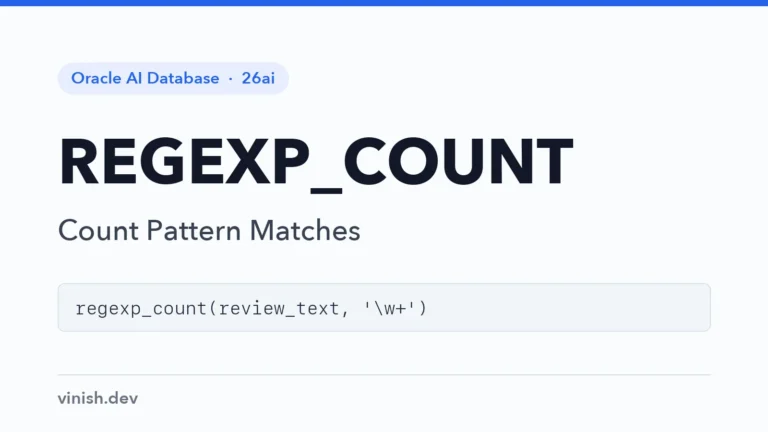
Count how many times a pattern occurs in a string, from words and search terms to digits and groups, with case-insensitive options.
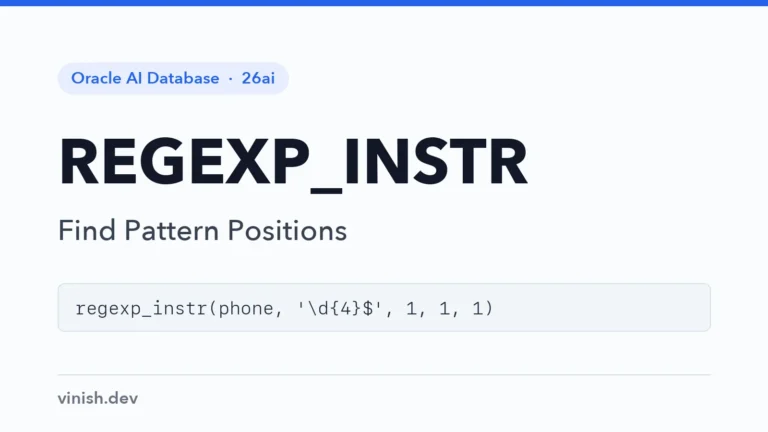
Find the position of a regular expression match in a string, choose which match, get the position after it, and locate a single group.
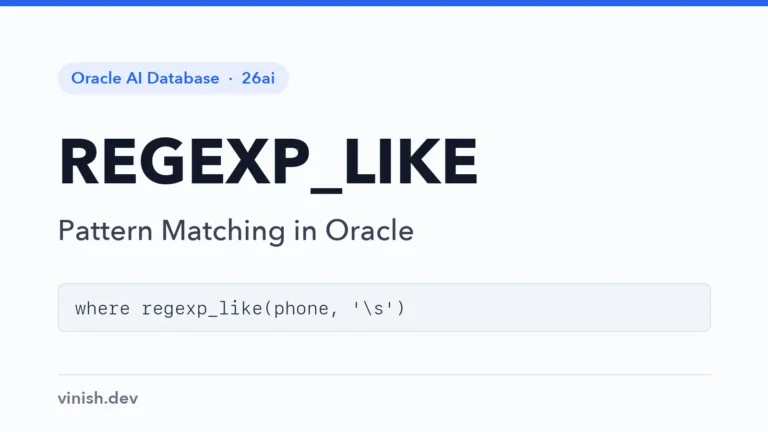
Match strings against regular expressions in WHERE, CASE, and CHECK constraints, and avoid the bracket mistake with \d in Oracle patterns.
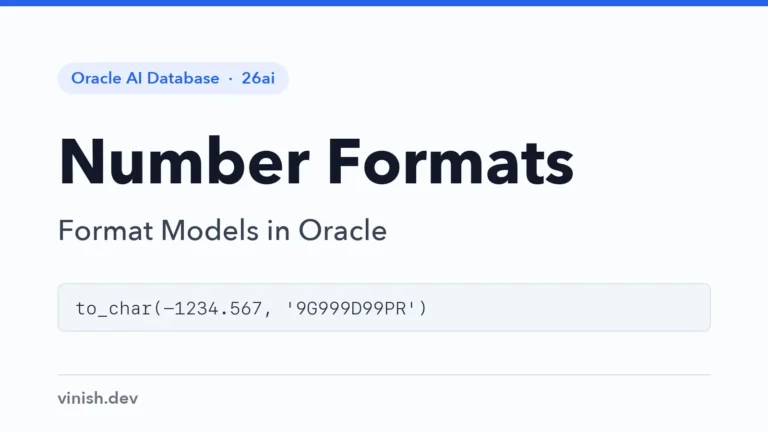
Format and read numbers with 9, 0, G, D, L, MI, PR, and other elements, keep leading zeros, and follow each locale's separators.
Format and read dates with the right elements, use FM, FX, TH, and SP, understand RR versus YY, and avoid session format surprises.
Learn what ROWNUM, ROWID, ORA_ROWSCN, and COLUMN_VALUE return, why ROWNUM is assigned before ORDER BY, and when to use FETCH instead.