
Most discussions about private cloud focus on where the hardware lives. The harder engineering problem is what happens to your control plane when the network link to the provider disappears. Oracle's two isolated cloud offerings, OCI Dedicated Region and Oracle Cloud Isolated Region, make different but overlapping bets on how to solve that problem, and understanding the architectural split between them is where the real engineering decisions start.
The Core Problem: Control Plane Coupling
Every major cloud provider runs a global control plane. When you provision a VM, resize a database, or push a policy update, that API call typically routes through a shared regional or global endpoint before landing on physical infrastructure. In a standard public cloud deployment, this coupling is invisible. In a disconnected or air-gapped environment, it becomes the single most important architectural constraint you will face.
The failure mode is well understood. A tenant running workloads in an isolated environment loses the ability to modify infrastructure, rotate credentials, or respond to incidents the moment that the upstream link goes dark. Your data plane keeps running, but your operations plane is effectively frozen.
The architectural answer is a fully localized control plane, meaning every API endpoint, identity service, metadata store, and orchestration layer runs on hardware inside your facility.
OCI Dedicated Region: Full Control Plane on Customer Premises
OCI Dedicated Region ships an entire OCI region into a customer-controlled data center. The service catalog runs at over 200 offerings, including Kubernetes Engine, Autonomous Database, Object Storage, Identity and Access Management, and Vault. Every one of these services is backed by a local control plane instance, not a proxy to a remote Oracle endpoint.
What "Local Control Plane" Actually Means
In practice, this means the following components run on your hardware in your facility:
- IAM (Identity and Access Management) service, including token issuance and policy evaluation
- OCI Console frontend and backend API gateway
- Resource Manager and Terraform state backend
- Monitoring, Logging, and Events pipelines
- Vault service for key management and secrets
- Networking control plane for VCN management, route tables, and security lists
When the WAN link between your facility and Oracle's public cloud goes down, all of the above continue operating. Provisioning, scaling, and incident response are uninterrupted. The control plane is not degraded to read-only; it continues accepting write operations.
Connectivity Model
OCI Dedicated Region is not permanently air-gapped by design. It maintains an optional connection back to Oracle's public cloud for purposes like pulling software updates, syncing service patches, and routing telemetry. The critical distinction is that this link is not required for day-to-day operation. You can sever it, and the region stays functional. Most regulated-industry deployments keep a low-bandwidth link active for patch propagation and then enforce strict egress filtering at the network boundary.
The typical network architecture for a Dedicated Region looks like this:
| Layer | Component | Location |
|---|---|---|
| Physical | Oracle-owned rack hardware | Customer data center |
| Networking | OCI spine/leaf Clos fabric | Customer data center |
| Control Plane | Local IAM, API gateway, Vault, Console | Customer data center |
| Data Plane | Compute, Storage, Database, Kubernetes | Customer data center |
| Upstream Link | Optional WAN to Oracle public cloud | Customer-managed edge |
Delivery and Operational Model
Oracle handles hardware procurement, rack installation, and ongoing hardware remediation. The customer provides facility, power, cooling, and network uplinks. Oracle SRE teams retain remote access for break-fix and patch operations, but this access can be scoped and audited through the IAM policies running inside the region itself.
Deployment timelines after site readiness run significantly shorter than comparable offerings from other providers because Oracle ships a pre-configured, pre-validated rack stack rather than a configuration-on-site model.
Oracle Cloud Isolated Region: Permanent Air-Gap Architecture
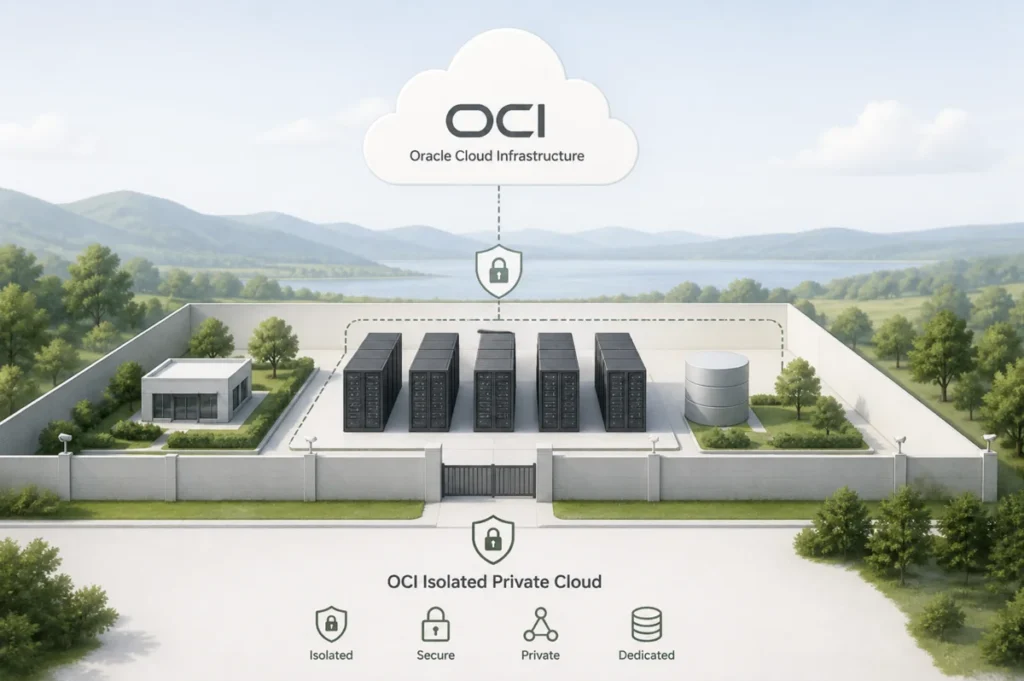
Oracle Cloud Isolated Region is the hardened variant, designed for environments that cannot tolerate any network path to a provider's public infrastructure, ever. The architectural differences from the Dedicated Region are not superficial.
Disconnection Tolerance
The Isolated Region is engineered for indefinite operation with zero connectivity to Oracle's external network. This has several concrete implications for how you manage the environment:
- Software patches and service updates are delivered via physical media or a strictly controlled, intermittent one-way data diode connection, not over a persistent WAN link
- There is no Oracle SRE remote access path. All operational access requires cleared, in-country personnel physically present in the facility
- Telemetry and usage data do not leave the boundary. Oracle's standard cloud telemetry pipeline is severed at the architecture level
- The service catalog remains at full parity with Dedicated Region. Isolation does not reduce the available service set
Personnel Sovereignty
The operational model for Isolated Region requires that all personnel with physical or logical access to the environment meet the security clearance requirements of the deploying organization. Oracle trains and places in-country staff to handle hardware operations, but the access governance model is inverted compared to a normal managed service. The customer's security authority approves personnel, not Oracle's corporate HR pipeline.
Key Management in a Disconnected Environment
One of the trickier infrastructure problems in a permanently air-gapped environment is key lifecycle management. In OCI public cloud, Vault integrates with HSMs that Oracle manages. In the Isolated Region, the HSM infrastructure and all key material remain inside the air-gap boundary. Key rotation, escrow, and revocation workflows need to be designed around the assumption that no external PKI hierarchy is reachable.
For teams building on top of Isolated Region, this typically means establishing a local certificate authority chain, planning your root of trust on hardware that lives inside the boundary, and ensuring your key rotation automation does not carry any dependency on an external OCSP or CRL endpoint.
Oracle Alloy: The Reseller Architecture
Oracle Alloy is the third configuration in this family, aimed at telcos, managed service providers, and systems integrators who want to deliver OCI-equivalent infrastructure to their own customers under their own brand. The technical architecture underneath is the same Dedicated Region stack, but the commercial and API access model allows the Alloy operator to set independent pricing, define their own service tiers, and present their own identity to end customers.
From an infrastructure engineering perspective, Alloy introduces a multi-tenancy boundary that sits above the standard OCI tenancy model. The Alloy operator's control plane manages the allocation of compute, storage, and networking capacity to downstream tenants, while Oracle's hardware management layer remains a layer below that.
API and Service Parity: Why It Matters for Platform Engineering
If you have built a Kubernetes-based platform on OCI public cloud, the Terraform modules, OCI CLI configuration, and API call patterns you use in your CI/CD pipelines are identical on a Dedicated Region or Isolated Region. There is no fork in your infrastructure-as-code repository. You change the region identifier in your provider configuration, and the endpoint resolves locally.
Compare this to a stripped-down edge appliance model where you get a subset of APIs, reduced instance types, and a management interface that diverges from the public cloud console. On those platforms, your CI/CD pipelines, Terraform state, and operator tooling all need parallel implementations.
| Capability | OCI Dedicated Region | Oracle Cloud Isolated Region |
|---|---|---|
| Service count | 200+ | 200+ |
| API parity with public OCI | Full | Full |
| Disconnection tolerance | Operational (WAN link optional) | Indefinite (permanent air-gap supported) |
| Remote Oracle SRE access | Yes, auditable via local IAM | No remote access path |
| Personnel sovereignty | Partial (Oracle manages hardware ops) | Full (cleared in-country staff only) |
| Patch delivery mechanism | WAN pull from Oracle public cloud | Physical media or controlled transfer |
Day 2 Operations: The Engineering Burden That Gets Underestimated
Getting the hardware provisioned and the control plane running is the easy part. The operational complexity compounds over time in ways that pure public cloud deployments do not prepare you for.
Patch Management Without a Live Update Channel
On a standard public cloud deployment, service updates are transparent. The provider rolls patches across the fleet and you consume the updated API without any action on your end. On a Dedicated Region with a low-bandwidth WAN link, you schedule patch windows, and Oracle pushes updates over that link. On an Isolated Region, your ops team needs a documented process for receiving physical patch media, validating it, and applying it in a sequence that does not break running workloads.
Capacity Planning Without Elastic Headroom
Public cloud elasticity relies on a shared oversubscription pool. On a dedicated hardware footprint, your available compute is bounded by what is physically racked. This pushes capacity planning work back onto your team. You need to model peak utilization, plan rack expansion lead times, and ensure that failure domain headroom exists within the physical installation, not just as a policy in a cloud scheduler.
Incident Response with No Provider Safety Net
When a hardware component fails in a public cloud region, the provider's ops team handles it invisibly. On an Isolated Region, hardware remediation requires a cleared technician, which may introduce delays depending on your staffing model and the physical security requirements of your facility. Your SLAs need to account for that mean-time-to-repair reality, not the SLA Oracle publishes for its public cloud hardware pools.
Infrastructure-as-Code Considerations
If you are targeting a Dedicated Region or Isolated Region from Terraform, the provider block requires only two changes from a standard OCI public cloud configuration. Set the region to your local region identifier and configure the endpoint override to resolve against your local API gateway rather than the public OCI endpoint.
Set the environment variable OCI_CLI_ENDPOINT to your local control plane URL, or in your OCI CLI config file set the endpoint key under the relevant profile. All SDK-based tooling that respects the standard OCI SDK configuration model will automatically route to the local control plane with no code changes in your application layer.
"The strongest predictor of long-term value retention in isolated infrastructure is architectural cohesion with the parent cloud platform." The practical implication of that is straightforward: any tooling you build against the OCI API surface works without modification across public OCI, Dedicated Region, and Isolated Region.
Conclusion
The engineering substance behind OCI's isolated private cloud offerings is a fully localized control plane that continues operating when the WAN link is severed, a service catalog at full parity with the public cloud, and an API surface that does not require a fork in your infrastructure-as-code or CI/CD tooling. The Dedicated Region suits regulated workloads that need local control but can tolerate an intermittent upstream connection. The Isolated Region handles the harder constraint: permanent disconnection from all provider infrastructure, with all operations handled by cleared in-country personnel.
The Day 2 complexity, patch logistics, capacity planning, and hardware remediation timelines are where these deployments demand real engineering investment. Build your operational runbooks for those constraints before you deploy, not after the first hardware failure in a facility where your ops team needs security clearance to get to the rack.
