
How to Return Custom JSON from a PL/SQL Handler
Return JSON documents of your own design from ORDS, built with SQL/JSON functions and written out with HTP in pieces.
Oracle APEX (Application Express) is a low-code development platform for building scalable, secure enterprise applications. It allows developers to quickly create web-based applications using a browser-based interface, reducing the need for extensive hand-coding.
For a more structured learning journey, you can also explore the Oracle APEX Roadmap for a sequential path through related concepts, features, and development topics.
Return JSON documents of your own design from ORDS, built with SQL/JSON functions and written out with HTP in pieces.
Return 400 errors with JSON messages and add your own response headers from ORDS PL/SQL handlers.
Let one resource URL answer GET, PUT, and DELETE, update and delete rows by the path parameter, and return the right status.
Read a JSON request body through bind variables, insert the row, and return 201 Created with the new resource and its URL.
Answer GET requests for one resource with a single JSON object, and let ORDS return 404 when the row does not exist.
Read values from the URL path and query string in ORDS handlers, and declare parameter types so bad input gets a clear error.
Group endpoints in a module, give them URL templates, and answer each HTTP method with a handler that runs your own SQL.

Read large ORDS collections page by page with limit and offset, follow next and prev links, and keep the order stable.
Ask an AutoREST collection for only the rows you need, with JSON filters for comparisons, patterns, lists, and sorting.
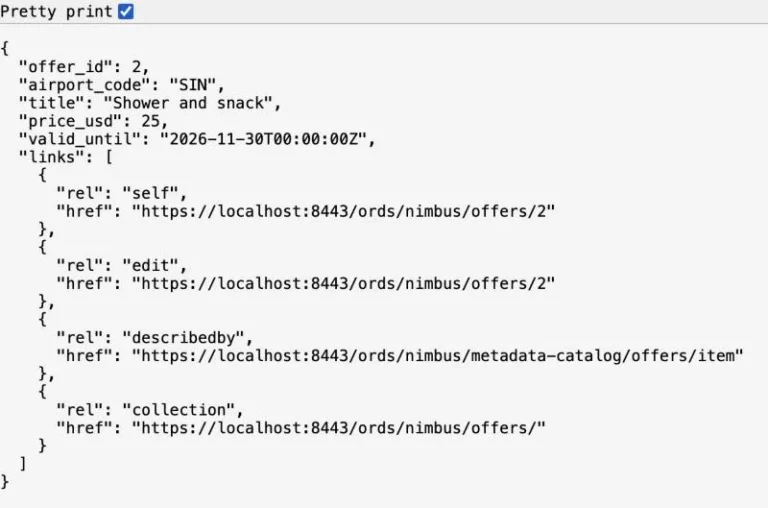
Publish a table as a full REST API with two ORDS calls, then read, insert, update, and delete rows over HTTP with real responses.
Register a schema with ORDS under a URL alias, check its status, browse its catalogs, and decide whether the catalog is public.
Install a new ORDS release next to the old one, upgrade the ORDS schema with the same configuration folder, and switch over safely.
Add a connection pool for each database or PDB, reach each APEX instance at its own ORDS URL, and manage every pool's settings separately.
Run ORDS as a web application in Apache Tomcat instead of standalone, serve the APEX images, and see which settings move to Tomcat.
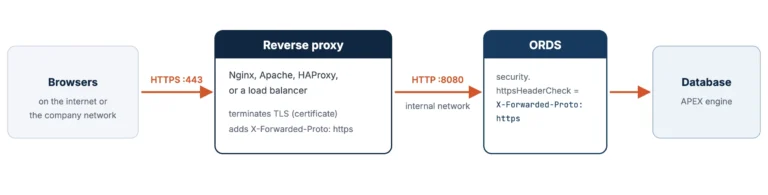
Secure Oracle APEX with HTTPS using an ORDS self-signed certificate for testing, your own certificate, or Nginx as a reverse proxy.
Understand how ORDS serves APEX, where its settings live, and how to change the web server and connection pool settings safely.
Run Oracle AI Database 26ai Free in a container and ORDS natively on your Mac, with start scripts and a launchd agent that starts ORDS at login.
Build a native Oracle APEX 26.1 server on Oracle Linux, with the database and ORDS running as systemd services that start at boot.