
You can be a brilliant engineer and still get rejected before a human ever reads your application. The reason is almost never your code — it's your resume. A great software engineer resume does one job: it convinces a recruiter and an applicant tracking system, in under ten seconds, that you can do the role and are worth a call.
The problem is that most engineering resumes read like a job description: a wall of responsibilities, a list of every technology ever touched, and zero evidence of impact. Recruiters skim hundreds of these. Yours has to be the one that makes them stop.
This complete guide walks you through exactly how to write a software engineer resume that survives the ATS, passes the recruiter skim, and earns the interview — section by section, with bullet formulas, before-and-after examples, and the mistakes that quietly kill applications.
What Recruiters and the ATS Actually Look For
Before you write a single line, understand the two audiences your resume must satisfy. They want different things, and you have to win both.
The ATS (Applicant Tracking System) is software that parses, ranks, and filters resumes before a human sees them. It scans for relevant keywords, job titles, and skills pulled from the job description. If it can't parse your file or doesn't find the right terms, you're filtered out — silently.
The human recruiter or hiring manager spends an average of Ladders eye-tracking study on recruiter resume review time six to eight seconds on a first pass. They're scanning for signal: relevant company names, recognizable tech, scope, and measurable results.
| Audience | Wants to see | Fails you when… |
|---|---|---|
| ATS | Exact-match keywords, clean structure, standard headings | Resume is an image, uses tables/columns it can't parse, or lacks job-specific terms |
| Recruiter | Impact, scope, relevant stack, career progression | Bullets describe duties instead of outcomes |
| Hiring manager | Technical depth, ownership, and problem-solving | No evidence of how you built or fixed something |
Key takeaway: Write for the ATS so you're found, and for the human so you're chosen. Skip either and the resume fails.
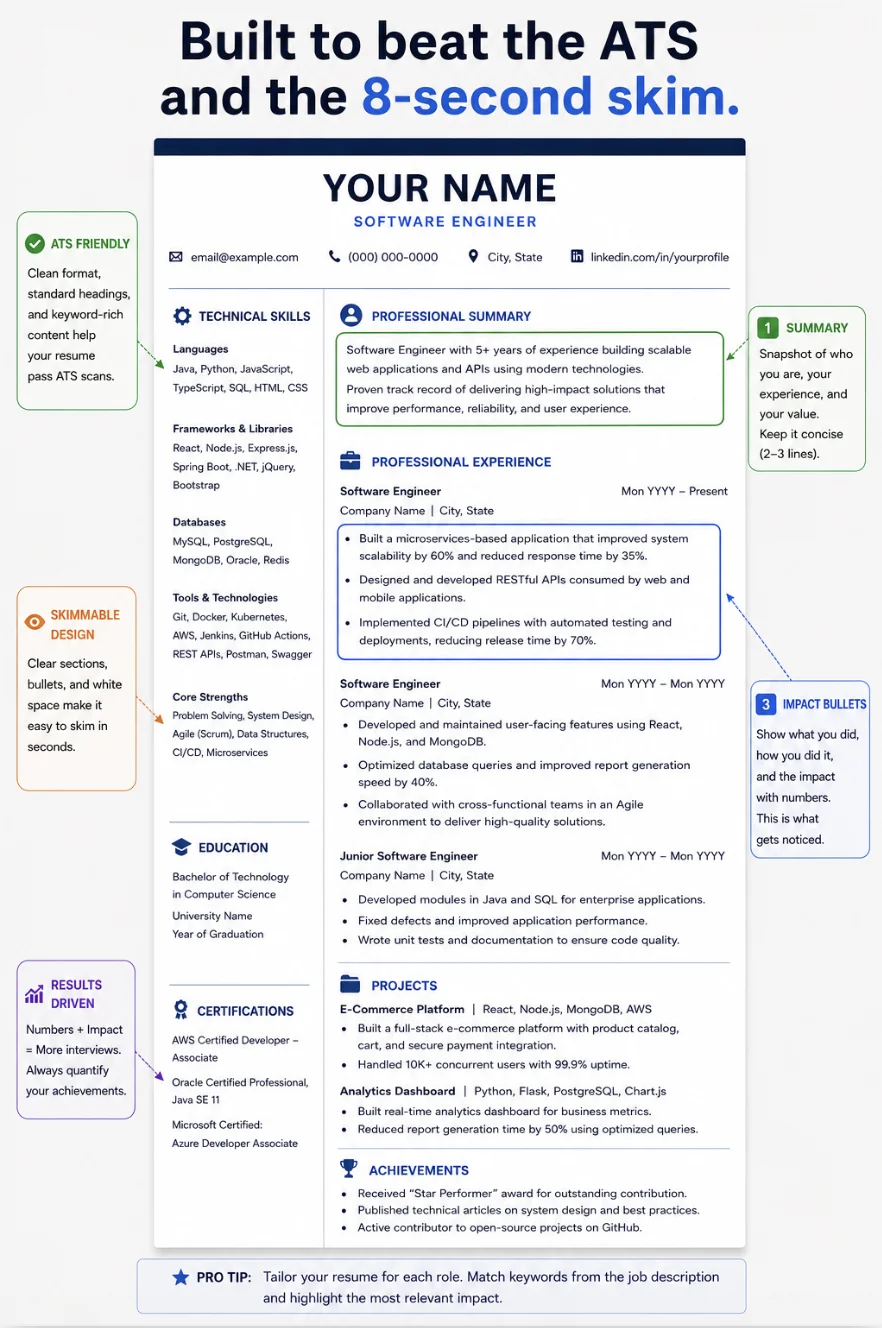
The Anatomy of a Strong Software Engineer Resume
A software developer's resume should be one page for most engineers (two pages only if you have 8+ years of relevant experience). Use this section order — it puts your strongest signal where the eye lands first.
1. Contact Information & Links
Keep it tight and put it at the very top:
- Full name
- Email and phone
- City, State (no full street address)
- LinkedIn URL (customized, not the default numeric one)
- GitHub / portfolio link — for engineers, this is non-negotiable
A live link to working code or a developer portfolio often does more than any bullet point. Make sure the repos you link are clean and have READMEs.
2. Professional Summary
Two or three lines, directly below your name. This is not an "objective" — nobody cares what you want. State what you are and what you deliver.
Backend engineer with 5 years building high-throughput Python and Go services. Scaled a payments API to 10M+ daily transactions and cut p99 latency by 40%. Strong in distributed systems, observability, and mentoring.
Notice it leads with role, years, stack, and a quantified win. That single block has to earn the rest of the read.
3. Technical Skills
Group your skills so both the ATS and a skimming human can scan them fast. Avoid a 40-item keyword dump — it signals padding.
| Category | Examples |
|---|---|
| Languages | Python, Go, TypeScript, SQL |
| Frameworks | Django, React, Node.js, FastAPI |
| Infrastructure | AWS, Docker, Kubernetes, Terraform |
| Data & Tools | PostgreSQL, Redis, Kafka, Git, CI/CD |
Mirror the wording in the job posting. If they ask for "CI/CD pipelines," don't only write "Jenkins" — include the exact phrase so the ATS matches it.
4. Work Experience
This is the heart of your software engineer resume, and where most candidates lose. List roles in reverse-chronological order with company, title, and dates. Then — this is the whole game — write impact bullets, not duty bullets.
5. Projects
Essential for junior engineers, career changers, and anyone whose day job is under NDA. Treat each project like a mini job: what you built, the stack, and the result (users, performance, or what you learned shipping it).
6. Education & Certifications
List your degree, school, and graduation year. Bootcamp grads: include it here. Relevant certifications (AWS, Kubernetes/CKA, Cloud Certifications earn their own line. Drop your GPA once you have 2+ years of experience.
How to Write Experience Bullets That Stand Out
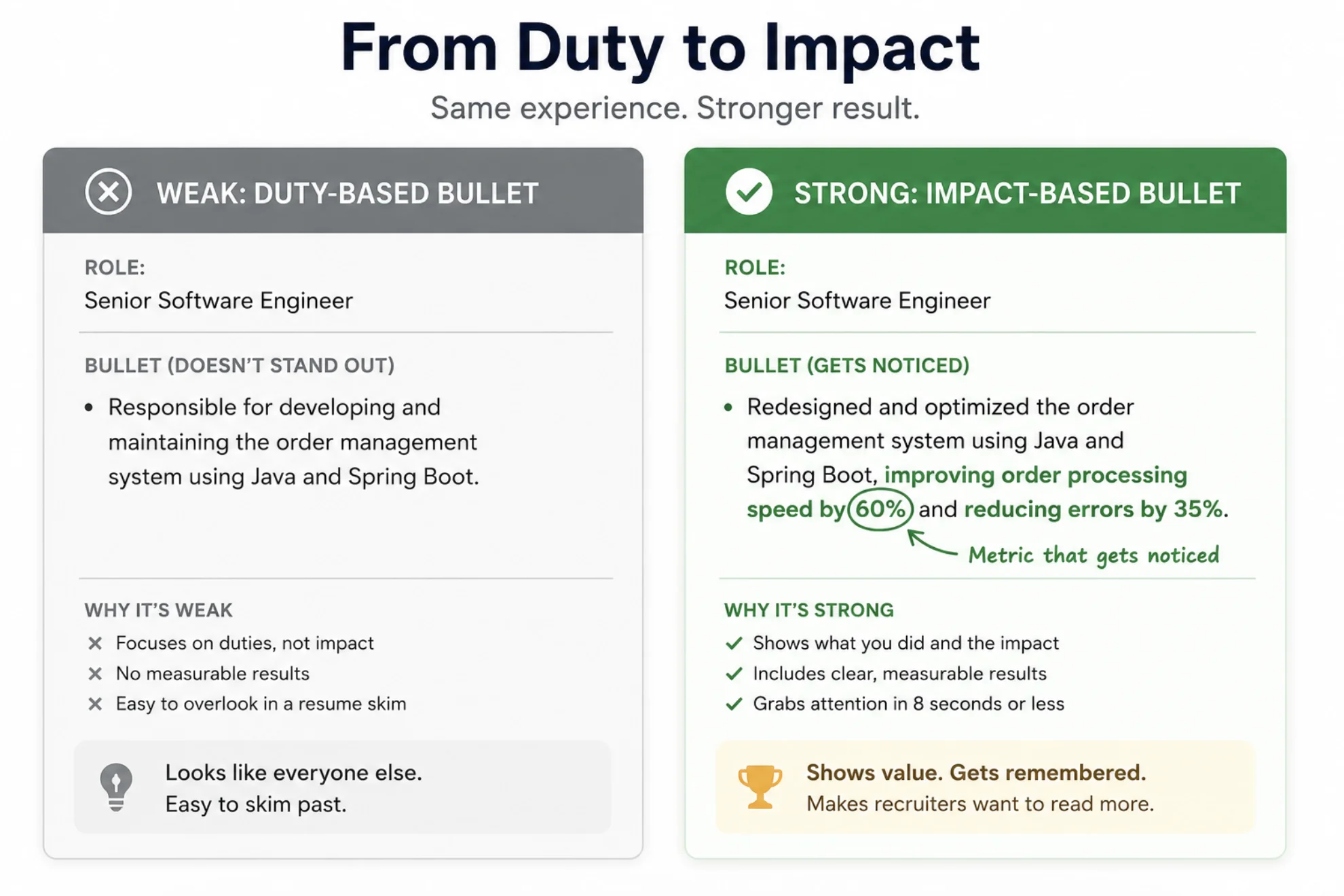
The single biggest upgrade you can make is rewriting your bullets around impact. Use the XYZ formula, popularized by Google's recruiting team:
Accomplished [X] as measured by [Y], by doing [Z].
In plain terms: what changed, how much, and how you did it. Start with a strong action verb, add a metric, and name the technical approach.
Before (duty-based — weak):
- Responsible for the payment service backend.- Worked on improving API performance.- Helped fix bugs in the checkout flow.
After (impact-based — strong):
- Cut payment API p99 latency 40% (820ms → 490ms) by adding Redis caching and rewriting N+1 queries, supporting 10M+ daily transactions.
- Reduced checkout error rate from 3.1% to 0.4% by instrumenting Sentry tracing and fixing three race conditions in the order pipeline.
- Led migration of 12 services to Kubernetes, cutting deploy time from 25 min to 4 min and eliminating weekend release windows.
Every strong bullet has three ingredients:
- Action verb — Built, Designed, Reduced, Scaled, Led, Automated, Shipped.
- A number — latency, percentages, users, dollars, time saved, team size.
- The technical "how" — the stack, pattern, or decision that produced the result.
No metrics yet? Estimate honestly. "Reduced manual reporting by ~6 hours/week" or "served ~50K monthly users" is far stronger than a vague claim and still truthful.
![A simple diagram breaking "Accomplished [X] as measured by [Y], by doing [Z]" into three labeled, color-coded blocks with a real example beneath.](https://vinish.dev/wp-content/uploads/2026/06/xyz-formula.webp)
Beating the ATS: Formatting and Keywords
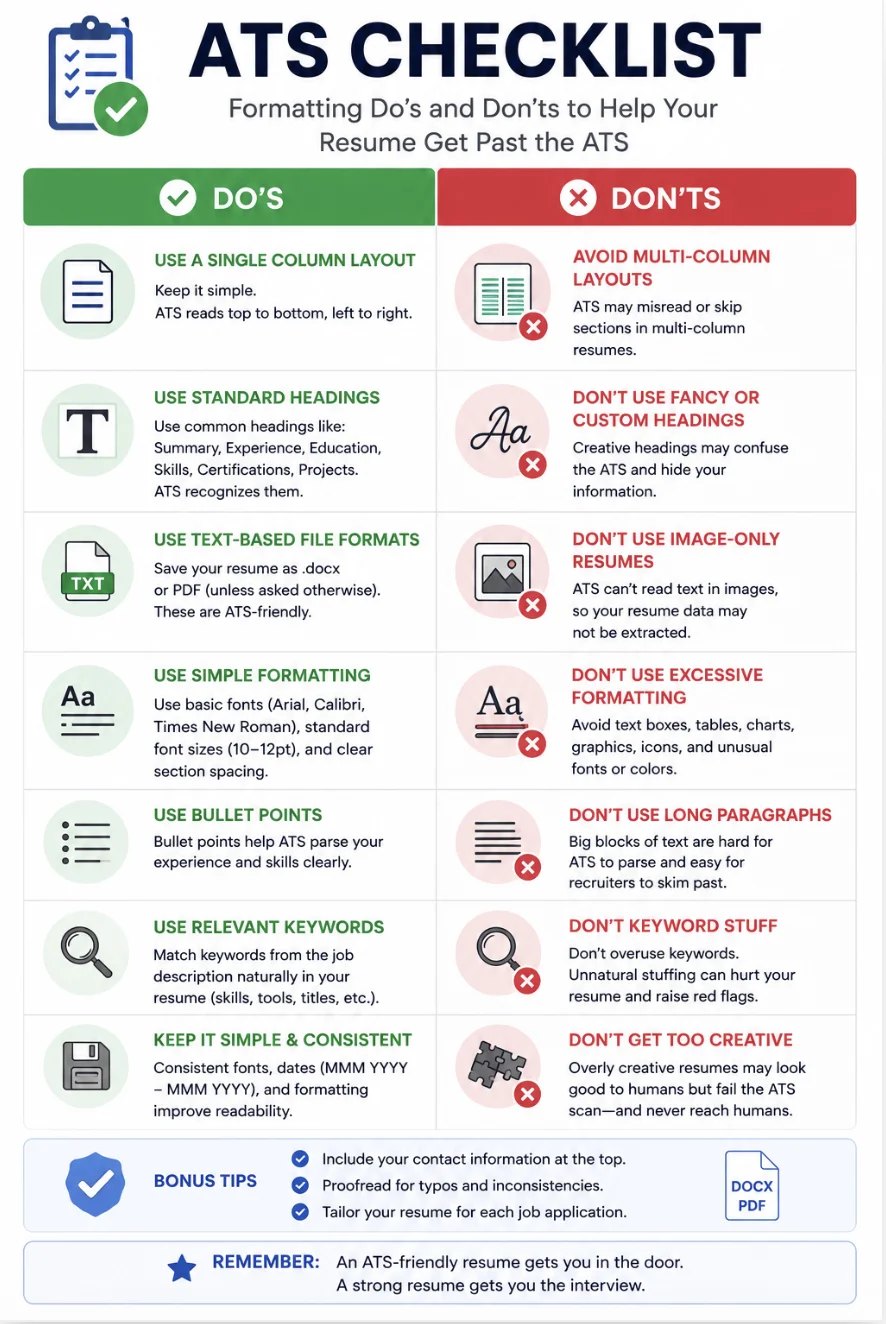
A perfectly written resume that the ATS can't parse is invisible. Follow these rules to stay machine-readable:
- Use a single-column layout. Multi-column and sidebar templates often scramble in parsing.
- Stick to standard section headings — "Work Experience," "Skills," "Education." Clever names like "Where I've Made Magic" confuse parsers.
- Submit a
.docxor text-based PDF, never a flattened image or design export. - Skip headers/footers, text boxes, and tables for critical info — many ATS engines drop them.
- Spell out then abbreviate key terms once: "Continuous Integration / Continuous Deployment (CI/CD)."
- Tailor keywords to each posting. Pull the exact skills and titles from the job description and reflect the true ones in your skills and experience.
A simple test: copy your resume file and paste it into a plain text editor. If the result is jumbled or missing sections, the ATS sees the same mess. Clean it up before applying.
Tailoring Your Resume for Each Role
Sending one generic resume to 50 jobs is the slowest path to an offer. Tailoring takes ten minutes and dramatically raises your response rate.
For each application:
- Read the job description twice and highlight the required skills, tools, and responsibilities.
- Match your top three bullets to that role's priorities — reorder so the most relevant experience sits highest.
- Align your skills section wording to the posting's exact terms (without lying).
- Adjust your summary's first line to echo the role title — applying for a "Backend Engineer" role? Lead with that.
You're not rewriting the whole document — you're re-pointing the spotlight at what this employer cares about.
Common Software Engineer Resume Mistakes to Avoid
These quietly sink strong candidates. Check your draft against every one:
- Listing duties, not results. "Maintained the backend" tells a recruiter nothing.
- Tech-stack soup. Twenty languages "known" reads as none mastered. List what you'd be comfortable in a technical interview on.
- No links to code. For engineers, a missing GitHub/portfolio is a red flag.
- Typos and inconsistent tense. Use past tense for past roles, present for current. Proofread — or have a tool and a friend do it.
- Going over one page too early. Junior and mid-level engineers rarely need two pages.
- Burying recent, relevant work under old internships or unrelated jobs.
- Generic, untailored applications. The single most common — and most fixable — mistake.
A Quick Resume Section Example
Here's how a single experience entry comes together using everything above:
Senior Software Engineer — Acme Payments Jan 2022 – Present
- Scaled core payments API to 10M+ daily transactions, cutting p99 latency 40% via Redis caching and query optimization (Python, PostgreSQL).
- Led 4-engineer migration to Kubernetes, reducing deploy time 25→4 min.
- Mentored 3 junior engineers; 2 promoted within 12 months.Stack: Python, Go, PostgreSQL, Redis, AWS, Kubernetes, Terraform
Clear scope, hard numbers, named stack, evidence of leadership — all skimmable in seconds.
FAQ
How long should a software engineer's resume be?
One page for most engineers, especially those with under eight years of experience. Go to two pages only if you have extensive, relevant experience that genuinely can't be condensed. Recruiters skim, so the density of impact matters more than length.
Do I need a portfolio or GitHub on my resume?
Yes. For software engineers, a link to working code, open-source contributions, or a personal project is one of the strongest signals you can give. Make sure linked repositories are clean, documented with a README, and represent your current skill level.
What should I put on a software engineer's resume with no experience?
Lead with projects, internships, and education. Build two or three portfolio projects that solve real problems, describe them with the same impact-and-stack format as jobs, and include relevant coursework, bootcamps, hackathons, and any open-source contributions. Quantify results wherever you can.
How do I get my resume past the ATS?
Use a single-column layout, standard section headings, and a text-based file (.docx or selectable-text PDF). Mirror the exact keywords and skills from the job description, avoid images and complex tables for critical content, and test parsing by pasting your resume into a plain text editor.
Should I customize my resume for every job?
Yes — at least lightly. Reorder bullets to match each role's priorities, align your skills wording to the posting, and tweak your summary's first line to echo the job title. Ten minutes of tailoring per application meaningfully increases your interview rate.
Conclusion
A strong software engineer resume isn't about listing everything you've done — it's about proving, fast, that you deliver results in the stack the employer needs. Lead with impact, back every claim with a number, keep the format ATS-clean, and tailor the spotlight to each role.
Rework your bullets with the XYZ formula, link to real code, cut the tech-stack soup, and customize before you hit apply. Do that, and your resume stops being a list of duties and starts being an argument for hiring you.
