
Creating clear test scenarios is a crucial part of modern software development. You want your entire team to understand exactly how a feature should behave. The Given-When-Then formula offers a highly effective way to achieve this clarity. It effortlessly bridges the communication gap between technical and non-technical team members.
This approach originates from Behavior-Driven Development (BDD). It helps you write acceptance criteria that are straightforward to read and execute. Using this structured approach ensures everyone is on the same page before coding even begins. Let us explore some practical Given-When-Then examples in software testing.
Understanding the Basics of Behavior-Driven Development
Behavior-Driven Development focuses on the actual behavior of your application. It shifts the conversation from writing tests to defining system behavior. This methodology encourages collaboration among developers, testers, and business stakeholders.
You use a specific format called Gherkin syntax to write these scenarios. Gherkin relies on plain English to describe exactly how the software should act. This approach makes your test scenarios accessible and understandable to anyone reading them.
Quality is not an act; it is a habit. Establishing clear behaviors early creates a habit of quality throughout your development cycle.
By focusing on behavior, you avoid getting bogged down in technical implementation details too early. You define what the system should do, rather than how it does it. This mindset keeps your agile testing process highly efficient and centered on user value.
How the Given-When-Then Formula Works
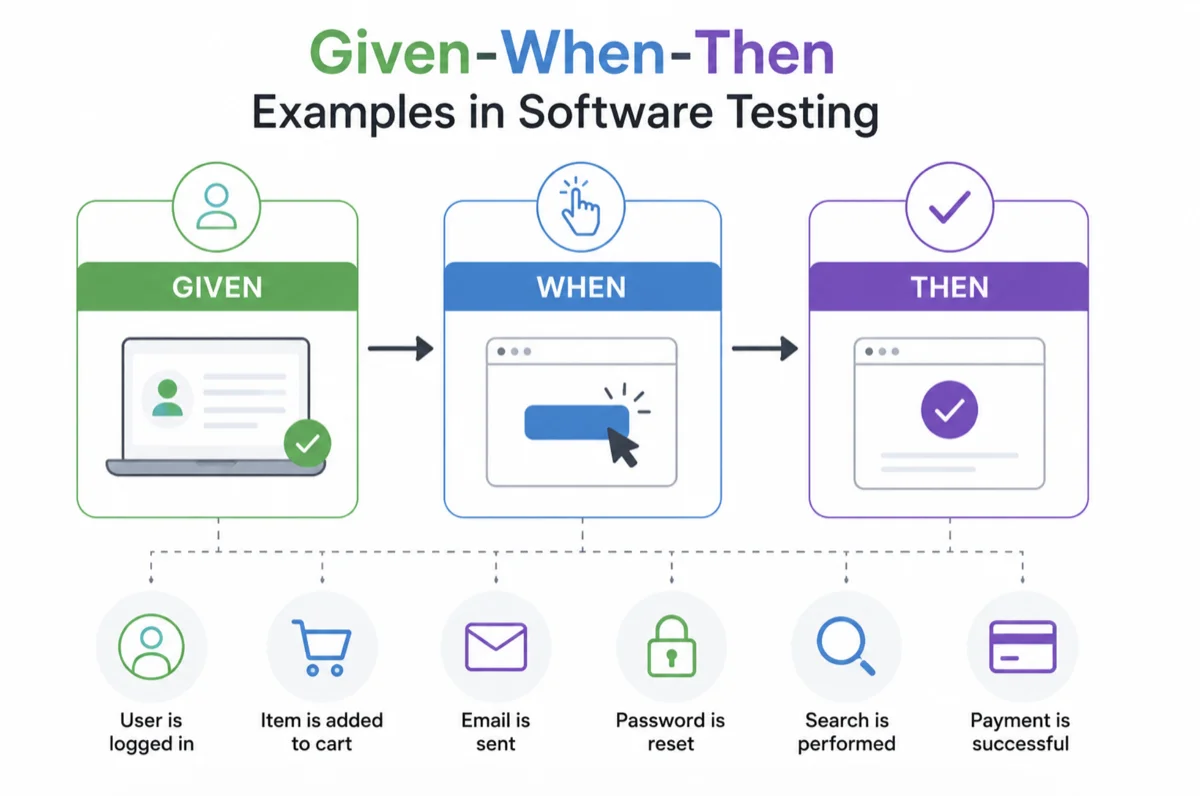
The framework breaks down user stories into three distinct phases. Each phase has a specific purpose in defining the test scenario. Following this structure keeps your automated tests organized and logical.
Given: Setting the Scene
The Given step establishes the initial state of your system. It explicitly sets up any preconditions required before the user takes an action. You can think of this phase as preparing the environment for your test.
When: The Action Takes Place
The When step describes the specific action the user performs. This is the core event that you are actively trying to test. It serves as the trigger that changes the current state of the application.
Then: The Expected Outcome
The Then step details the result you expect to observe after the action occurs. This is where you verify that the system behaved correctly. You ultimately check if the outcome strictly matches your acceptance criteria.
Practical Given-When-Then Examples in Software Testing
Observing the framework in action truly helps you understand its power. Below are a few real-world Given-When-Then examples in software testing. They cover common, everyday scenarios you might encounter during development.
Example 1: User Login Process
Logging into an application is a fundamental feature that requires rigorous testing. You need to ensure that valid users can securely access their accounts. Here is exactly how you can format this scenario.
Scenario: Successful user login
Given the user is on the login page
And the user has a valid account
When the user enters their username and password
And the user clicks the login button
Then the user is redirected to the dashboard
And a welcome message is displayed
Example 2: E-commerce Checkout
E-commerce platforms rely heavily on a smooth checkout process. You must verify that inventory checks and payment gateways function together. This scenario outlines a basic purchase flow.
Scenario: Purchasing an item in stock
Given the user has an item in their shopping cart
And the item is currently in stock
When the user proceeds to checkout
And the user enters valid payment details
Then the purchase is confirmed
And the item quantity is reduced in the inventory
Example 3: Password Reset Functionality
Users frequently forget their passwords and need a reliable way to recover them. Testing this flow ensures users do not get locked out permanently. This example shows the initial request for a reset link.
Scenario: Requesting a password reset link
Given the user is on the forgot password page
When the user enters a registered email address
And the user submits the request
Then a password reset link is sent to that email
And the system displays a success confirmation
Benefits of Using Gherkin Syntax for Test Scenarios
Adopting this structured language brings numerous advantages to your overall software quality efforts. It standardizes how your entire team communicates and discusses features. Here is a brief breakdown of the primary benefits.
| Benefit | Description |
|---|---|
| Improved Collaboration | Business analysts and developers share a common language for requirements. |
| Living Documentation | Your test scenarios serve as up-to-date documentation for your application. |
| Easier Automation | Tools like Cucumber can easily parse and execute these structured sentences. |
| Fewer Misunderstandings | Clear acceptance criteria reduce the chances of building the wrong feature. |
Integrating Given-When-Then into Agile Testing
You can seamlessly weave this practice into your existing agile workflows. It fits naturally into sprint planning and refinement sessions. Consider these steps for successful integration.
- Write scenarios during backlog refinement to clarify user stories early.
- Use them as the baseline for your automated testing framework.
- Review the scenarios with product owners to confirm expected behavior.
- Treat failing tests as a signal to update either the code or the criteria itself.
Simplicity is the ultimate sophistication. Utilizing a straightforward formula significantly reduces the complexity of software testing.
When everyone contributes to writing these scenarios, the entire team takes ownership of quality. You stop relying solely on the QA department to catch defects late in the cycle. Quality becomes built-in from the very beginning of the project.
How Gherkin Syntax Enhances Communication
Effective communication is the backbone of any successful software project. Often, business stakeholders speak a completely different language from software engineers. The Given-When-Then structure acts as a universal translator between these diverse groups.
When product owners write user stories, they can include these scenarios directly into the requirements. Developers read them and instantly know exactly what they need to build. Testers then use the exact same scenarios to verify the final product.
This alignment drastically reduces the endless back-and-forth usually required to clarify requirements. You spend much less time in meetings and more time actually building the software. The end result is a faster and highly predictable development cycle.
Common Mistakes When Writing Test Scenarios
Even with a simple framework, you can still fall into a few common traps. Writing highly effective scenarios requires practice and careful attention to detail. Knowing these common pitfalls helps you write significantly better tests.
Adding Too Much Technical Detail
Your scenarios should primarily describe behavior, not the underlying code. You should completely avoid mentioning database tables or specific UI elements like CSS classes. Keep the language entirely focused on the user experience and core business logic.
If you include too many technical details, your scenarios become extremely fragile. Any small change to the user interface will immediately break your tests. This fragility creates frustrating and unnecessary maintenance work for your team.
Writing Overly Complex Scenarios
A single scenario should only test one specific behavior or rule. You might be tempted to chain multiple actions together to save time. This makes the test hard to read and even harder to debug if it fails.
Keep your Given-When-Then blocks concise and focused. If a scenario feels too long, you should probably split it into multiple smaller scenarios. This improves clarity and makes your automated tests much more reliable.
Forgetting the Negative Test Cases
Teams often focus entirely on the happy path where everything goes right. You must also consider what happens when things go wrong. Testing error states is just as important as testing successful actions.
Scenario: Invalid user login attempt
Given the user is on the login page
When the user enters an incorrect password
And the user clicks the login button
Then an error message is displayed
And the user remains on the login page
Writing negative scenarios ensures your application handles errors gracefully. It improves the overall user experience and security of your software. Always ask yourself what could fail when defining your acceptance criteria.
Scaling Your Automated Testing Efforts
As your project grows, your suite of scenarios will expand rapidly. You need a strategy to manage this growing library of tests. Grouping them by feature or module keeps things organized.
Many teams use tags to categorize their scenarios. This allows you to run specific subsets of tests, like only running the regression suite. Proper organization is key to maintaining a fast and efficient testing pipeline.
Conclusion
Mastering Given-When-Then examples in software testing transforms how your team approaches software quality. You create a shared understanding that eliminates confusion and speeds up development. By adopting Behavior-Driven Development principles, you ensure that every feature delivers exactly what the user needs. Start writing your test scenarios with this simple formula and watch your testing process become significantly more effective.
