
If you want to build high-quality software, you need a solid automated testing framework. The test pyramid ISTQB concept provides a clear roadmap for your software quality assurance efforts. It shows you exactly where to focus your time and resources for maximum impact.
The International Software Testing Qualifications Board defines global standards for testing professionals. When you align their definitions with the test pyramid, you get a highly effective test automation strategy. This alignment helps you avoid common pitfalls in agile development environments.
As Mike Cohn once said, The test pyramid is a metaphor that tells us to group software tests into buckets of different granularity. When you follow the ISTQB guidelines, you apply this metaphor to create a robust and efficient test execution cycle.
Understanding the Test Pyramid ISTQB Model
The test pyramid ISTQB model is a visual guide that helps you balance your software testing levels. It encourages you to write many small, fast tests and fewer large, slow tests. This approach keeps your continuous integration pipelines fast and your maintenance costs low.
At its core, the pyramid reminds you that not all tests are created equal. You should push testing as low down the stack as possible to enable a shift-left testing culture. This catches software defects early when they are cheapest and easiest to fix.
Here is a visual representation of the ISTQB test pyramid.
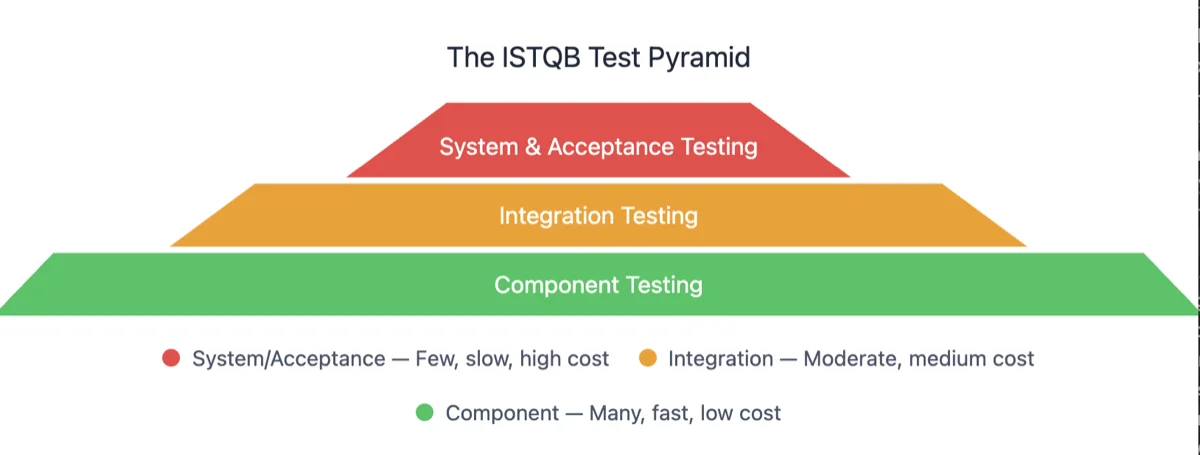
Exploring the Levels of the Test Pyramid ISTQB
To use the test pyramid effectively, you must fully understand its different layers. Each level serves a unique purpose in your overall software quality assurance strategy. Let us look at how the ISTQB syllabus defines these crucial levels.
Component Testing at the Base
Component testing forms the wide, sturdy base of your test pyramid ISTQB structure. You might also know this phase as unit testing in common industry language. These tests verify the smallest testable parts of your application in complete isolation.
You should have a massive number of component tests in your automated testing framework. They run incredibly fast and give you immediate feedback on your recent code changes. When a component test fails, you know exactly which function or class contains the defect.
Here is a simple example of what a component test looks like in a typical project.
// Component test example
function calculateTotal(price, tax) {
  return price + tax;
}

test('calculateTotal adds price and tax', () => {
  expect(calculateTotal(100, 20)).toBe(120);
});
Because they do not rely on databases or external services, these tests never suffer from network timeouts. You can run thousands of them in just a few seconds.
Integration Testing in the Middle
Moving up the pyramid, you reach the integration testing layer. This level assesses how different software components interact in a realistic scenario. It ensures that the individual pieces of your software communicate properly.
According to ISTQB principles, you can categorize this into component integration testing and system integration testing. Component integration verifies the links between internal modules, while system integration verifies the links to external systems. You should write a moderate number of these tests to cover your API endpoints and database connections.
System and Acceptance Testing at the Top
At the very narrow top of the test pyramid ISTQB model, you find system and acceptance testing. System testing evaluates the complete, integrated software product against its specified requirements. Acceptance testing validates whether the final system actually meets user needs and business processes.
These high-level end-to-end tests are slow, brittle, and notoriously expensive to maintain. Therefore, you should keep their numbers relatively low in your regression testing suite. They act as a final safety net rather than your primary method for finding software defects.
Why the Test Pyramid ISTQB Approach Works
Adopting the test pyramid ISTQB strategy brings massive benefits to your entire software development lifecycle. It completely transforms how you approach software quality assurance daily. Here are some key advantages you will experience right away.
- Faster execution times for your continuous integration builds.
- Easier debugging because lower-level tests pinpoint the exact location of a failure.
- Reduced financial costs since finding defects early is significantly cheaper than fixing them in production.
- Higher reliability as your test suite becomes less prone to false failures and flaky behavior.
- Better system architecture because writing testable components forces you to write cleaner, modular code.
As Martin Fowler notes, Tests that run end-to-end through the UI are brittle, expensive to write, and time-consuming to run. The pyramid helps you avoid that exact trap while still ensuring high quality.
The Ice Cream Cone Anti-Pattern
Many teams accidentally build the exact opposite of the test pyramid ISTQB model. This dangerous setup is commonly called the ice cream cone anti-pattern in software engineering. You have an ice cream cone when your test execution suite is top-heavy with slow UI tests and lacks a solid base of component tests.
This anti-pattern leads to severely delayed feedback and incredibly high maintenance overhead for your engineers. Your automated testing framework becomes a bottleneck rather than an enabler of speed and confidence.
Here is a table comparing the two contrasting testing approaches.
| Attribute | Test Pyramid ISTQB | Ice Cream Cone Anti-Pattern |
|---|---|---|
| Component Tests | Massive foundation | Very few or missing |
| Integration Tests | Moderate coverage | Some coverage |
| System/Acceptance Tests | Minimal and targeted | The majority of the suite |
| Execution Speed | Extremely fast | Painfully slow |
| Maintenance Cost | Low overhead | Unsustainably high |
You must avoid the ice cream cone at all costs if you want a healthy, agile development cycle. It provides a false sense of security while continuously draining your team's valuable energy.

Practical Tips for Your Test Pyramid ISTQB Journey
Building a proper test pyramid takes considerable time, patience, and team discipline. You cannot magically fix a broken automated testing framework overnight. However, you can start making impactful improvements today by changing your team habits.
First, strictly mandate component tests for all new feature code you write. Second, push existing high-level tests down to the integration or component level whenever it is technically possible. Finally, reserve your slow system tests exclusively for your most critical end-to-end business workflows.
You should also review your regression testing suite regularly to identify tests that frequently fail for no reason. Delete or rewrite these flaky tests so they stop eroding trust in your test automation strategy. Keeping your suite healthy requires constant pruning.
Conclusion
The test pyramid ISTQB concept is an essential tool for any modern software development team. It guides you toward a perfectly balanced, highly efficient, and cost-effective testing strategy. By focusing your primary efforts on the base of the pyramid, you build a remarkably sturdy foundation for software quality.
You should start evaluating your current automated testing framework today. Look closely for areas where you can add more component tests and reduce your heavy reliance on slow system tests. Your future self, your team members, and your end users will all thank you for the effort.
