
You're about to apply for a job, and the posting asks for a "CV" but everything you've ever written is a resume. Or you're applying abroad, and suddenly the rules feel different. The resume vs CV confusion trips up job seekers constantly, and getting it wrong can mean sending a two-page marketing document where a ten-page academic record was expected, or vice versa.
The short version: a resume and a CV are not the same thing — except when they are. The right answer depends almost entirely on where you are in the world and what you're applying for. This guide clears it up completely: the real differences, what each document contains, and exactly which one to send.
The Quick Answer
If you only read one section, read this.
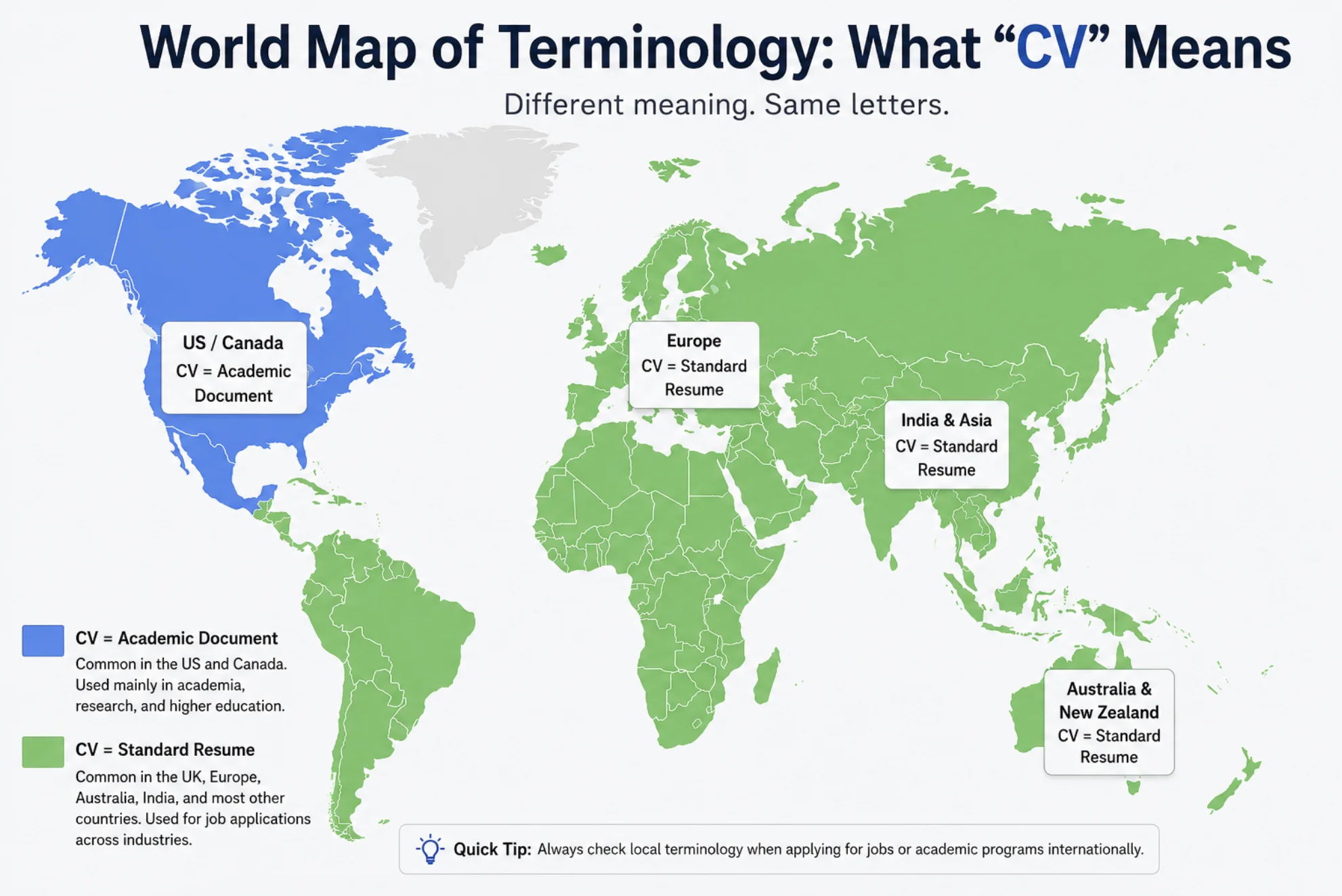
Key takeaway: In the US and Canada, a resume is a short (1–2 page), tailored summary of your relevant experience, while a CV is a long, comprehensive academic document used for research, teaching, and fellowships. In the UK, Ireland, most of Europe, Australia, New Zealand, and much of Asia and Africa, "CV" is simply the standard word for what Americans call a resume.
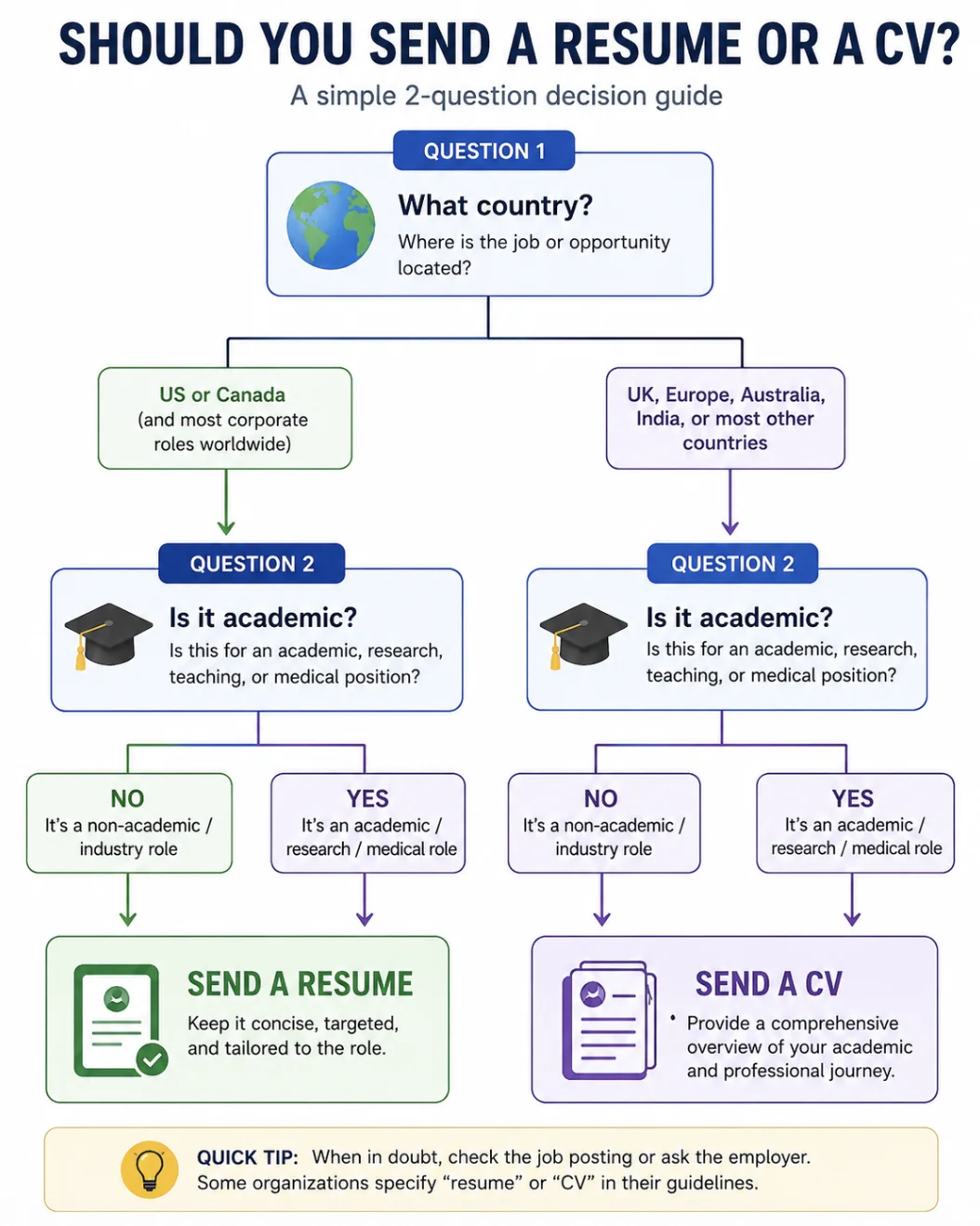
So before anything else, ask two questions: What country is this job in? and Is this an academic or research role? Those two answers tell you which document to send.
Resume vs CV at a Glance
| Feature | Resume | CV (Curriculum Vitae) |
|---|---|---|
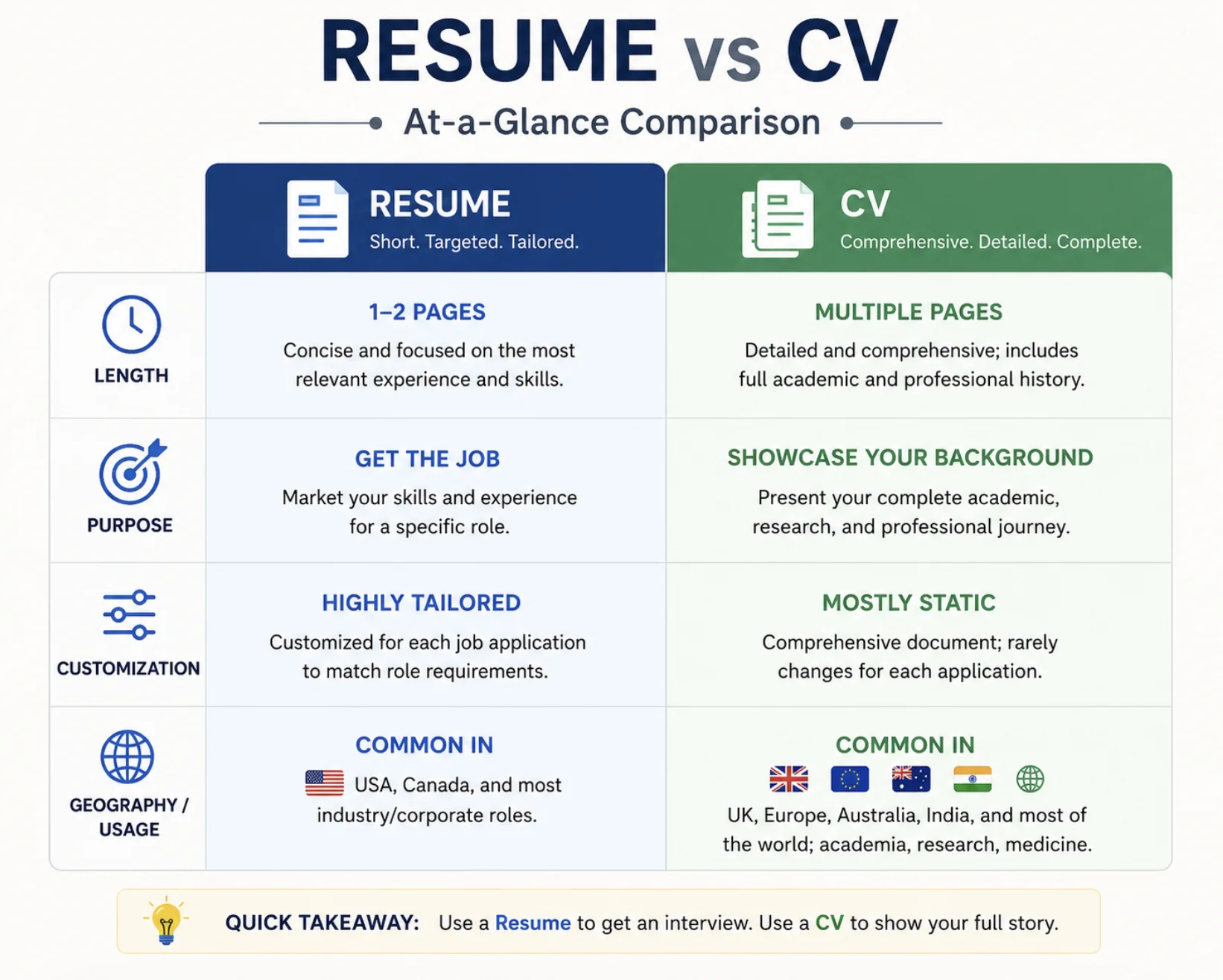
| Length | 1–2 pages | 2+ pages, often 3–10+ (academic) |
| Purpose | Win a specific job, fast | Document your full professional/academic life |
| Content | Tailored, relevant highlights only | Comprehensive: every role, publication, grant, talk |
| Customization | Rewritten for each application | Mostly static; grows over time |
| Common in | US, Canada (industry jobs) | UK, Europe, academia, research, medicine worldwide |
| Photo/personal details | No (US/Canada norms + anti-bias laws) | Sometimes, in parts of Europe and Asia |
| Tone | Marketing pitch | Complete record |
What Is a Resume?
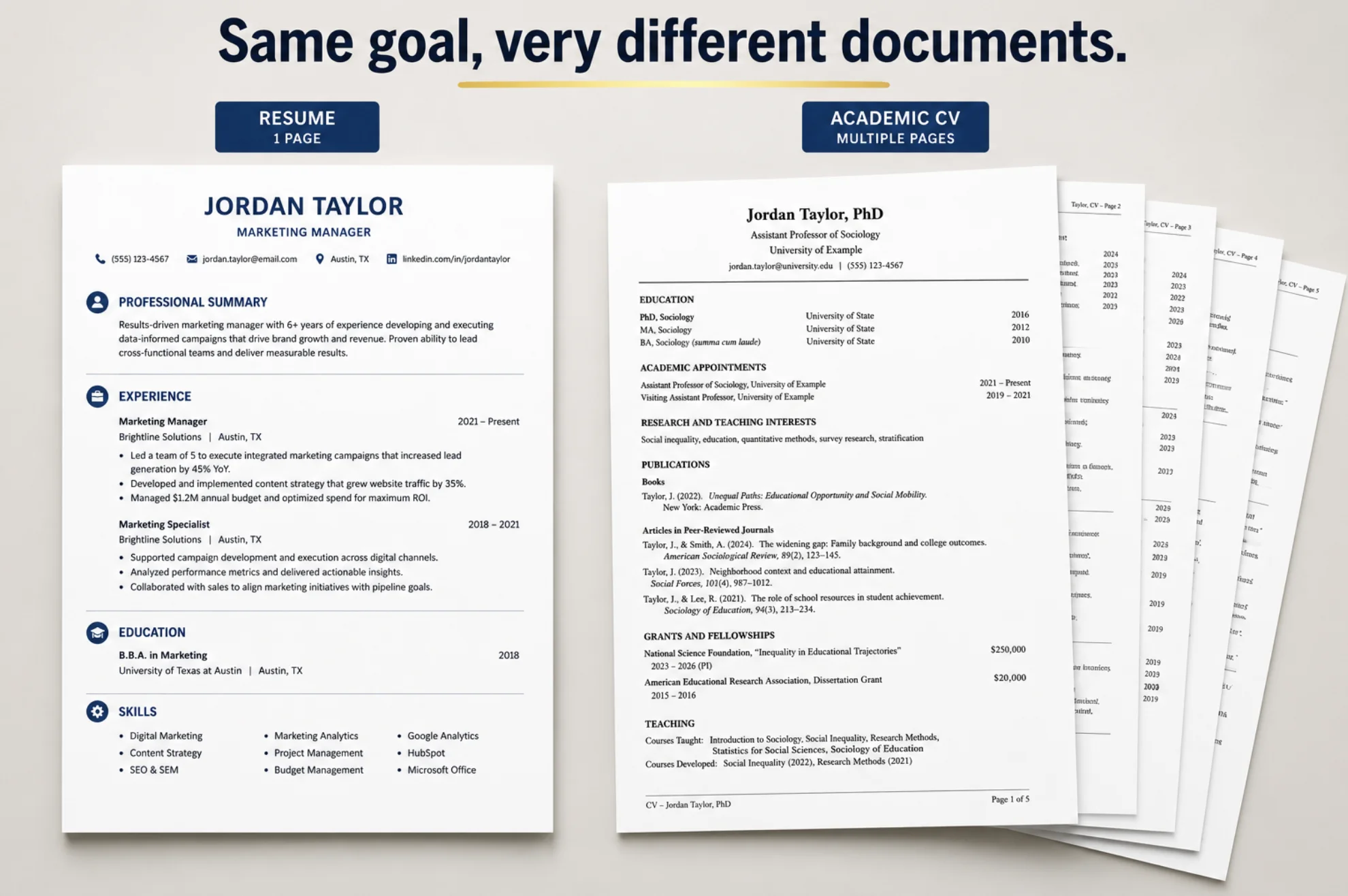
A resume (from the French résumé, "summary") is a concise, one-to-two-page document that summarizes the skills and experience most relevant to a specific job. Its entire purpose is persuasion: convince a recruiter and an applicant tracking system, in seconds, that you can do this role.
A resume is curated, not complete. You deliberately leave things out. The barista job from a decade ago, the skills unrelated to the posting, the projects that don't strengthen your case — all cut. What remains is the tightest possible argument for this hire.
Typical resume sections:
- Contact information & links (LinkedIn, portfolio, GitHub)
- Professional summary — two or three lines on who you are and what you deliver
- Work experience — impact bullets with metrics, not duty lists
- Skills — grouped and matched to the job posting
- Education — degree, school, year
- Projects/certifications — when relevant
The defining trait of a great resume is tailoring. You rewrite it — or at least re-point it — for every application. If you're writing one for a technical role, our software engineer resume guide breaks down the bullet formulas and ATS rules section by section.
What Is a CV?
CV stands for curriculum vitae — Latin for "course of life." And here's where geography splits the meaning in two.
The academic CV (US & Canada)
In North America, a CV is a long, detailed, comprehensive document used almost exclusively in academia, research, science, and medicine — for PhD applications, faculty positions, grants, fellowships, and postdocs. It is the opposite of curated: the goal is completeness, not brevity.
An academic CV grows throughout your career and can run anywhere from two pages for a new graduate to fifteen-plus for a senior professor. It typically includes:
- Education and degrees (with thesis/dissertation titles)
- Research experience and interests
- Publications (the centerpiece — papers, books, chapters)
- Conference presentations and invited talks
- Teaching experience and courses taught
- Grants, funding, and awards
- Professional memberships and service (peer review, committees)
- References
Unlike a resume, you generally don't trim an academic CV to fit a single posting — it is the record. You might reorder or emphasize, but you rarely cut.
The "CV" that just means resume (everywhere else)
In the UK, Ireland, most of continental Europe, Australia, New Zealand, India, South Africa, and much of the Middle East and Asia, the word "CV" is simply what people call a job-application document — the same 1–2 page, tailored summary that Americans call a resume.
So when a job posting in London or Berlin or Sydney asks for your "CV," they almost always mean: send me a concise, well-targeted resume. They are not asking for a ten-page list of publications.
Key takeaway: "CV" is two completely different documents depending on context. In the US/Canada it means a long academic record. In most of the rest of the world it means a normal, short job-application resume.
The Core Differences, Explained
Beyond the table above, four differences actually matter when you sit down to write.
1. Length and detail
A resume is ruthlessly short because recruiters skim. An academic CV is long because completeness is the point — a hiring committee wants to see your full publication and funding record. Sending a 6-page document to a startup, or a 1-page summary to a tenure committee, both signal that you misread the room.
2. Purpose
A resume is a marketing document — it sells a version of you optimized for one role. An academic CV is an archival document — it records everything you've done so reviewers can evaluate the whole. One persuades; the other proves.
3. Customization
You tailor a resume for every job: reorder bullets, mirror the posting's keywords, tweak the summary. An academic CV stays largely the same across applications; you update it as you publish or present, not per submission.
4. Geography and conventions
This is the one most people miss. Where the job is determines not only which document but also what goes in it:
- US / Canada: No photo, no date of birth, no marital status, no nationality. Anti-discrimination norms (and employer caution around bias) mean these details are left off resumes entirely.
- Parts of Europe and Asia: A photo, date of birth, or nationality is sometimes expected or at least common — though this is fading, and many Europass-style templates now de-emphasize photos.
When in doubt, research the norms of the specific country and follow them.
Which One Should You Send?
Use this decision shortcut:
| Your situation | Send a… |
|---|---|
| Industry/tech/business job in the US or Canada | Resume |
| Academic, research, scientific, or medical role (anywhere) | Academic CV |
| Any job in the UK, Europe, Australia, NZ, India, etc. | A "CV" — i.e., a resume, by their definition |
| PhD, postdoc, fellowship, or grant application | Academic CV |
| The posting explicitly names one | Send exactly what they ask for |
The golden rule: read the job posting and honor the local convention. If it says CV and the role is in Europe, send your normal tailored resume. If it says CV and the role is a US professorship, send the long academic version.
How to Convert Between the Two
Most of the time, you already have one and need the other.
Resume → Academic CV: Expand rather than persuade. Add full sections for publications, presentations, teaching, grants, and service. Stop cutting for length — include everything relevant and let it grow. Lead with education and research instead of a punchy summary.
Academic CV → Resume: Compress hard. Pick the 1–2 pages of most relevant, impressive, recent material for the target job. Translate academic accomplishments into industry impact ("published 4 papers" → "led research that produced 4 peer-reviewed publications and a patent"). Add a results-focused summary and quantified bullets. Cut anything that doesn't sell this role.
If you're moving from academia into industry tech, a strong developer portfolio and a tightly written programmer CV/resume will do far more than a publication list.
Common Mistakes to Avoid
- Sending the wrong length for the region. A 5-page "CV" to a US startup, or a 1-page "resume" to a tenure committee, reads as a misfire.
- Assuming "CV" always means academic. Outside North America it usually just means resume. Don't send your publication list to a marketing job in Manchester.
- Never tailoring. Even a CV-by-another-name (a UK resume) should be customized per role.
- Including a photo or personal details where they're discouraged. Follow US/Canada norms for North American applications: skip the photo, DOB, and marital status.
- Padding a resume to look like a CV. Length is not strength. For a resume, density of impact beats volume.
- Using one generic document for every country and role. The single most common — and most fixable — mistake.
FAQ
Is a CV the same as a resume?
It depends on where you are. In the US and Canada, a CV is a long, detailed academic document and a resume is a short, tailored job summary — they are different. In the UK, Europe, Australia, and much of the world, "CV" is simply the standard term for what Americans call a resume, so they mean the same thing.
Which is longer, a CV or a resume?
A resume is short — one to two pages. An academic CV is long and comprehensive, often three to ten-plus pages, because it lists every publication, presentation, grant, and role. Outside North America, a "CV" is the same length as a resume (1–2 pages).
When should I use a CV instead of a resume?
Use an academic CV for research, teaching, scientific, or medical positions, and for PhD, postdoc, fellowship, and grant applications. Use a resume for most industry and business jobs in the US and Canada. If applying outside North America, a "CV" usually just means a resume.
Does a CV include a photo?
In the US and Canada, no — photos and personal details like date of birth are left off to avoid bias. In parts of Europe and Asia a photo is sometimes included or expected, though this practice is declining. Always follow the norms of the country you're applying to.
How do I turn my resume into a CV?
Expand it. Add full sections for publications, conference presentations, teaching, grants, awards, and professional service, and stop trimming for length. Lead with your education and research rather than a marketing summary, and let the document grow to reflect your complete record.
Conclusion
The resume vs CV question has a clean answer once you anchor on two things: geography and purpose. In the US and Canada, a resume sells a tailored version of you for one job, while a CV is a long academic record. Almost everywhere else, "CV" is just the word for a resume.
So before you apply: check the country, check whether the role is academic, and send exactly what the posting asks for in the form that region expects. Tailor the short document, complete the long one, and never let a vocabulary mismatch cost you the interview.
Ready to sharpen your application? Explore our guides to building a programmer CV that gets noticed and writing a software engineer resume for templates and examples you can use today.
