
In Retrieval-Augmented Generation (RAG), the quality of your answers is only as good as the quality of your retrieved data. Before you can store data in a vector database, you must split it into smaller pieces called chunks.
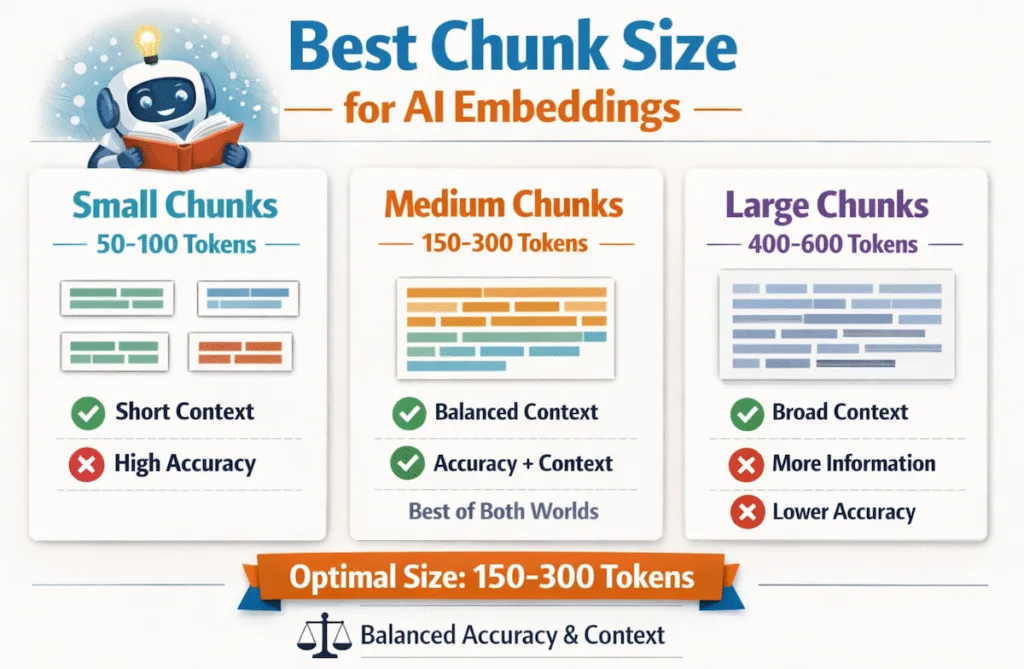
Choosing the right chunk size is a classic "Goldilocks" problem. If the chunk is too small, it lacks the context to be meaningful; if it is too large, it contains too much noise, confusing the embedding model.
In this guide, we will explore the science behind chunking, compare fixed vs. semantic strategies, and reveal the optimal token lengths for models like OpenAI and Cohere.
What is Chunking in RAG?
Chunking is the process of breaking down large documents—like PDFs, HTML files, or codebases—into smaller, manageable segments. These segments are then converted into vector embeddings and stored in a database like Pinecone or Milvus.
When a user asks a question, the system searches for the chunks that are semantically closest to the query. The "Best Chunk Size" is simply the length of text (measured in tokens) that maximizes the probability of retrieving the correct answer.
Why Chunk Size Matters for Retrieval Accuracy
The length of your chunk directly impacts the "semantic density" of the vector.
The Risk of Small Chunks (< 128 Tokens)
Small chunks are precise but lack context. If a chunk only contains the sentence "He pressed the button," the embedding model doesn't know who pressed it or what the button did.
During retrieval, this chunk might match a query about "buttons," but it provides zero value to the LLM trying to answer "How do I reset the server?".
The Risk of Large Chunks (> 1024 Tokens)
Large chunks capture plenty of context but suffer from "signal dilution." If a 2,000-token chunk contains three different topics (e.g., Pricing, API Docs, and Legal Terms), the vector becomes a muddy average of all three.
A specific query about "Pricing" might fail to retrieve this chunk because the "Legal" and "API" content pulls the vector embedding away from the target topic.
Optimal Token Lengths for Popular Models
There is no single magic number, but there are standard heuristics based on the embedding model architecture.
OpenAI (text-embedding-3-small/large)
For OpenAI's latest models, the sweet spot typically lies between 256 and 512 tokens. This length is usually sufficient to capture a complete thought or paragraph without introducing excessive noise.
Open Source (Sentence-Transformers)
Models like all-MiniLM-L6-v2 often have a hard limit of 256 or 384 tokens. If you exceed this, the model simply truncates the text, meaning the end of your chunk is ignored completely.
The "512 Token" Standard
For general prose (articles, documentation), starting with 512 tokens is the industry standard. It provides enough room for 3-4 paragraphs of text, ensuring that pronouns (he/it/they) usually resolve to a noun within the same chunk.
Chunking Strategies: Fixed vs. Semantic
How you split the text is just as important as where you split it.
1. Fixed-Size Chunking
This is the simplest method. You split text purely by token count (e.g., every 500 tokens).
- Pros: Computationally cheap and easy to implement.
- Cons: It often cuts sentences in half, severing the semantic meaning at the boundary.
2. Recursive Character Text Splitter
This is the standard for LangChain users. It tries to split by paragraphs first (\n\n), then by sentences (.), and finally by words.
- Pros: Respects the logical structure of the document.
- Cons: Still arbitrary; it doesn't "understand" when a topic shifts.
3. Semantic Chunking (The Agentic Approach)
This advanced method uses an embedding model to scan the text sentence by sentence. It calculates the semantic similarity between sentence A and sentence B.
If the similarity is high, they belong in the same chunk. If the similarity drops (indicating a topic change), it starts a new chunk. This creates variable-length chunks that map perfectly to distinct ideas.
The Role of Chunk Overlap explained
Even with intelligent splitting, you risk cutting a critical connection between two sentences. To fix this, we use Chunk Overlap.
Overlap ensures that the end of "Chunk 1" is repeated as the start of "Chunk 2."
- Recommendation: A 10% to 20% overlap is standard (e.g., 50 tokens overlap for a 512-token chunk).
- Benefit: It acts as a "contextual bridge," ensuring that no information is lost in the seam between chunks.
Advanced Architecture: Parent Document Retrieval
If you are struggling to balance specific details with broad context, consider Parent Document Retrieval.
In this architecture, you create two layers of chunks:
- Child Chunks (Small): 128 tokens. Highly specific and optimized for vector search.
- Parent Chunks (Large): 1024+ tokens. The original document context.
The system searches using the Child Chunks (for precision) but feeds the Parent Chunk to the LLM (for context). This gives you the best of both worlds: accurate search and rich generation context.
Vector Database Performance Tuning
Chunk size affects your infrastructure costs and latency.
- Storage Cost: More small chunks mean more vectors to store. A 10MB document split into 100-token chunks yields 10x more vectors than 1000-token chunks.
- Search Latency: Vector search (HNSW or IVF algorithms) slows down as the number of vectors increases. Using larger chunks reduces the total vector count, improving query speed.
Finding Your "Goldilocks" Zone: A Testing Framework
Do not guess; test. Use a framework like Ragas or TruLens to evaluate different chunk sizes.
- Dataset: Create 20 questions based on your data.
- Experiment: Index your data at 128, 256, 512, and 1024 token sizes.
- Metric: Measure "Hit Rate" (is the right chunk in the top 3?) and "MRR" (Mean Reciprocal Rank).
You will likely find a bell curve where performance peaks. For most text-heavy applications, that peak is around 512 tokens.
Conclusion: Start Small, Then Optimize
There is no universal chunk size, but there is a universal starting point. Begin with 512 tokens and 15% overlap using a Recursive Character Splitter.
From there, monitor your RAG system's answers. If the AI misses details, reduce the size. If the AI lacks context, increase the size or switch to Parent Document Retrieval.
Frequently Asked Questions (FAQ)
- Does chunk size affect API cost? Indirectly. Smaller chunks mean you might retrieve more of them to get context, increasing the input token count for the LLM call.
- Is chunking different for code? Yes. Code relies on scope (functions, classes). You should use language-specific splitters (like Python or JS splitters) rather than generic text splitters.
