
Database administration has traditionally been a reactive discipline. A pager goes off at 3 AM because of a deadlock, and a groggy human logs in to kill a session.
AI Agents are changing this dynamic by shifting from "alerting" to "acting." Unlike simple automation scripts that follow rigid if-then logic, AI agents use Large Language Models (LLMs) to reason through complex, novel problems.
In this guide, we will deconstruct the architecture of a self-healing database agent and provide three concrete workflows you can implement today.
The Architecture of a Self-Healing Agent
A robust AI agent is not just a chatbot connected to a database. It is a system composed of three distinct layers: Perception (Sense), Cognition (Think), and Action (Do).
1. The Perception Layer (The Eyes)
This layer acts as the agent's nervous system. It continuously ingests telemetry data from observability tools like Prometheus, Datadog, or AWS CloudWatch.
It doesn't just look for "CPU High"; it ingests query logs, EXPLAIN plans, and error traces. This raw data is formatted into a textual context that the LLM can understand.
2. The Cognition Layer (The Brain)
This is where the LLM (e.g., GPT-4o, Claude 3.5 Sonnet) resides. It uses a ReAct (Reason + Act) loop to process the incoming signals.
The agent has access to a Vector Database (Long-Term Memory) containing the company's runbooks, schema definitions, and post-mortem history. It retrieves relevant context to decide if a spike in latency is a known issue or a new anomaly.
3. The Action Layer (The Hands)
Once a decision is made, the agent executes it through a secure Tool Interface. This layer connects to the database via SQL drivers (e.g., psycopg2 for Postgres) or API calls.
Crucially, this layer includes a Guardrail Mechanism. Before executing a destructive command (like DROP INDEX), it checks against safety policies or requests human approval for high-risk actions.
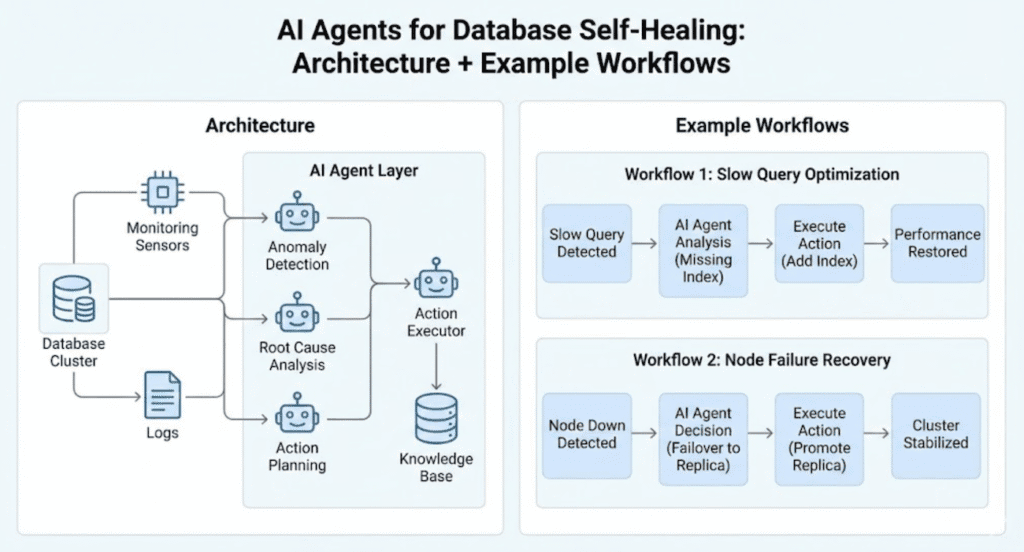
Workflow 1: The "Slow Query" Hunter
Performance degradation is often death by a thousand cuts. This workflow autonomously optimizes queries that drift into unacceptably slow execution times.
- Trigger: The Perception layer detects a query taking longer than 200ms (P99 latency) via the Slow Query Log.
- Diagnosis: The agent retrieves the specific SQL statement and runs an
EXPLAIN ANALYZEto visualize the execution path. - Reasoning: The LLM identifies a "Sequential Scan" on a table with 10 million rows. It queries the Vector Memory to check if this query pattern is new or a regression.
- Proposal: The agent drafts a
CREATE INDEX CONCURRENTLYcommand targeting the specific columns used in theWHEREclause. - Validation: In a safe "dry-run" mode (or staging environment), the agent estimates the cost reduction.
- Execution: The agent executes the index creation during a designated maintenance window or immediately if the impact is low.
Workflow 2: The "Deadlock" Diplomat
Deadlocks are notoriously difficult to debug because they involve timing and race conditions between multiple transactions.
- Trigger: The database emits a
Deadlock Detectederror code (e.g., ORA-00060 or PG code 40P01). - Analysis: The agent pulls the "Deadlock Graph" from the logs, identifying Transaction A and Transaction B.
- Root Cause: The LLM analyzes the SQL from both transactions. It recognizes that App A locks Table X then Y, while App B locks Y then X.
- Short-Term Action: The agent kills the "victim" transaction (usually the one with less work done) to restore service immediately.
- Long-Term Fix: The agent generates a Pull Request (PR) for the application code. It suggests reordering the lock acquisition in the code to prevent future conflicts.
Workflow 3: The "Disk Space" Janitor
Disk exhaustion is a common cause of hard outages. This workflow manages storage elasticity and hygiene.
- Trigger: Disk usage on the primary node crosses the 85% threshold.
- Investigation: The agent runs shell commands to identify the largest directories (e.g.,
/var/lib/postgresql/datavs./var/log/). - Decision:
- If it is Log bloat: The agent compresses old logs and pushes them to S3, then truncates the local files.
- If it is Data bloat: The agent identifies "dead tuples" and checks if
VACUUMhas been running.
- Action: The agent executes a
VACUUM FULL(if safe) or provisions a larger EBS volume via Terraform/AWS CLI to increase capacity dynamically.
The Tooling Ecosystem
You don't have to build these agents from scratch. A mature ecosystem of tools exists to support this architecture.
- Frameworks: LangChain and LlamaIndex provide the scaffolding for connecting LLMs to SQL databases and defining tools.
- Specialized Agents: DB-GPT is an open-source project designed specifically for database interaction with privacy preservation.
- Commercial Platforms: Oracle Select AI and OtterTune offer managed AI tuning services that handle much of the heavy lifting out of the box.
Risks and Guardrails
Giving an AI root access to your database is risky. Strict guardrails are non-negotiable.
- Read-Only Mode: Start agents with SELECT-only permissions to build trust before enabling INSERT/UPDATE/DELETE.
- Human-in-the-Loop: For high-stakes actions (like dropping tables), the agent should pause and send a Slack notification requesting approval from a human engineer.
- Context Limits: Ensure the agent cannot access PII (Personally Identifiable Information) by scrubbing query parameters before sending them to the LLM.
Conclusion
AI Agents are moving the DBA role from "operator" to "overseer." By automating the detect-diagnose-fix loop, organizations can achieve self-healing databases that are more reliable and performant than humanly possible.
The future is not just about faster databases; it is about autonomous databases that sleep when you sleep and fix themselves when you don't.
