
For the past decade, backend development has been defined by writing APIs, optimizing SQL queries, and managing server configurations. By 2030, this definition will be obsolete.
Artificial Intelligence (AI) and automation are not just assisting developers; they are fundamentally changing the nature of the "backend." In this article, we will explore how the role of a backend developer will evolve into that of an AI Architect and System Orchestrator between 2025 and 2030.
The Extinction of Boilerplate: AI as the Primary Coder
The days of manually writing CRUD (Create, Read, Update, Delete) endpoints are numbered. By 2025, Generative AI models will be capable of instantly scaffolding entire microservices based on simple schema definitions.
Autonomous Code Generation
Developers will no longer write standard API controllers or data models line by line. Instead, they will define the business logic and constraints, allowing AI agents to generate the implementation code in milliseconds.
This shift means the value of a developer is no longer measured by lines of code produced. It is measured by their ability to review, audit, and integrate AI-generated modules into a secure ecosystem.
The "Prompt-to-API" Workflow
Imagine typing "Create a user authentication service with OAuth2 and rate limiting" and receiving a fully deployable container. This "Prompt-to-API" workflow will become the standard for 80% of routine backend tasks.
Backend engineers will spend their time refining the intent of the software rather than the syntax. The focus shifts from "how to write a loop" to "how to structure data flow."
This is exactly what my AI prompt generator tool enables. Try it out and see how quickly your ideas become real, production-ready backend services.
The Rise of Self-Healing Infrastructure
DevOps is evolving into "NoOps" or AI-driven operations. By 2030, backend systems will not just report errors; they will autonomously fix them.
Predictive Scaling and Maintenance
Current auto-scaling groups react to traffic spikes after they happen. Future AI infrastructure will predict traffic surges based on historical patterns and social media trends, provisioning resources before the load hits.
This predictive capability extends to database maintenance. AI will automatically optimize indexes and vacuum tables based on usage patterns without human intervention.
Automated Incident Response
When a service fails, an AI agent will analyze the logs, identify the root cause, and deploy a patch or rollback the change instantly. The role of the Site Reliability Engineer (SRE) will shift from fighting fires to designing the fire suppression systems.
The New Database Paradigm: Vector and AI-Native
The relational database (RDBMS) has been king for 40 years, but the AI era demands something different. The backend of 2030 will heavily rely on vector databases designed to store and retrieve semantic meaning, not just rows and columns.
RAG (Retrieval-Augmented Generation) Pipelines
Backend developers will need to master the architecture of RAG pipelines. This involves connecting Large Language Models (LLMs) to private company data, ensuring that AI responses are accurate and secure.
Building these pipelines requires a deep understanding of embedding models and semantic search. It is a new layer of the stack that sits between the traditional database and the frontend user experience.
AI-Optimized Querying
Traditional SQL optimization will be handled by AI engines that rewrite inefficient queries on the fly. Developers will focus on modeling complex relationships and ensuring data governance/privacy compliance in an AI-first world.
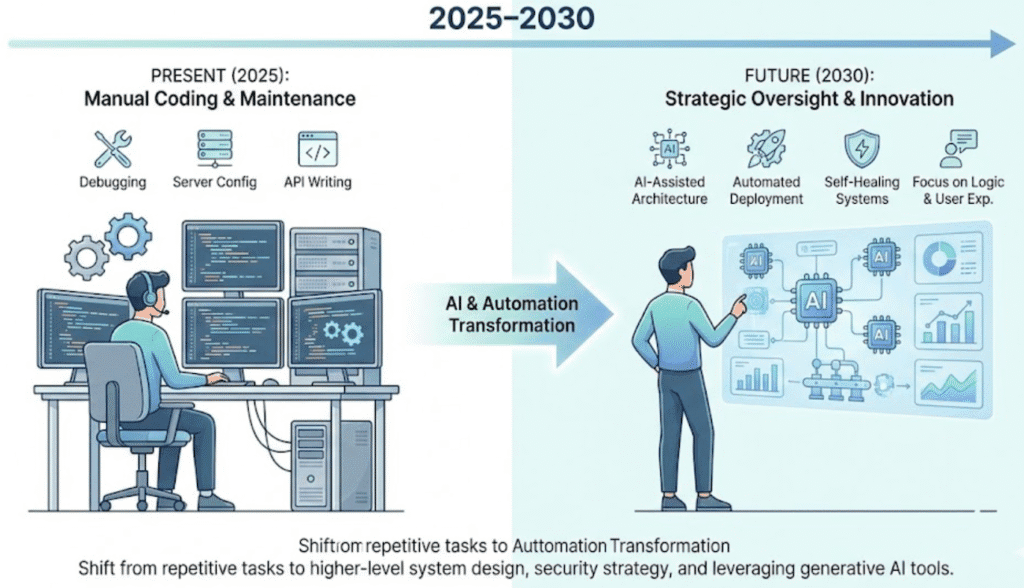
Shift in Skills: What You Need to Learn by 2030
As the "what" of programming becomes automated, the "why" and "how" become more critical.
System Design and Architecture
With AI writing the functions, the human engineer must design the system. You will need to understand how to decouple services, manage eventual consistency, and design fault-tolerant distributed systems.
The ability to visualize the entire topology of a complex application will be the defining skill of a Senior Backend Engineer.
AI Security and Governance
As AI agents gain autonomy, security risks increase exponentially. Backend developers will become the guardians of these systems, implementing guardrails to prevent "prompt injection" attacks and data leaks.
You will need to understand how to secure non-deterministic AI outputs. This is a fundamentally different challenge than securing a deterministic REST API.
LLM Ops and Orchestration
"Backend" will soon mean "the logic that governs AI agents." Developers will write the orchestration layers that tell autonomous agents when to call an external tool, when to query a database, and when to ask a human for help.
Frameworks like LangChain and AutoGPT are the precursors to the standard backend frameworks of 2030.
The Human Advantage: Complex Problem Solving
AI excels at repeating known patterns, but it struggles with novelty and ambiguity. The most valuable backend developers will be those who can solve problems that have never been solved before.
Debugging the "Black Box"
When a complex distributed system of AI agents fails, it fails in unpredictable ways. Tracing a request through a web of non-deterministic models requires a high level of critical thinking and intuition.
Humans will remain the ultimate arbiters of system logic. We will be the ones who decide trade-offs between cost, latency, and accuracy—decisions that AI cannot fully make for us.
Conclusion: Adapt or Obsolesce
The transformation of backend development is not a distant possibility; it is an active process. By 2030, the "coder" will be replaced by the "architect," and the "script" will be replaced by the "agent."
Engineers who embrace AI as a force multiplier will build systems of unprecedented scale and complexity. Those who cling to manual syntax generation will find themselves competing with algorithms that work faster, cheaper, and 24/7.
