
Databases are the heartbeat of modern applications, yet traditional monitoring relies on static thresholds that often fail. Setting a rule like "Alert if CPU > 90%" creates a binary world that misses subtle performance degradation or security breaches.
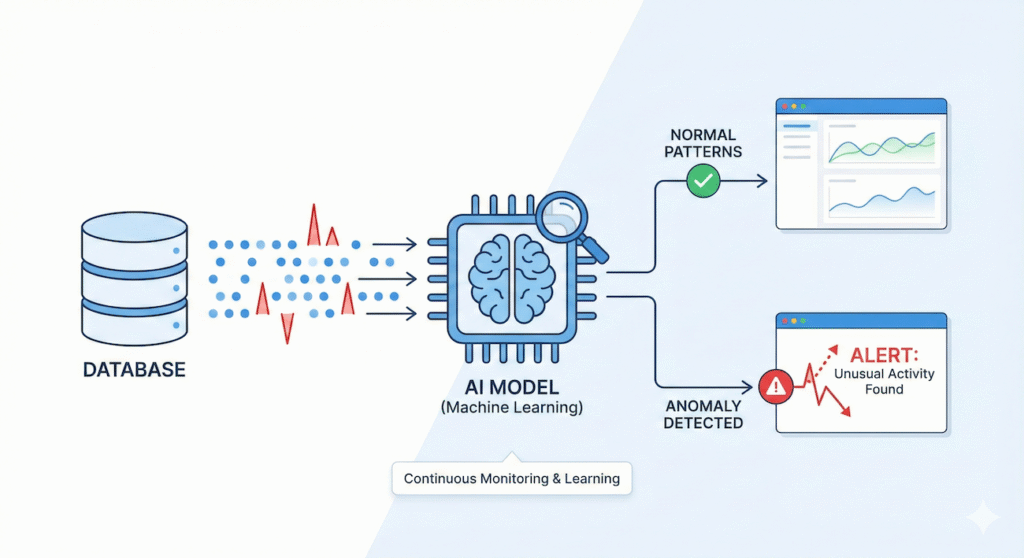
Artificial Intelligence (AI) and Machine Learning (ML) solve this by learning the "normal" behavior of your database over time. In this article, we will explore how AI anomaly detection identifies performance bottlenecks, security threats, and data integrity issues before they become outages.
1. Why Rule-Based Monitoring is Obsolete
Static rules are rigid and cannot adapt to dynamic workloads. A spike in traffic during Black Friday is expected, but the same spike on a quiet Tuesday might indicate a DDoS attack.
Human operators cannot manually adjust thresholds for every metric across hundreds of database instances. This leads to "alert fatigue," where critical warnings are ignored because they are buried under thousands of false positives.
AI anomaly detection replaces these hard limits with dynamic baselines. It understands seasonality, daily cycles, and workload patterns to flag only true deviations.
2. Detecting Performance Anomalies with AI
Performance issues often manifest as slow queries or resource exhaustion. AI models analyze metrics like query latency, throughput, and lock wait times to detect subtle regressions.
Query Latency & Throughput
An AI model learns the expected execution time for specific query patterns. If a routine reporting query that usually takes 500ms suddenly takes 5 seconds, the system flags it as an anomaly.
This detection happens even if the overall database CPU usage remains low. It pinpoints the specific "bad actor" query without requiring a full system meltdown to trigger an alert.
Resource Contention
AI can correlate disparate metrics to find the root cause of resource contention. It might notice that a spike in Disk I/O aligns perfectly with a specific background job, identifying a resource hog that was previously invisible.
3. Security: AI for SQL Injection and Intrusion
Security anomalies are harder to detect with static rules because attackers actively try to evade them. AI behavioral analysis is critical for spotting unauthorized access attempts.
Detecting SQL Injection (SQLi)
Machine learning models trained on SQL query logs can distinguish between legitimate user queries and malicious injection attempts. Unlike regex-based firewalls, AI looks at the intent and structure of the query, identifying abnormal syntax patterns that signal an attack.
Data Exfiltration Patterns
AI monitors user access patterns to detect data exfiltration. If a service account that normally reads 100 rows per hour suddenly exports 10,000 rows, the system flags this volume anomaly immediately.
4. Data Observability: Ensuring Data Quality
Anomaly detection extends beyond infrastructure to the data itself. Data observability tools use AI to monitor the "health" of the data flowing into your database.
Schema Changes and Drift
AI detects unexpected schema changes, such as a column being renamed or a data type changing from integer to string. These "silent breakers" often crash downstream applications but don't trigger standard infrastructure alerts.
Volume and Freshness
Models track the expected volume of data ingestion. If an ETL pipeline usually loads 1 million rows every night but only loads 500 tonight, the AI flags this "freshness anomaly" so engineers can fix the pipeline before the CEO opens their dashboard.
5. Implementing AI Anomaly Detection
You don't need to build these models from scratch. Modern observability platforms have democratized access to these advanced capabilities.
Tooling Landscape
Tools like Datadog Watchdog and Dynatrace provide out-of-the-box anomaly detection for infrastructure metrics. For data-specific anomalies, platforms like Monte Carlo and Bigeye specialize in data observability.
Cloud providers also offer native solutions, such as Amazon DevOps Guru for RDS. These services automatically ingest your performance insights metrics and generate ML-powered recommendations.
The Feedback Loop
For any AI system to be effective, it requires human feedback. When an anomaly is flagged, operators should be able to mark it as "useful" or "false positive," retraining the model to improve future accuracy.
Conclusion
AI for anomaly detection is not just a buzzword; it is a necessity for managing the scale and complexity of modern databases. By shifting from static rules to dynamic learning, organizations can catch issues faster and reduce the noise that burns out engineering teams.
This technology empowers DBAs to stop fighting fires and start preventing them. It transforms the database from a fragile component into a self-monitoring asset.
