Free Cell and Virus 3D Models: Animal Cell, Plant Cell, Bacteria, Viruses, Neuron and More (GLB, OBJ, STL)
Twelve free cell and virus 3D models: an animal cell and a plant cell cut open, a rod bacterium, a spiked virus, a bacteriophage, red blood cells, a white blood cell, a neuron, a mitochondrion cut open, an icosahedral virus, a coccus cluster and a spiral bacterium. Free for commercial use under CC BY 4.0, no login.
- 12 models
- 4,776–63,713 triangles
- 121 KB–1.5 MB each
- GLB, glTF, OBJ, STL
- CC BY 4.0
- No login
All 12 models
Drag a model to turn it, or tap it to open the 3D viewer, where you can zoom and download it. Sizes are width × depth × height.
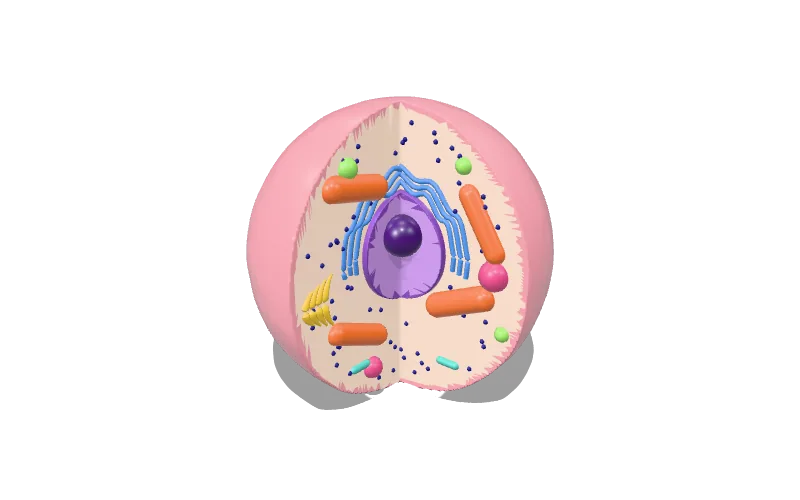
Animal Cell
Quarter cut away
An animal cell with a quarter cut away: membrane, nucleus with nucleolus, mitochondria, ER, Golgi, ribosomes, lysosomes and centrioles.
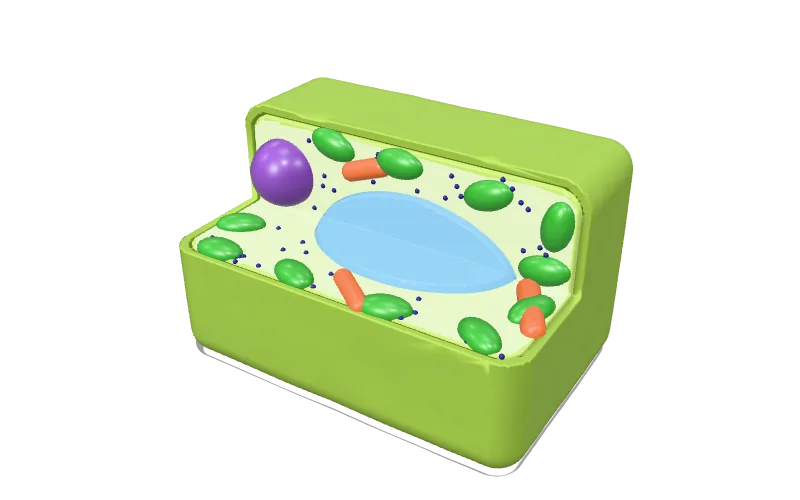
Plant Cell
Corner cut away
A boxy plant cell with a corner cut away: cell wall, big blue vacuole, nucleus, chloroplasts, mitochondria and ribosomes.
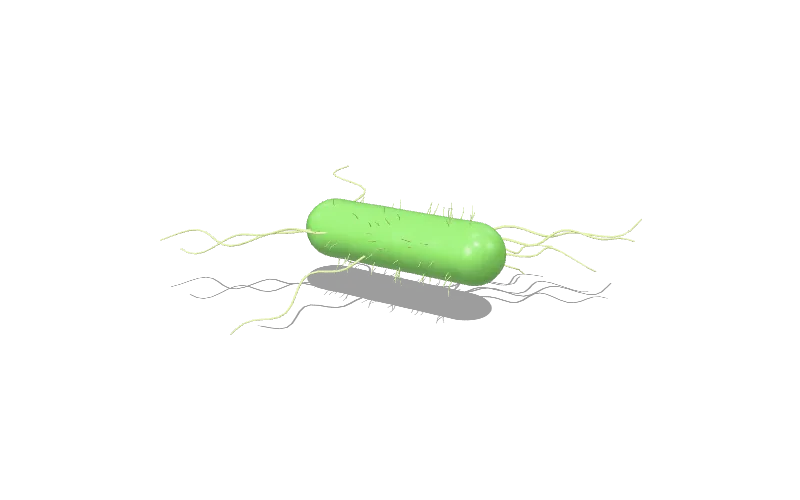
Rod Bacterium
Flagella and pili
A rod-shaped bacterium with long wavy flagella and short hair-like pili all over its body.
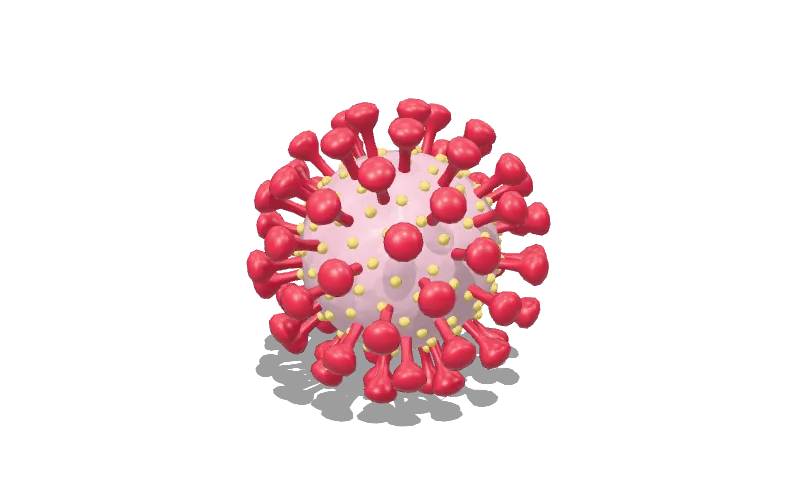
Spiked Virus
Club-shaped spikes
A round enveloped virus covered in seventy red club-shaped spikes and small yellow membrane proteins.
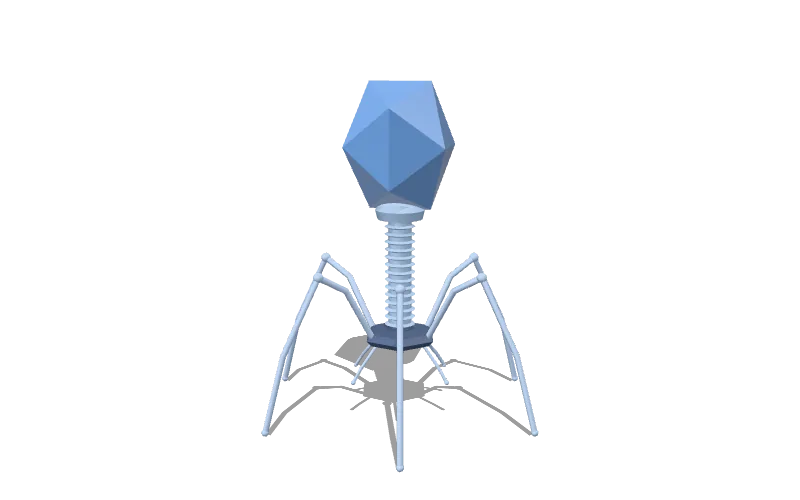
Bacteriophage
Head, tail and legs
A phage with a faceted icosahedral head, ribbed tail, hexagonal base plate and six jointed legs.
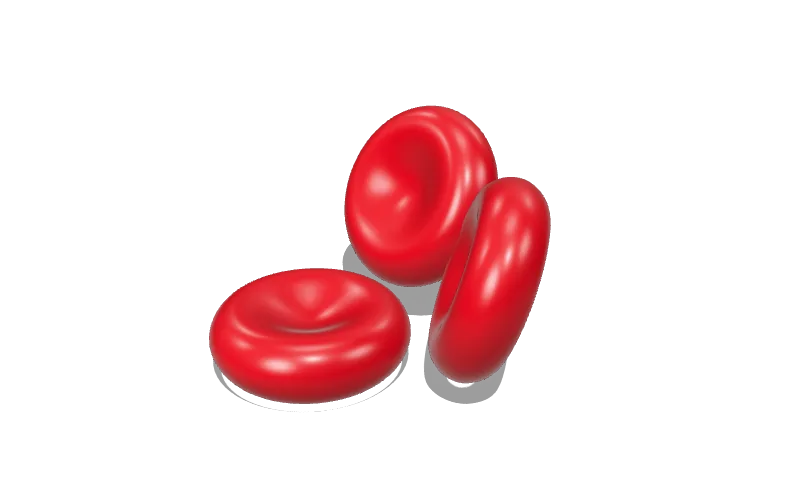
Red Blood Cells
Three biconcave discs
Three red blood cells with the true dimpled disc shape, one lying flat and two standing on edge.
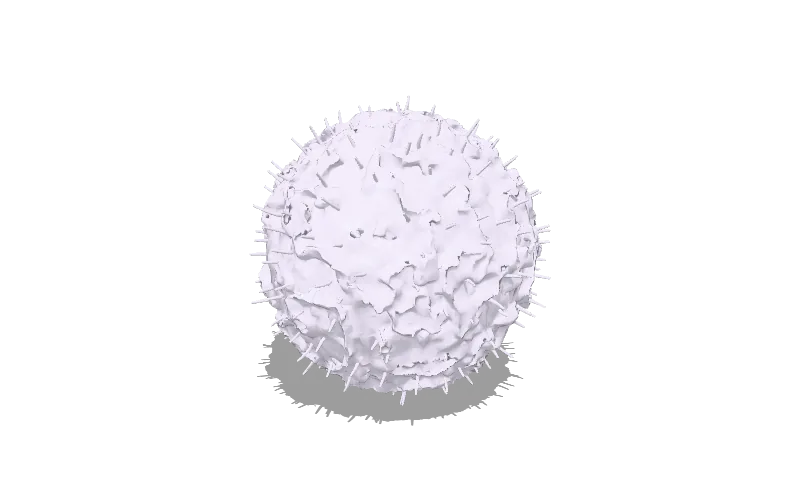
White Blood Cell
Ruffled surface
A white blood cell with a ruffled, folded surface and hundreds of short finger-like microvilli.
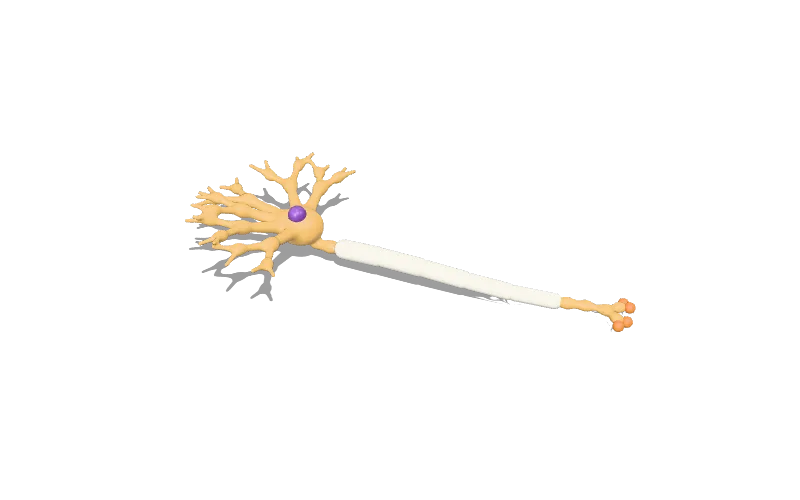
Neuron
Dendrites and myelinated axon
A nerve cell with a cell body and nucleus, branching dendrites, an axon wrapped in myelin and bulb terminals.
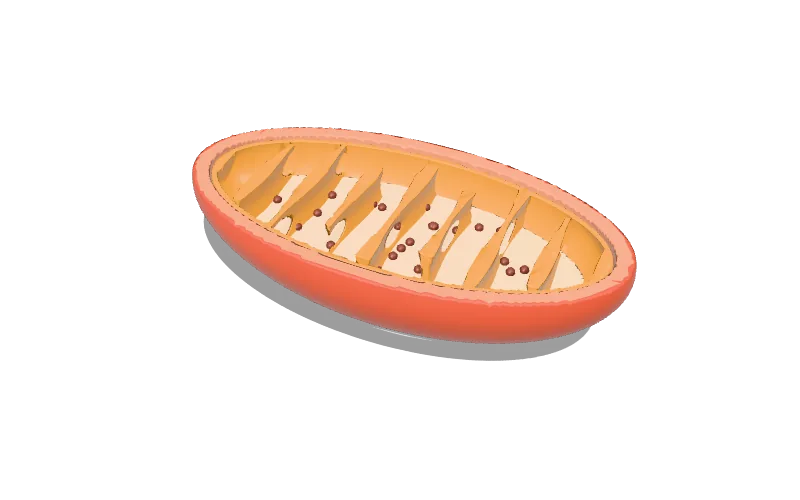
Mitochondrion
Cut open, cristae
A mitochondrion cut open along its length: outer membrane, folded inner membrane cristae and granules in the matrix.
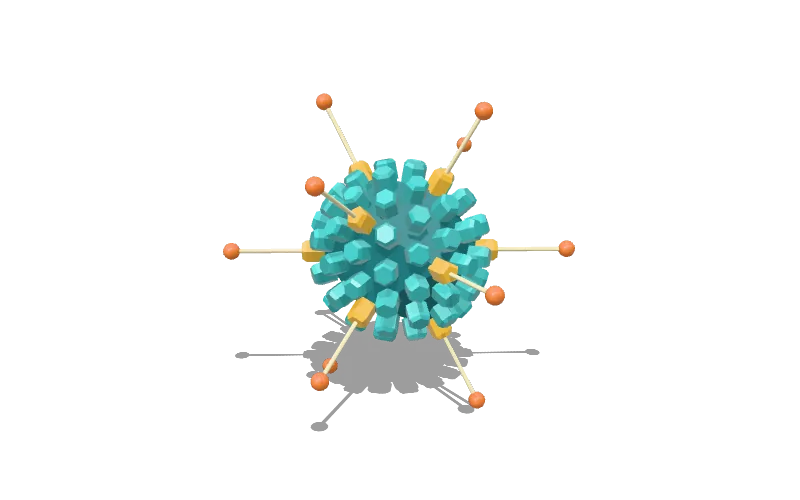
Icosahedral Virus
Capsomers and fibres
An icosahedral virus built from teal capsomer knobs, with a gold penton and a long knobbed fibre at each corner.
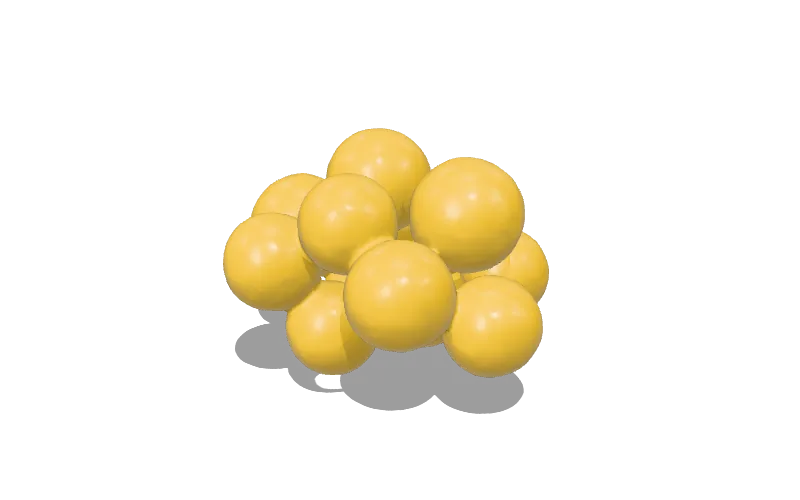
Coccus Bacteria
Grape-like cluster
A grape-like cluster of round coccus bacteria in slightly different sizes, softly joined where they touch.
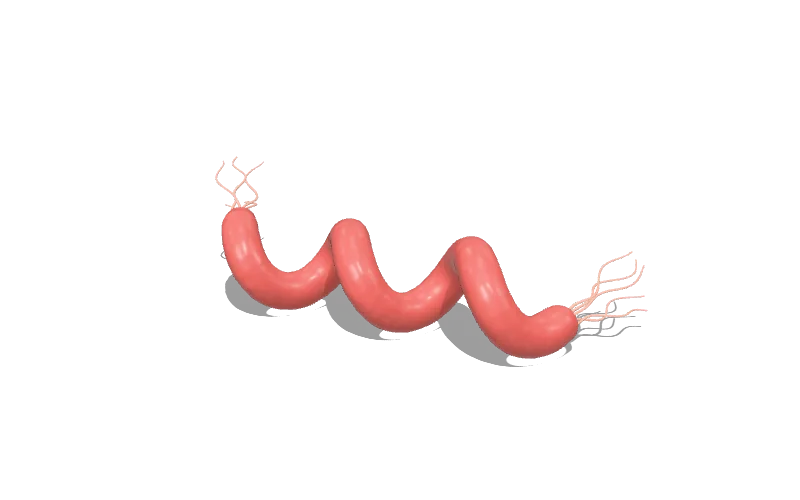
Spiral Bacterium
Corkscrew with flagella
A corkscrew-shaped spiral bacterium with a tuft of fine flagella at each end.
Made for games
- Cut open to show insideThe animal cell has a quarter cut away and the plant cell a corner, so the nucleus, mitochondria, ER, Golgi, chloroplasts and vacuole sit right on the cut faces. The mitochondrion is cut along its length to show the cristae.
- A material per partEvery organelle and part has its own material, such as Nucleus, Mitochondrion, Golgi, Chloroplast, Myelin or Spike_Red, so you can recolour or highlight one part in a lesson.
- Display sizeThey are built at a size you can see, not true size: the animal cell is 0.8 m across, the neuron 1.46 m long and each red blood cell 0.4 m wide, all resting on y = 0.
- Light for the webThey are about 4,800 to 64,000 triangles each, with smooth organic shapes and no textures to load.
How to use these GLB models
GLB is binary glTF 2.0: one file with the mesh, materials and node names. Every modern 3D tool reads it.
three.js
Load it with GLTFLoader, as in the code below. Babylon.js, PlayCanvas and A-Frame load GLB directly too.
Unity
Add the free glTFast package (Package Manager, add by name: com.unity.cloud.gltfast), then drag the .glb into Assets.
Godot 4
Drop the .glb into the FileSystem dock. Godot imports it as a scene you can instance.
Blender
File, Import, glTF 2.0. From there you can also export to FBX, OBJ or STL.
import * as THREE from 'three';
import { GLTFLoader } from 'three/addons/loaders/GLTFLoader.js';

const gltf = await new GLTFLoader().loadAsync('model.glb');
const model = gltf.scene;
scene.add(model);

// the model is in metres, +Y up, facing +Z, standing on the ground at the origin

// make the nucleus glow when the cell is clicked (three.js)
const gltf = await new GLTFLoader().loadAsync('animal-cell.glb');
scene.add(gltf.scene);
const parts = [];
gltf.scene.traverse(o => { if (o.isMesh && o.material.name === 'Nucleus') parts.push(o); });
for (const o of parts) o.material = o.material.clone();
addEventListener('click', () => {
  for (const o of parts) o.material.emissive.set(o.material.emissive.r ? 0x000000 : 0x6a2aa0);
});
renderer.setAnimationLoop(() => renderer.render(scene, camera));
Licence: free with credit (CC BY 4.0)
All models are made by vinish.dev and released under Creative Commons Attribution 4.0. You may use them in personal and commercial projects, change them and share them. The one condition is credit, for example in your game's credits, your app's about page or your video description:
Each file carries its own credit line inside it (the glTF asset.copyright field), and each zip has a CREDITS.txt. If you change a model, say so after the credit, for example "recoloured".
Questions
Are they at real size?
No. Cells and viruses are microscopic, so these are built at display size: the animal cell is 0.8 m across, the plant cell 0.9 m long, the spiked virus 0.61 m across with its spikes and the neuron 1.46 m long. Scale them to suit your scene.
Which parts can I pick out?
Each part is its own material: Cell_Membrane, Cytoplasm, Nucleus, Nucleolus, Mitochondrion, ER, Golgi, Ribosome, Lysosome, Vesicle and Centriole in the animal cell; Cell_Wall, Vacuole and Chloroplast in the plant cell; Outer_Membrane, Inner_Membrane and Matrix in the mitochondrion; and Myelin and Axon_Terminal on the neuron.
Are they copies of real scans or textbook art?
No. They are our own models after the general shapes taught in biology, with no labels or printed text.
What goes with them?
Pair them with the Science Lab, Lab Glassware, Sci-Fi Laboratory and Hospital Room packs.
Can I use them in a paid game or video?
Yes. They are CC BY 4.0: free for commercial use, just credit vinish.dev.
Can I use these models in a commercial game?
Yes. CC BY 4.0 allows commercial use. Put the credit line in your credits or about screen.
Do I need an account?
No. There is no login, sign-up or email. Open a model in the 3D view and press Download: the file is yours.
Can I get OBJ, STL or glTF?
Yes. Open the model in the 3D view and pick glTF, OBJ or STL. Your browser makes the file from the GLB in a second or two. OBJ and STL have no animation. STL is in millimetres with Z up; the models are made of separate parts, so a slicer may need to repair or merge them before 3D printing. For FBX, import the GLB into Blender (File, Import, glTF 2.0) and export it.
Can I change the models?
Yes. You may edit, recolour or cut them up. Keep the credit and mention that you changed them.
More from vinish.dev
- Free 3D Models: every pack in the library
- All 3D model categories: the full list on one page, with a search box
- Free Industrial Machine 3D Models: Factory and workshop machines with controls and guards.
- Free Tower Defense 3D Models: Path tiles, towers, a spawn portal and a crystal to defend.
- Free Combat Robot 3D Models: Arena fighting robots with spinners, flippers and axes.
- Free Bar and Pub 3D Models: Pub furniture, beer taps, pool, darts and drinks.
- Free Sidewalk 3D Models: Sidewalk tiles, curbs and gutters that join into streets.
- Free Jewelry 3D Models: Rings, necklaces, earrings and bracelets at true size.
- Free Mythical Creature 3D Models: Rigged, animated legends from unicorns to krakens.
- Free Harbor 3D Models: Quays, piers and dockside pieces that tile into a working harbor.
- Free Windmill and Watermill 3D Models: Old wind and water power with sails, caps, wheels and stones that really turn.
- Free Cyberpunk Vehicle 3D Models: Angular future traffic with neon strips, glowing hover pods and dark glass, ready for a night city.
- Free Low Poly Animal 3D Models: Faceted forest and farm animals in flat colours, light enough for any mobile game.
- Free Old Firearm 3D Models: Antique guns from the first hand cannons to caplocks, with locks and hammers that move.
- Free Kitchen Appliance 3D Models: Big built-in appliances and countertop helpers with doors, lids and drawers that open.
- Free Desert 3D Models: Dunes, rock towers, dry plants, bones and an oasis to build a desert level from.
- Free Mech 3D Models: Piloted walking machines with turning torsos and arms, from a 2.4 m exosuit to a 7.9 m sniper.
- Free Puzzle Block 3D Models: A grid kit of switches, lasers, mirrors, locks and blocks for puzzle and adventure games.
- Free Plant-Eating Dinosaur 3D Models: Horned, crested, armoured, long-necked and feathered herbivores that walk, run and call.
- Free Stone Age 3D Models: Shelters, stone tools, megaliths and daily life from the Old and New Stone Age.
- Free Soft Drink and Juice 3D Models: Cans, bottles, cartons and glasses with made-up artwork, see-through glass and drinks inside.
- Free Post-Apocalyptic Vehicle 3D Models: Rusted cars, trucks and buggies with steel plates, spiked rams, cages and loaded roof racks.
- Free Trophy and Medal 3D Models: Gold cups, star trophies, medals, plaques and a title belt for prize screens and award scenes.
- Free Drone 3D Models: Camera, racing, delivery and survey drones with spinning rotor nodes, plus a controller and a dock.
- Free Factory and Warehouse 3D Models: Brick factories, clad warehouses, loading docks, chimneys and tank farms for city and industrial scenes.
- Free Skeleton 3D Models: Undead warriors, archers and kings with weapons, armour and glowing eyes for fantasy games.
- Free Phone and Laptop Mockup 3D Models: Blank-screen phones, laptops, tablets and monitors for app and website mockups.
- Free Birthday Party 3D Models: Cake, candles, balloons and streamers for a bright party scene.
- Free Restaurant Kitchen 3D Models: Stainless cooking lines, prep stations and a dish pit for a busy back-of-house scene.
- Free Mountain and Hill 3D Models: Snowy peaks, rock ridges and green hills ready to drop round a game level.
- Free Engine and Motor 3D Models: Petrol, diesel, electric and steam engines with pulleys, fans and flywheels that turn.
- Free Home Decor 3D Models: Calm modern shelf and table styling pieces in wood, marble, glass and rattan.
- Free Sci-Fi Laboratory 3D Models: A clean white future lab with glowing fluids, screens and moving parts.
- Free E-Bike and Electric Scooter 3D Models: Electric bikes, scooters and boards with moving wheels, forks and stems.
- Free Endless Runner Kit 3D Models: Bright track pieces, obstacles and coins for lane-switching runner games.
- Free Low Poly Weapon 3D Models: Light flat-shaded weapons for stylized, mobile and prototype games.
- Free Rifle 3D Models: Long guns from the frontier to the range, with their moving parts on their own nodes.
- Free Game Controller and Console 3D Models: Our own controller and console designs for gaming rooms, desks, shops and menus.
- Free Stadium and Arena 3D Models: Whole sports venues and the pieces round them, at real size in metres.
- Free Railway Track Kit 3D Models: Standard gauge track pieces that snap together into a railway, with the lineside and station pieces to dress it.
- Free Ice Age Animal 3D Models: Prehistoric mammals of the last ice age, each rigged with its own legs, head and tail and ready to idle, walk and run.
- Free Elf, Dwarf and Orc 3D Models: Three fantasy folk with their own builds: tall slim elves, short broad dwarves with big beards and huge green-skinned orcs with tusks.
- Free Quad Bike and ATV 3D Models: Four-wheel off-road machines for farms, trails, races and snow, with wheels, bars and work tools ready to animate.
- Free Cave Kit 3D Models: A modular cave system: rough rock tunnels with matching ends for building cave levels, and formations and set pieces to dress them.
- Free Neon Sign 3D Models: Picture signs bent from glowing glass tubes, with no letters, so they suit any shop, bar, diner, motel or arcade in any language.
- Free Feudal Japan 3D Models: Shrines, temples, gardens and castle-town props of old Japan, from a vermilion gate and a pagoda to lacquered armour and paper screens.
- Free Meat and Barbecue 3D Models: Grills, a smoker and a fire pit loaded with food, plus meats served on boards and platters, for cookouts, kitchens, restaurants and food scenes.
- Free Low Poly Car 3D Models for Games: 12 vehicles with separate wheels
- Sample GLB Files: small test files for loaders, viewers and engines
- Free browser games and simulators by vinish.dev